
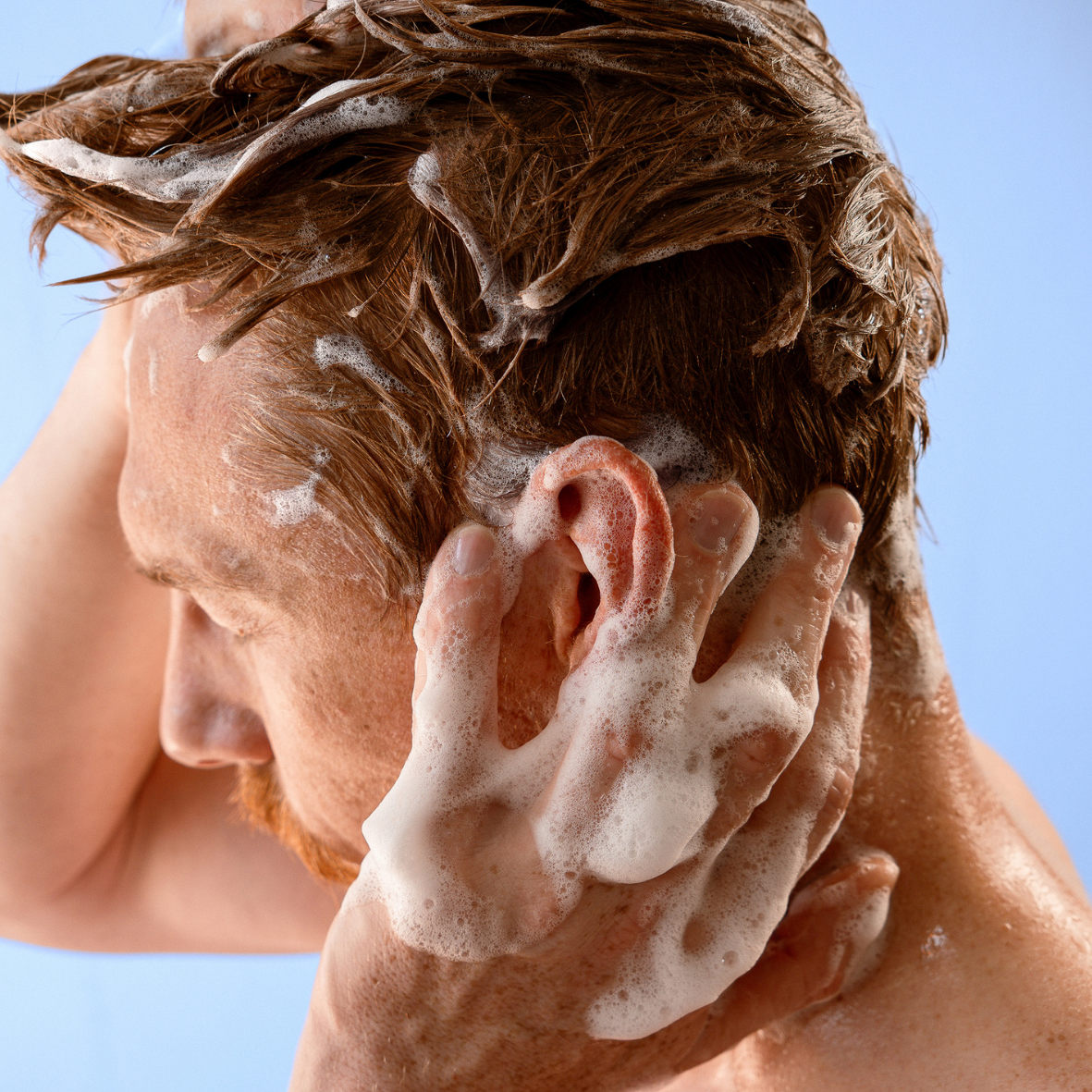
Hair feels waxy after switching to a shampoo bar for one of three reasons: you are using a true soap bar in hard water, you are using too much product and not rinsing long enough, or you are in the adjustment period where your scalp is still producing oil at the rate your old shampoo trained it to. The first is chemistry, the second is technique, and the third passes.
The good news is that the waxy feeling is almost always fixable, and usually within a week. This guide covers how to work out which of the three is happening to you, and what to do about each one.
- 1. Why does my hair feel waxy after using a shampoo bar?
- 2. Is it the bar, or is it your water?
- 3. How do I know if I have hard water?
- 4. How should I actually use a shampoo bar?
- 5. Does an apple cider vinegar rinse actually help?
- 6. How long does the transition period last?
- 7. Why does my bar behave differently when I travel?
- 8. Is Rinsed a soap bar?
- 9. Summary
- 10. Frequently asked questions
Why does my hair feel waxy after using a shampoo bar?
The waxy or coated feeling is residue sitting on the hair shaft, not dirt. Something is not rinsing away, and the cause is either what is in the bar, what is in your water, or how you are washing. Work through this table to narrow it down.
| What you notice | Most likely cause | How long it lasts | Fix |
|---|---|---|---|
| Waxy from the first wash, worse over time | True soap bar plus hard water | Until you change something | Switch bar type or use an acidic rinse |
| Heavy and flat, but hair is clean | Too much product, not rinsed enough | Immediate | Less bar, longer rinse |
| Greasy at the roots after a few days | Scalp adjusting to a new routine | One to four weeks | Wait it out, wash normally |
| Squeaky then instantly greasy | Stripping and rebound oil | One to three weeks | Wash less aggressively |
| Fine at home, waxy when travelling | Different water hardness | While you are away | Acidic rinse or bottled water rinse |

Shampoo, body and face wash, all in one bar. Cooling, refreshing and designed for those always on the go.
Is it the bar, or is it your water?
This is the distinction that explains most waxy hair complaints, and almost nobody mentions it on the packaging. Solid hair bars come in two very different chemistries.
True soap bars are made by saponification, the reaction between fats and an alkali. They are alkaline, typically somewhere around pH 9 to 10. Syndet bars, short for synthetic detergent, are built from milder surfactants and are usually formulated to a lower, more skin-friendly pH. They look almost identical on a shelf.
The difference matters in hard water. True soap reacts with the calcium and magnesium dissolved in hard water to form an insoluble residue, the same stuff that leaves a ring around a bath. On skin you rinse it off without noticing. On hair, it clings to the shaft, and that is the wax you are feeling. Syndet bars do not form that residue in the same way, which is why they behave more like liquid shampoo.
If your bar lathers poorly and leaves a film, and you live somewhere with hard water, you have almost certainly found your answer. We go into the differences in detail in what is a syndet bar.
How do I know if I have hard water?
Three signs, none of which need a test kit. Limescale on your kettle or shower head. Soap that will not lather easily. A white or cloudy film on glassware out of the dishwasher. Most water companies also publish the hardness for your postcode on their website, usually for free.
Large parts of the Netherlands, Belgium and northern France sit in the moderately hard to hard range, so this affects a lot of people who assume the bar is faulty. Our full guide is do shampoo bars work in hard water.
How should I actually use a shampoo bar?
Most waxiness that is not water related is technique. People treat a bar like liquid shampoo, which means using far too much of it and rinsing for far too short a time.
- Soak your hair properly first. Thirty seconds under water, not five. Dry hair does not lather.
- Lather in your hands, or stroke the bar over your scalp two or three times. Not ten. You need far less than you think.
- Work it into the scalp with your fingertips, not the lengths. The scalp is what needs cleaning. The lengths get cleaned by the water running through them.
- Rinse for twice as long as feels necessary. This is the step people skip. Sixty to ninety seconds of running water.
- Check with your fingers. Hair should feel slippery, then clean, not coated.

Shampoo, body and face wash, all in one bar. Keep your hair and skin healthy on the go. Monoï-infused scent with a touch of vanilla. Designed for those always on the go.
Does an apple cider vinegar rinse actually help?
Yes, and the reason is straightforward chemistry rather than folk wisdom. Soap residue is alkaline. A dilute acidic rinse helps dissolve it and brings the hair closer to its normal slightly acidic state, which is also what makes the cuticle lie flat and the hair feel smooth.
| Rinse | Rough mix | When to use it | Notes |
|---|---|---|---|
| Apple cider vinegar | One tablespoon in a large mug of water | After washing, before conditioner | Smell disappears once dry |
| White vinegar | One tablespoon in a large mug of water | Same | Cheaper, works the same way |
| Lemon juice | Juice of half a lemon in a mug of water | Occasionally | Can be drying on repeat use |
| Citric acid | A quarter teaspoon in a mug of water | Travel friendly | Packs small, no smell |
Pour it over, leave it for thirty seconds, rinse. Do this two or three times a week while you are transitioning, then only when hair starts to feel coated. If you are using a syndet bar rather than a true soap bar and your water is soft, you probably will not need it at all.
How long does the transition period last?
Two different things get filed under "transition period", and they are worth separating. One is real: your scalp has been producing oil at the rate your old shampoo trained it to, and it takes a week or two to settle down. The other is not a transition at all. If a true soap bar is leaving scum on your hair in hard water, waiting four weeks will not fix it, because nothing is adjusting. The chemistry will do the same thing in week five. So if your hair is still waxy after two weeks, stop waiting and go read the first ingredient on your bar.
If your hair is adjusting rather than reacting to hard water, one to four weeks is typical, and most people notice a clear change inside two. The scalp produces oil at a rate partly set by how aggressively it has been stripped. Change the routine and it takes a little while to settle.
Some caution here: the transition period is a real thing people report, but it is also used to explain away problems that are actually chemistry. If your hair is still waxy after three or four weeks, it is not adjusting. It is a hard water and true soap problem, and waiting longer will not fix it.
| Week | What people commonly report | What to do |
|---|---|---|
| Week 1 | Hair feels heavier or greasier than usual | Do not wash more often, keep the routine steady |
| Week 2 | Starting to settle, some good days | Add an acidic rinse if it still feels coated |
| Week 3 to 4 | Back to normal, often less greasy than before | Reduce the acidic rinse |
| Still bad after week 4 | Not a transition | Change bar type, or treat the water |
Why does my bar behave differently when I travel?
Because the water is different. Water hardness changes enormously from one place to the next, so a bar that behaves perfectly at home can feel completely different in a hostel in Lisbon or a surf camp in Morocco.
If you are travelling and the bar suddenly feels waxy, a small amount of citric acid packs flat and solves it. It is also worth noting that this cuts both ways: people with hard water at home sometimes find their bar works beautifully on holiday and assume the bar improved.
For everything else about washing on the move, see how to wash your hair without a shower and our surf trip packing list.
Shampoo, body and face wash, all in one bar. Cooling, refreshing and designed for those always on the go.
Is Rinsed a soap bar?
No. Rinsed bars are syndet bars: the ingredient list opens with Sodium Cocoyl Isethionate and contains no saponified oils. That means the first cause on this page, soap reacting with the calcium in your water, is not a reaction our bars can have.
It does not make us magic. The second cause still applies to every bar ever made, ours very much included. Use too much, rinse too little, and your hair will feel heavy no matter what the label says.
Summary
Waxy hair after switching to a bar is nearly always one of three things. Hard water reacting with a true soap bar, which an acidic rinse or a different bar type fixes. Too much product and too short a rinse, which technique fixes in one wash. Or a scalp adjusting to a new routine, which fixes itself in two to four weeks. Work out which one you have before changing anything else.
Frequently asked questions
Is Rinsed a soap bar?
No. Rinsed 3-in-1 bars are syndet bars. The ingredient list opens with Sodium Cocoyl Isethionate and contains no saponified oils, so they do not form the insoluble calcium compound that true soap forms in hard water. The full INCI is on every product page.
Why does my hair feel waxy after using a shampoo bar?
Usually because a true soap bar is reacting with hard water and leaving an insoluble residue on the hair shaft. It can also be too much product and too short a rinse, or a scalp still adjusting to a new routine. Hard water is the most common cause and the one people miss.
How long is the shampoo bar transition period?
One to four weeks for most people, with a noticeable improvement by week two. If your hair is still waxy after four weeks, it is not a transition period. That is a hard water problem and it will not resolve on its own.
Will an apple cider vinegar rinse fix waxy hair?
Often, yes. Soap residue is alkaline and a dilute acidic rinse helps dissolve it. Roughly one tablespoon of vinegar in a large mug of water, poured over after washing, left for thirty seconds, then rinsed. The smell goes as the hair dries.
Am I using too much shampoo bar?
Probably. Two or three strokes of the bar over a wet scalp is enough for most hair. People used to liquid shampoo tend to use several times what they need, then under-rinse, and the combination is what leaves hair feeling coated.
Do all shampoo bars cause waxy hair?
No. True soap bars are alkaline and react with hard water to form residue. Syndet bars are built from milder surfactants at a lower pH and behave much more like liquid shampoo, so they do not usually leave the same film.
Can I use a shampoo bar on my body too?
Many are designed to. A 3-in-1 bar covers hair, body and face, which is the whole point of carrying one bar instead of three bottles. What to look for is in our guide on using a shampoo bar on your body and face.
One bar, hair, body and face
Shampoo, body and face wash in one 80g bar. No bottles to leak, no liquid limits at the airport, and 30 to 60 washes per bar.
Travel with Rinsed™ →30 day money back guarantee, no questions asked.
Alexandre
Founder @Rinsed™
Hey, I’m Alexandre! I started Rinsed™ for people like myself: sporty, hardworking and always on the go. Check out our bars!