

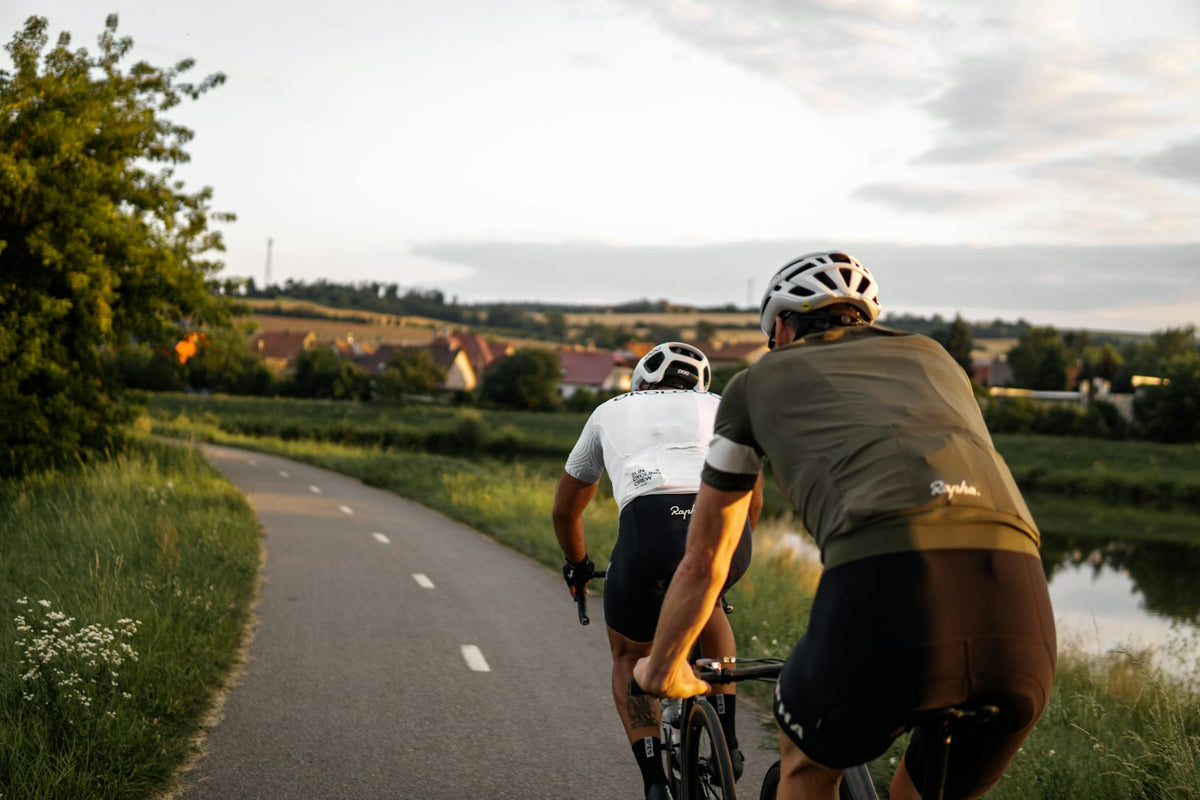
A shower after a bike commute can be a ten-minute job: roll the last few minutes gently, pause before you step in, take a short warm shower that starts with armpits, groin and feet, dry properly and put on clean clothes. If you cycle to work, you know the ride is the easy part. The tricky part is the gap between locking your bike and sitting in the Monday meeting looking like someone who came by tram. Here's the routine we'd give a friend.
It's part of our cyclist's hair and body care guide.
Do you really need to shower after a bike commute?
Not always. It depends on how hard you rode, how far, and what the weather did. Put simply: the faster you go, the harder you're working, and the hotter and sweatier you'll get. Fifteen minutes on a city bike in March is one thing. Twenty-five kilometres on a race bike into a headwind is another.
Official Dutch guidance for employers draws the same line: a shower and changing room are especially welcome when staff cycle far, ride a racing bike or arrive in bad weather. If that's you, wanting a shower isn't fussy.
And the smell you're quietly worried about? Sweat itself doesn't smell: body odour is what you notice when sweat meets the bacteria on your skin. The standard health advice is to wash your armpits, groin and feet with soap, dry thoroughly, and change and wash your clothes regularly. In everyday terms: washed, dried skin and a shirt that isn't the one you rode in.
You're in good company. In the Netherlands, bike trips to work rose by more than 2 million per working week in 2022. That's a lot of towels in the corridor at 8.40, so let's make it quick.
What does a ten-minute office shower routine look like?
It starts on the bike. The usual tip for bike commuters is to take it easy: you can always speed on the way home. Treat the last five minutes as a cool-down lap, then pause before you step in. You know the feeling of showering too soon and being damp again before your shirt is buttoned (more in how soon to shower after training). From there, it goes like this.
| Minute | What you do | Where the advice comes from |
|---|---|---|
| 0 to 2 | Lock up, drink water, grab your kit | Practical: a short pause first |
| 2 to 7 | Warm shower: armpits, groin and feet first | Standard health advice (where to wash), dermatologists (5 to 10 minutes, warm water) |
| 7 to 9 | Dry off, between your toes too, then deodorant | Standard health advice (dab feet dry, antiperspirant on dry skin) |
| 9 to 10 | Clean clothes on, damp things hung up | Dermatologists (change into clean clothing) |
Short and warm is a dermatologist's line too: for dry skin, the advice is 5 to 10 minutes of warm water. And the step everyone skips when a colleague is waiting outside is the drying. The standard health advice on athlete's foot is to dry your feet after washing, particularly between your toes, and to wear clean socks every day. The classic mistake isn't the rushed shower. It's a fresh shirt over the socks you rode in.
For any of this to take ten minutes, the kit has to be there already. The usual suggestion for bike commuters is to keep soap or shower gel, shampoo, a wash cloth, a towel and deodorant in a locker or desk drawer. Sensible, but that's several bottles sharing a drawer with your stapler. This is where a solid bar makes sense to us: one 3-in-1 bar for hair, body and face, with nothing to leak.

Shampoo, body and face wash, all in one bar. Cooling, refreshing and designed for those always on the go.
Bottle or bar, what makes the routine work is that your kit is waiting when you arrive. So what else belongs in that locker?
What should you keep at the office?
A towel, something to wash with, deodorant, flip-flops, spare socks, work shoes and a bag for wet kit. A few notes on that list:
- Your wash kit. A bar should dry between showers in a ventilated tin or mesh pouch. See how to store a soap bar.
- A week of clothes, if there's space. One idea: bring them in on Monday by car or public transport.
- Somewhere to hang damp things. The Dutch guidance for employers mentions lockers or a drying room for rain gear and cycling clothes. Neither at your office? It's fair to ask.
And for mornings when the sky does the soaking, there's our guide to getting clean and dry after cycling in the rain.
Do you have to wash your hair every time?
No. That depends on your hair and scalp, not on your commute. Dermatologists say that if you have straight hair and an oily scalp, you may want to shampoo every day, while dry, textured, curly or thick hair can be shampooed when needed. So two colleagues on the same bike path can sensibly choose differently: one washes every morning, the other twice a week. When you do wash, apply shampoo to your scalp, not the whole length of your hair, which keeps things quick when there's a call at 9.00. More in our helmet hair guide and washing your hair when you train every day.
Hair is usually where the office kit starts to grow. First a shampoo, then a shower gel, then a face wash because the shower gel felt odd on your face. Three bottles for a five-minute shower.

Shampoo, body and face wash, all in one bar. Keep your hair and skin healthy on the go. Monoï-infused scent with a touch of vanilla. Designed for those always on the go.
A founder's note from me, Alexandre: I sell bars for a living, and I'll still say that if there's a dispenser on the shower wall and you're happy with it, use it. The routine matters more than what you wash with. Which is good news if your office has no shower at all.
What if there's no shower, or you have to share one?
No shower: clean up at the washbasin. The usual advice for bike commuters is to have wet wipes and deodorant to hand, and to wipe at least your face, armpits and groin area. Dermatologists add that if you can't shower, you should at least wash your face and change into clean clothing. So: ride in a little slower, take a flannel and a clean shirt to the toilets, wash, dry, change. For hair, see washing your hair without a shower.
Shared shower: flip-flops on, keep it short, take everything with you. Dermatologists say not to go barefoot in gym showers or locker rooms, because these high-traffic areas carry a risk of skin infections like fungus or warts. The same tip is part of the standard health advice for avoiding athlete's foot. One shower between forty cyclists counts as high traffic. As for bars in shared showers, we looked at the evidence in is bar soap hygienic?
Then there's the ride home. A dry second pair of shorts is nicer than pulling the morning pair back on (see saddle sores and chamois hygiene). So your bag now holds a laptop, lunch, a spare shirt and two sets of kit. The last thing it needs is a bottle whose lid pops open on the cobbles.
Shampoo, body and face wash, all in one bar. Cooling, refreshing and designed for those always on the go.
And that's it: a calm last kilometre, a short shower, dry feet and clean socks.
Summary
A shower after a bike commute works best as a ten-minute routine: ease off at the end, pause, wash armpits, groin and feet first, dry properly and change into clean clothes. Keep a towel, wash kit, flip-flops and spare socks at work, and use the washbasin when there's no shower. For everything else, head back to the cyclist's hair and body care guide.
Frequently asked questions
Is it OK to skip the shower after a short bike commute?
Often, yes. You can still clean up with wet wipes and deodorant, wiping at least your face, armpits and groin.
Why do you smell after cycling to work?
Sweat itself doesn't smell. Body odour is what you notice when sweat meets the bacteria on your skin.
How do you sweat less when cycling to work?
Take it easy: the faster you go, the harder you're working, and the hotter and sweatier you'll get. Treat the last five minutes as a cool-down lap. You can always speed on the way home.
How long should you wait to shower after cycling to work?
We haven't found an official number. Practically, a few minutes: lock up, drink some water, unpack, then shower.
How long should a shower at work take?
It can be short. In the ten-minute routine above, the shower itself takes about five minutes, and dermatologists' advice for dry skin is 5 to 10 minutes of warm water.
What should you wash first after a bike commute?
Armpits, groin and feet. The standard health advice is to wash them with soap, dry thoroughly, and change and wash your clothes regularly.
Do you need to wash your hair after every bike commute?
No. Dermatologists say people with straight hair and an oily scalp may want to shampoo every day, while dry, textured, curly or thick hair can be shampooed when needed.
What should you keep at the office if you cycle to work?
A towel, something to wash with, deodorant, flip-flops, spare socks, work shoes and a bag for wet kit. If there's space, a week of clothes too.
Should you wear flip-flops in the office shower?
Yes. Dermatologists advise against going barefoot in showers and locker rooms, and the standard health advice is to wear flip-flops in changing rooms and showers to help avoid athlete's foot.
Can you ask your employer for a shower?
Yes. Official Dutch guidance for employers lists shower and changing rooms among the facilities for staff who cycle.
Sources
The facts in this article are based on the sources below, checked in October 2026.
- How to look smart when cycling to work. Cycling UK, accessed 2026.
- Factsheet: Fietsvoorzieningen bij de werkgever. Rijkswaterstaat, 2024.
- Body Odor: Causes, Changes, Underlying Diseases & Treatment. Cleveland Clinic, 2022.
- Body odour (BO). NHS, 2025.
- Fiets naar het werk steeds populairder. Rijksoverheid, 2023.
- Dermatologists' top tips for relieving dry skin. American Academy of Dermatology, 2026.
- Athlete's foot. NHS, 2024.
- How your workout can affect your skin. American Academy of Dermatology, 2021.
- Tips for healthy hair. American Academy of Dermatology, 2024.



