

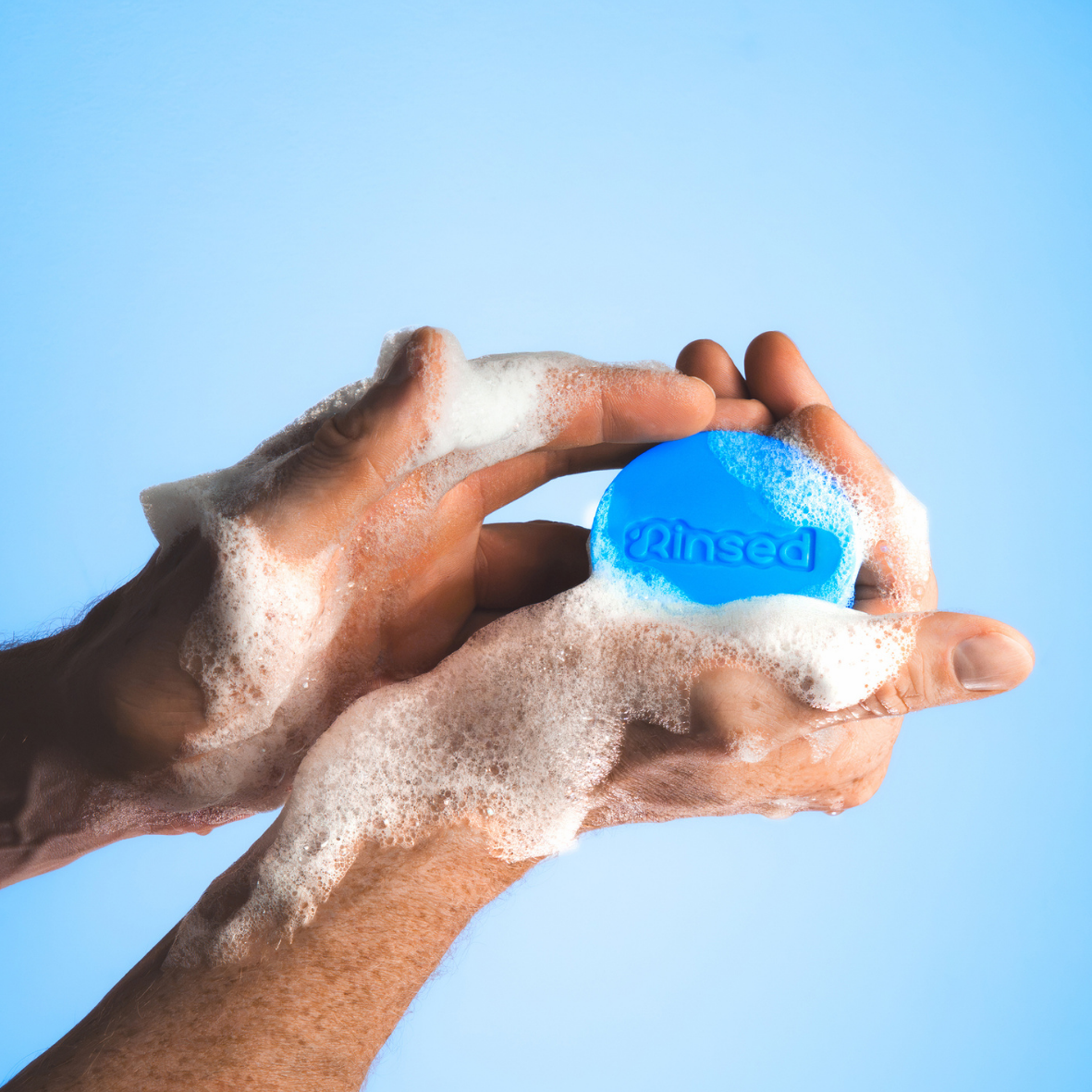
If your shampoo bar is barely foaming, it is almost always one of four things: hard water reacting with a true soap bar, not enough water in your hair, too little contact time with the bar, or build up left by whatever you used before. Only one of those is really about the bar, and even then it is about what kind of bar it is rather than a faulty one.
There is a bigger point underneath it too. Foam is a sensory expectation, not a measure of how clean your hair gets. Worth knowing before you decide the bar has failed you.
- 1. Why is my shampoo bar not lathering?
- 2. Is it your water or your bar?
- 3. Does lather actually matter for cleaning?
- 4. How to get more lather from the bar you have
- 5. When is it actually the bar's fault?
- 6. What to look for if you buy another one
- 7. Summary
- 8. Frequently asked questions
Why is my shampoo bar not lathering?
Match what you are seeing to a cause first, because the four causes look quite different in the shower.
| Symptom | Likely cause | What to do |
|---|---|---|
| Almost no foam, chalky film on your hands | A true soap bar reacting with hard water | Test once with bottled water over the sink |
| A little foam that collapses in seconds | Hair and bar are not wet enough | Soak hair a full 30 seconds, rewet the bar |
| Foam only appears at the end of washing | Too little contact time on the scalp | Rub the bar longer, then work it in with fingertips |
| Nothing on wash one, fine on wash two | Residue from a previous shampoo or styling product | Wash twice for the first few washes |
| Fine at home, hopeless on holiday | Different water hardness there | Nothing is wrong with the bar. It is the tap |
| Bar feels soft, slimy or mushy | It has been sitting in standing water | Let it dry fully between uses |
| Modest foam, but hair rinses clean | Nothing. This is how that formula foams | Leave it alone |
Work down it in order. The bottled water test costs about a euro and rules out the most common cause in one wash.
Is it your water or your bar?
If you are using a traditional soap based bar in a hard water area, the poor lather is a chemical reaction rather than a manufacturing problem. Once you know the mechanism it stops being mysterious.
A traditional soap bar is made by saponifying oils: reacting fats with an alkali to produce the sodium salts of fatty acids. Hard water carries dissolved calcium and magnesium, and when soap meets it, those ions swap places with the sodium. The catch is that the calcium and magnesium versions are not soluble, so instead of foaming they drop out as a sticky curd.
You already know that curd. It is the ring around the bath. In hair it uses up soap that would otherwise have foamed and settles as a dull, slightly waxy coating. Sound familiar? Read why shampoo bars leave hair feeling waxy, because it is the same mechanism in a different hat.
A syndet bar is a different category. Syndet is short for synthetic detergent, meaning the bar is built from mild surfactants rather than saponified oils. Rinsed is a syndet bar: the INCI list opens with Sodium Cocoyl Isethionate and contains no saponified oils. The calcium salt of that surfactant behaves very differently in hard water than a fatty acid salt does, so the reaction above is not the one taking place. That is an ingredient fact about what the bar is made of, not a promise about how your hair will feel.
Read next: do shampoo bars work in hard water and what is a syndet bar. Large parts of the Netherlands, Belgium and northern France sit in the moderately hard to hard range, and your water company publishes the figure by postcode.
Does lather actually matter for cleaning?
Not nearly as much as decades of advertising have trained you to think. Foam is air trapped in a thin surfactant film. Cleaning is surfactants surrounding oil so water can carry it down the drain. Related jobs, but one is not a measurement of the other.
Formulators can tune how much a product foams fairly independently of how it cleans. Foam boosters exist for exactly that reason. Plenty of surfactants that work perfectly well foam modestly, and a big showy foam mostly tells you it was designed to.
You have seen the proof yourself. Oil collapses bubbles, which is why the second wash always foams more than the first. Useful as a diagnostic, useless as a measure of clean.
So we are not going to promise you a mountain of foam. We could write it, but we could not stand behind it. What you can reasonably judge instead:
- Does your hair rinse out without feeling coated?
- Is your scalp still comfortable by the evening?
- Is there a film left on your hands afterwards?

Shampoo, body and face wash, all in one bar. Cooling, refreshing and designed for those always on the go.
How to get more lather from the bar you have
Almost all of the gain here comes from water and time, and it costs nothing. Bars are concentrated, so they need more of both than a bottle does.
- Soak your hair properly. Thirty seconds, not the five second splash most of us do. Dry patches will not foam.
- Wet the bar too. A dry bar dragged across wet hair gives you very little.
- Take it straight to the scalp. A few passes there rather than over the lengths, since that is where washing needs to happen.
- Or build it in your hands. Work the bar between wet palms for ten seconds, if you prefer the control.
- Give it time. Thirty to forty five seconds of fingertips. Friction plus water is what makes foam, and most people quit at ten.
- Wash twice at the start. Pass one removes old residue, pass two is the actual wash.
- Rinse longer than feels necessary. A short rinse is what makes hair feel heavy, which then gets blamed on the bar.
- Let the bar dry out. A bar left in a puddle goes gluey. See how to store a soap bar.
The full routine is in how to use a shampoo bar. Run the bottled water test over the sink, and keep the lather to somewhere that drains properly rather than out in the open.

Shampoo, body and face wash, all in one bar. Keep your hair and skin healthy on the go. Monoï-infused scent with a touch of vanilla. Designed for those always on the go.
When is it actually the bar's fault?
Sometimes it genuinely is the bar, and it is worth being honest about which cases those are.
It is a true soap bar sold as a shampoo bar and your water is hard. Not a defect. It is a mismatch between a chemistry and a tap, and soap makers write a lot of coping advice about it because coping is their only option.
It has been stored in water for weeks. A waterlogged bar goes soft and breaks down. It still washes, but it disappears far faster.
You just do not enjoy how it foams. A completely legitimate reason to use something else. Washing is a daily ritual and it is allowed to feel good.
What to look for if you buy another one
Read the ingredient list before the marketing, because the first ingredient tells you the category.
- Look at the top of the INCI list. Sodium Cocoyl Isethionate and similar surfactants mean a syndet bar. Sodium Olivate, Sodium Cocoate and their relatives mean saponified oils, so a true soap bar.
- See whether pH is mentioned. Soap sits alkaline, typically around 9 to 10, because that is what saponification produces. Syndet bars can be formulated closer to skin's own range.
- Ignore foam claims. Easy to write, impossible to hold anyone to.
- Check weight and expected life. Most people get somewhere between 30 and 60 washes, depending on use and storage. More in how long does a shampoo bar last.
- Think about where you will use it. Travelling means a new tap every week. See hand luggage only toiletries.
Labels here are confusing, and sulphate free, soap free and syndet are not the same thing. We untangled them in sulphate free, soap free and syndet labels explained. Still weighing up the format? Try shampoo bar versus liquid shampoo and shampoo bar versus soap bar versus 3-in-1.
Shampoo, body and face wash, all in one bar. Cooling, refreshing and designed for those always on the go.
Summary
Poor lather is nearly always hard water meeting a true soap bar, hair that is not wet enough, a bar that spent two seconds on your scalp, or residue from your old shampoo. Test with bottled water, soak for thirty seconds, slow down, and wash twice at first. Then let go of foam as your measuring stick: it is a sensory expectation formulators can dial up or down, not a readout of how clean your hair is.
Frequently asked questions
Why is my shampoo bar not lathering?
Usually hard water reacting with a true soap bar, hair and bar that are not wet enough, too little contact time, or build up from a previous shampoo. Work through them in that order.
Does a shampoo bar have to lather to clean my hair?
No. Foam is air trapped in a surfactant film. Cleaning is surfactants lifting oil so water can carry it away. Plenty that work well foam modestly, so judge by whether your hair rinses clean.
Does hard water stop shampoo bars from lathering?
It stops true soap bars lathering well. Calcium and magnesium swap places with the sodium in the fatty acid salts soap is made of, and those versions are not soluble, so you get curd instead of foam.
Why does my shampoo bar lather better on the second wash?
Because oil collapses foam. The first wash is busy dealing with oil and residue, so bubbles are suppressed. Once that is gone, the second pass foams freely. A good sign, not a bad one.
How long does it take hair to adjust to a shampoo bar?
Most of what people call a transition is old residue washing out, so washing twice at first usually shortens it. If hair still feels coated, look at your rinse time and water hardness.
My bar has gone soft and mushy. Is that why it is not lathering?
Quite possibly. A bar left in standing water softens and breaks down, which changes how it behaves and makes it vanish faster. Keep it somewhere it can dry fully between washes.



