
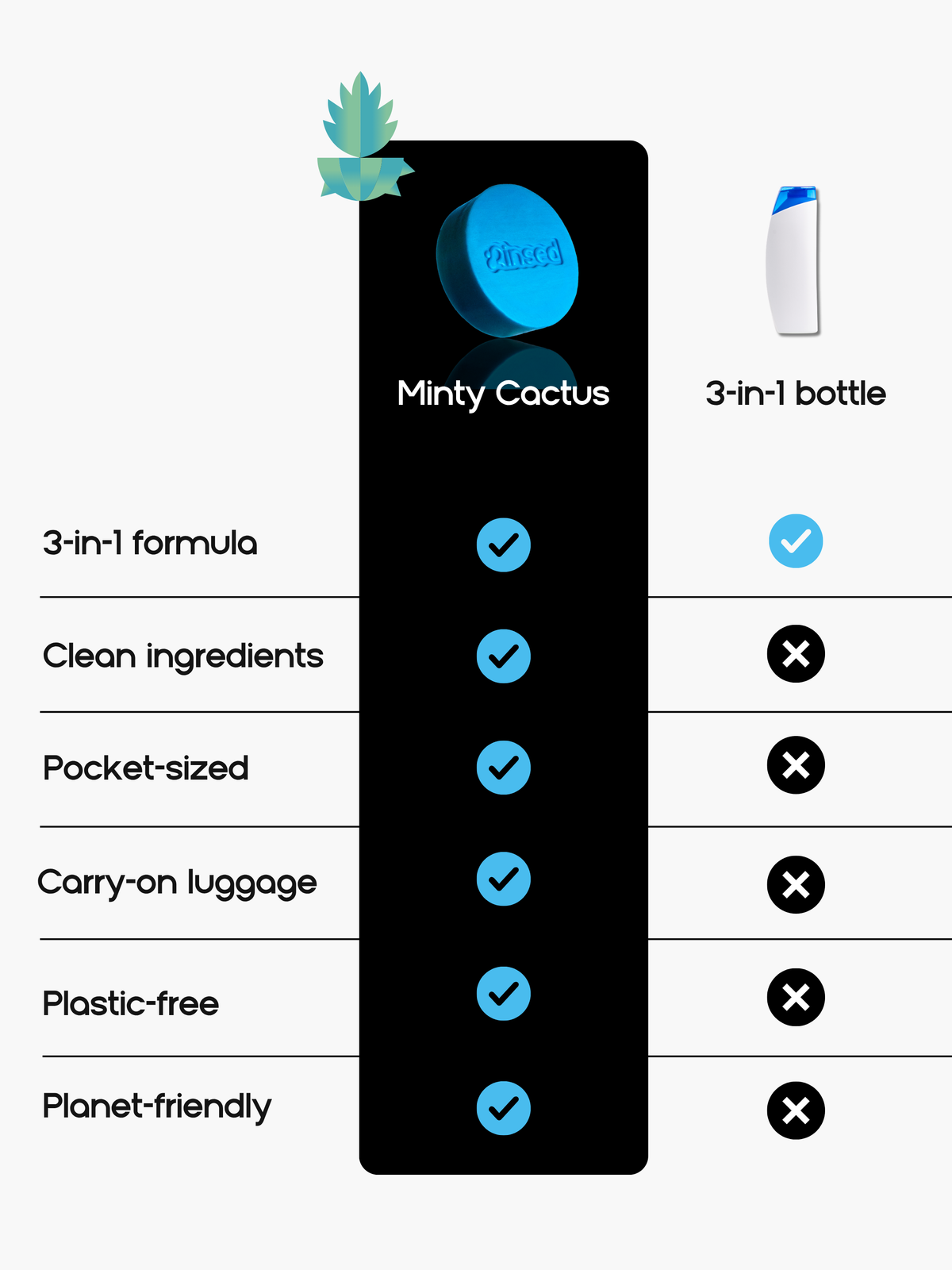
A shampoo bar and a bottle of liquid shampoo do the same job, and the honest differences are about format rather than performance. A bar has no bottle, weighs a fraction as much because you are not carrying water, and is not a liquid at airport security. A bottle lathers more easily in hard water, needs no drying spot, and is what most people already know how to use.
Which one suits you comes down to where you wash, how you travel and what water you have. This is an honest comparison rather than a sales pitch, including the things bars are genuinely worse at.
- 1. Shampoo bar vs liquid shampoo: the differences that are real
- 2. Where a bar is genuinely better
- 3. Where liquid shampoo is genuinely better
- 4. Which is better for the environment?
- 5. Which lasts longer?
- 6. How to switch without hating the first week
- 7. Summary
- 8. Frequently asked questions
Shampoo bar vs liquid shampoo: the differences that are real
This table sticks to things you can check yourself. Cleaning performance is left out deliberately, because it depends far more on the specific formulation than on whether it is solid or liquid.
| Shampoo bar | Liquid shampoo | |
|---|---|---|
| Packaging | Usually paper or none | Usually a plastic bottle |
| Weight carried | Mostly active product | Largely water |
| Airport hand luggage | Not a liquid, so not limited to 100ml | Limited to 100ml containers |
| Leaking in a bag | Nothing to leak | A known risk |
| Hard water | Depends on type, true soap struggles | Generally unaffected |
| Needs to dry between uses | Yes, or it goes soft | No |
| Shared or outdoor showers | Needs somewhere to put it | Easier to hold |
| Learning curve | Some, mostly rinsing technique | None |

Shampoo, body and face wash, all in one bar. Cooling, refreshing and designed for those always on the go.
Where a bar is genuinely better
Travel, mostly, and specifically air travel. Solid soap is not a liquid, gel, aerosol or paste, so it sits outside the hand luggage liquid rules that apply to a bottle. If you are trying to fly with cabin baggage only, that is the difference between a wash bag that fits the rules and one that does not.
The weight point is simple and often overstated by brands, so here is the plain version: liquid shampoo is mostly water, and you are paying to ship that water and then carrying it. A solid bar is not. On a long trip with a weight limit, that matters. On a short trip in a car, it does not.
Bars also have nothing to spill. Anyone who has opened a bag to find shampoo through their clothes knows the value of that, and it is the reason a lot of people switch and stay switched. More on packing in our surf trip packing list.
Where liquid shampoo is genuinely better
Worth saying plainly, because most comparisons skip it.
- Hard water. A true soap bar reacts with calcium and magnesium and leaves residue. Liquid shampoo does not. A syndet bar closes most of this gap, but a bottle sidesteps the issue entirely.
- No drying spot needed. A bar left in a puddle turns soft and disappears. In a damp bathroom with no shelf, that is a real annoyance.
- Nothing to learn. Bars need a longer rinse and less product than people expect, and the first few washes can go badly if nobody tells you that.
- Specialist formulations. If you use a specific medicated or treatment shampoo, the bar market is much smaller.
- Easier to handle. A wet bar in cold hands in an outdoor shower is a genuine skill.
If hard water is your situation, read do shampoo bars work in hard water before switching. And if the worry is hygiene rather than performance, is bar soap hygienic covers what the evidence actually says.
One thing worth saying plainly, since this article is comparing categories: Rinsed sits in the syndet column. Our ingredient list opens with Sodium Cocoyl Isethionate and contains no saponified oils.

Shampoo, body and face wash, all in one bar. Keep your hair and skin healthy on the go. Monoï-infused scent with a touch of vanilla. Designed for those always on the go.
Which is better for the environment?
The honest answer is that it depends on more than the packaging, and anyone giving you a clean single number is guessing. What can be said factually is narrow, so here it is.
A bar typically avoids a plastic bottle. It is also lighter to transport for the same number of washes, because it does not contain the water. Those two things are true and checkable.
What is not established by those two facts alone is the total environmental footprint. That depends on the ingredients, how they are produced, how the product is manufactured, how far it travels, how it is used and how much water you run while washing. A full comparison needs a life cycle assessment, and most brands, including small ones, do not have one.
So we will say the specific true things and skip the slogan. No bottle, less weight per wash, nothing to send to recycling. That is what a bar changes.
Which lasts longer?
This is harder to compare than it looks, because a bar and a bottle are not measured the same way. A bar's life depends heavily on how you store it. Left in standing water it will disappear in a fraction of the time it would on a draining dish.
| Factor | Effect on a bar | Effect on a bottle |
|---|---|---|
| Stored wet | Softens and dissolves much faster | No effect |
| Hard water | Uses more product per wash | Little effect |
| Hair length | More product per wash | More product per wash |
| Wash frequency | Proportional | Proportional |
| Over-application | Common, wasteful | Common, wasteful |
Storage is the biggest single variable and the easiest to control. how to store a soap bar so it does not turn to mush covers it.
How to switch without hating the first week
Most bad first experiences come from three habits carried over from bottles. Using far too much product, rubbing the bar directly on the hair rather than lathering first, and rinsing for fifteen seconds when a bar needs closer to a minute.
Soak your hair properly, take two or three strokes of the bar or lather it in your hands, work it into the scalp rather than the lengths, and rinse for longer than feels necessary. If your hair still feels coated after that, it is almost certainly your water rather than your technique, and our guide to waxy hair explains what to do.
Shampoo, body and face wash, all in one bar. Cooling, refreshing and designed for those always on the go.
Summary
Bars win on travel, weight and not leaking. Bottles win on hard water, convenience in a damp bathroom and needing no technique. On environmental impact, a bar avoids a bottle and carries less water, and anything beyond that needs evidence most brands do not have. If you fly, swim or travel often, a bar is the obvious choice. If you have very hard water and never leave home, a bottle is a reasonable one.
Frequently asked questions
Is Rinsed a soap bar?
No. Rinsed 3-in-1 bars are syndet bars. The ingredient list opens with Sodium Cocoyl Isethionate and contains no saponified oils, so they do not form the insoluble calcium compound that true soap forms in hard water. The full INCI is on every product page.
Is a shampoo bar better than liquid shampoo?
Better for travel, weight and avoiding leaks. Not automatically better at cleaning, which depends on the specific formulation rather than the format. Liquid shampoo has the advantage in hard water and in bathrooms where a bar has nowhere to dry.
Do shampoo bars clean as well as liquid shampoo?
A well formulated bar cleans perfectly well. The variable is the type: syndet bars behave much like liquid shampoo, while true soap bars can leave residue in hard water. Most complaints about bars not cleaning are really hard water complaints.
Are shampoo bars better for the environment?
A bar avoids a plastic bottle and is lighter to transport per wash, because it does not contain water. Those are the specific verifiable differences. The total footprint depends on ingredients, manufacturing and transport, which needs a full life cycle assessment to answer properly.
Can you take a shampoo bar in hand luggage?
Yes. Solid soap and shampoo bars are not liquids, gels, aerosols or pastes, so the 100ml hand luggage limit does not apply to them and they do not need to go in the clear pouch. Rules change, so check your departure and return airports before flying.
Why does my hair feel different after switching to a bar?
Usually the rinse. Bars need a noticeably longer rinse than liquid shampoo and much less product than people instinctively use. If it feels waxy rather than just different, hard water is the likely culprit.
Do I still need conditioner with a shampoo bar?
If you used conditioner before, you will probably still want it. Some people find they need less over time, others find no change. An acidic rinse also helps hair feel smoother, particularly in hard water areas.
Three bottles, one bar
Shampoo, body and face wash in one 80g bar. Nothing to leak, no liquid limits at the airport, and 30 to 60 washes per bar.
Travel with Rinsed™ →30 day money back guarantee, no questions asked.
Alexandre
Founder @Rinsed™
Hey, I’m Alexandre! I started Rinsed™ for people like myself: sporty, hardworking and always on the go. Check out our bars!