

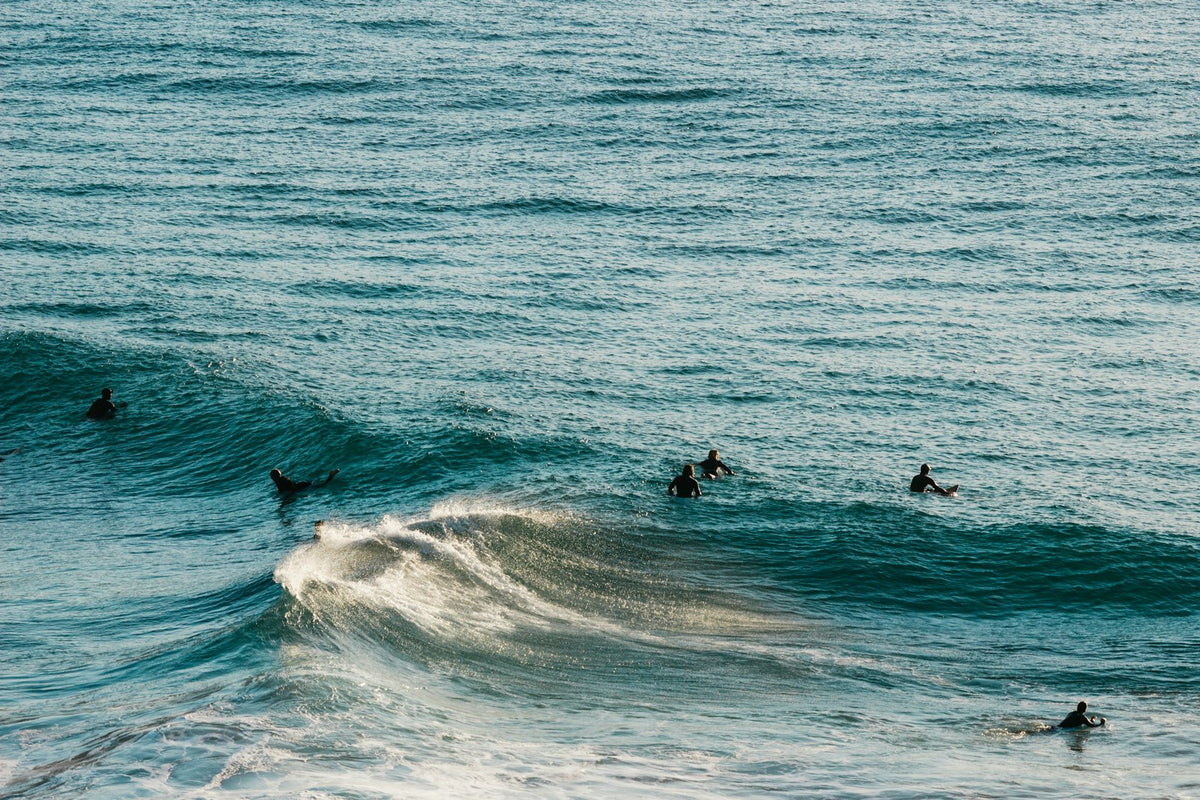
Note to travelling surfers
- Ecosystem first. Be kind to the environment you’re visiting: don’t leave any trash behind.
- Be kind to locals. Every lineup has an order and it was earned over years. Wait your turn, and respect local etiquette.
- Fly less, stay longer. The flight is the biggest impact of any surf trip. Two weeks once beats one week twice!
The rules of surf etiquette are: the surfer closest to the peak has right of way, don't drop in, don't snake, paddle out wide, hold on to your board, surf within your level, say where you're going, share the waves, respect the locals and leave the beach as you found it.
None of this is law. It's a shared code that keeps people from colliding, and the wording barely changes whether you read it from Surfing England, the RNLI, the Fédération Française de Surf (FFS) or Surfing Queensland. Learn it once and it travels with you.
Below are the ten rules those bodies repeat most, plus the part that rarely makes the posters: the car park, the beach shower and the surf camp bathroom. Just starting out? Read it alongside our best places to learn to surf in Europe.
- 1. What are the rules of surf etiquette?
- 2. Who has right of way on a wave?
- 3. How do you paddle out without getting in the way?
- 4. Why should you never let go of your board?
- 5. Which waves should you paddle out to?
- 6. How do you share waves in a crowded line-up?
- 7. Surf etiquette on land: locals and the environment
- 8. Showers, car parks and wet kit after the session
- 9. Summary
- 10. Frequently asked questions

What are the rules of surf etiquette?
There are ten: the first three decide who gets the wave, and the rest keep everyone safe and welcome.
| Rule | In practice | Who says it |
|---|---|---|
| 1. Closest to the peak has right of way | Look towards the peak before you paddle | Surfing England, RNLI, FFS |
| 2. Don't drop in | One wave, one surfer | Surfing England, RNLI, FFS |
| 3. Don't snake | Don't paddle around someone to steal the inside position | Surfing England, RNLI, Surfing Queensland |
| 4. Paddle out wide | Go around the breaking zone | RNLI, FFS, Surfing England |
| 5. Hold on to your board | Wear a leash and never ditch your board | RNLI, Surfing England, Surfing Queensland |
| 6. Surf within your level | If you have any doubts, don't go out | Surfing England, French sports ministry |
| 7. Say where you're going | Call "left" or "right" | RNLI, Surfing England, FFS |
| 8. Share the waves | Don't take them all | Surfing England, FFS |
| 9. Respect the locals | Don't paddle straight to the best take-off spot | Surfing England, FFS |
| 10. Leave the beach as you found it | Take your litter home, stay off reefs and dunes | FFS, Irish Surfing, O'Neill |
Who has right of way on a wave?
The surfer closest to the peak, the part of the wave that breaks first, has priority.
Surfing England states it plainly: "The surfer who is nearest to the peak of the wave has priority, or right of way." The RNLI uses almost the same words, and the FFS calls it the golden rule. The habit that follows is to check over your shoulder towards the peak as you paddle. If another surfer is closer to it, pull back.
Imagine a wave peeling to the right. You're paddling for it, and someone two metres to your left, deeper towards the breaking part, is paddling too. It's their wave. If you stand up anyway, you've broken rule two.

Dropping in is taking off on a wave that someone with priority is already riding. Surfing England calls it "a major no no", dangerous and seriously bad form. The FFS and the French sports ministry compress it into four words: one wave, one surfer.
Snaking is the sneakier version. According to Surfing Queensland, it happens when a surfer paddles around other surfers to take the inside position closest to the peak. It's jumping the queue, and Surfing England warns it's "likely to lead to some stern words".
The RNLI adds two refinements: priority also goes to the person furthest out, and to the person first to their feet.
One caveat from the FFS: even when I have priority, I avoid all danger. Being in the right doesn't help much if you run someone over.
How do you paddle out without getting in the way?
Paddle around the breaking waves, not through them, and if you get caught inside, aim for the white water.
The RNLI's wording is "Paddle wide, not through the peak". Surfing England adds that you should time your paddle between sets.
Sometimes it goes wrong and a surfer is coming straight at you. Your instinct says paddle for the shoulder, the unbroken part of the wave, because it looks like the easy way over. That's exactly where the surfer is heading. Surfing England's advice is to "change your direction and head to the white water to minimise the chance of a collision". The FFS puts it as a personal promise: if necessary, I'd rather go under the foam than get in the way of the surfer who's riding.
It means you take the wave on the head so that they keep their ride. They'll do the same for you.
Why should you never let go of your board?
Because a loose surfboard can seriously hurt the person behind you, and it's also what keeps you afloat.
"Always wear a leash" is one of the RNLI's nine simple checks for safe surfing. Surfing England's rule is "Don't ditch your board", both when you kick out of a wave and when you paddle out. Surfing Queensland is blunter still: "You never have permission to throw or discard your board."
The temptation comes when a wall of white water is about to land on you. The FFS asks you never to throw your board without looking behind you, and never to rely on the leash alone to hold it.
There's a safety reason for you as well. The RNLI says never to ditch your board because it will keep you afloat in an emergency and make you easier to find. And when you fall, both the RNLI and the FFS say the same thing: don't dive head first.
Which waves should you paddle out to?
The ones that match your level, in the area set aside for surfing, and ideally with a friend.
Surfing England's line is the easiest to remember: "If you have any doubts, don't go out." The French sports ministry tells beginners to stay in the white water or the small waves, use a foam board and choose supervised areas.
Know the zones, too. On lifeguarded beaches in the UK, the RNLI explains, red and yellow flags mark the area for swimmers and bodyboarders, black and white chequered flags mark the area for surfboards, and a red flag means don't go in at all. In France, the FFS rule is never to surf in the bathing zones.
The RNLI's other checks are common sense: surf with a mate, tell someone where you're going, and wear the right wetsuit (our wetsuit thickness guide helps with that one).
The gentlest way to learn all of this is with a surf school. And if you book a week at a surf camp, you'll find the same sharing logic applies indoors: a handful of people, one shower, one narrow shelf. One solid bar for hair, body and face takes up a corner of it and leaves room for everyone else's things.

Shampoo, body and face wash, all in one bar. Cooling, refreshing and designed for those always on the go.
Back in the water, the same generosity is what makes a busy peak work.
How do you share waves in a crowded line-up?
Take your turn, let some go, and talk to the people around you.
The FFS code has two lines for this: I don't take all the waves, and I stay cool, because surfing isn't war. Surfing England asks longboarders and stand-up paddlers in particular to hold back. Because they can catch waves from further back, they should "let plenty go for other surfers in the water".
Talking helps too. The RNLI's rule is to call "left" or "right" so the surfer next to you knows which way you're going.
And if the peak is simply too full, Surfing England suggests trying somewhere else, because "a 10 minute walk along the beach can yield empty peaks". It's the first thing we'd try on a busy summer day, at home or on a trip to the surf spots of Hossegor.
Surf etiquette on land: locals and the environment
Respect the locals
At a new spot, arrive quietly, watch for a while, and don't paddle straight to the best take-off spot.
Surfing England asks visitors to respect the local surfers and not to fight for the prime position the moment they arrive. Its fix for mistakes is refreshingly simple: if you drop in on someone or make a mistake, "just apologise".
Respect starts before you're wet. Irish Surfing asks surfers not to block gates, roadways or residences, and to remember that access often depends on the goodwill of landowners and residents.
Most of us turn up at a new break as travellers, often on a short trip with hand luggage only, and arriving light makes it easier to be a low-key guest. A solid bar is not a liquid at airport security, and one bar covers hair, body and face. Our carry-on surf trip wash kit shows what else fits.

Shampoo, body and face wash, all in one bar. Keep your hair and skin healthy on the go. Monoï-infused scent with a touch of vanilla. Designed for those always on the go.
However you get there, the place deserves the same care as the people in it.
Respect the environment
Take everything home with you, and stay off the things that grow.
The FFS keeps it to two instructions: leave no litter behind you, and avoid walking on reefs and areas of marine vegetation. Irish Surfing says "Please take your litter home". O'Neill's list of surfing's unwritten rules adds the dunes: don't litter, and avoid damaging them.
Showers, car parks and wet kit after the session
Keep the beach shower short and soap-free, change without blocking anyone, and take your wet kit home in a bag.
No federation has written this part down, so take it as our own addition to the code. A beach shower is for rinsing salt and sand off you and your wetsuit, quickly, because there's usually a queue of cold people behind you. Keep it to fresh water only. Don't rinse shampoo or soap directly into the ocean or into beach showers that drain to the sea. Save the lather for a bathroom where the water goes into a drain. We cover the routine in how to rinse off after a surf, and the shared-bathroom version in surf camp showers.
In the car park, don't block anyone in. Then everything wet goes into one bag for the drive back, wash things included. A bottle with a flip lid doesn't always survive that journey. A solid bar has nothing in it that can leak.
Shampoo, body and face wash, all in one bar. Cooling, refreshing and designed for those always on the go.
Hang the wetsuit up when you get in, and the session is properly finished.
Summary
The surfer closest to the peak has right of way, so don't drop in and don't snake. Paddle out wide, hold on to your board, and only go out in waves that match your level. Say where you're going, share the waves, respect the locals and leave the beach as you found it. When you get one wrong, and everyone does, say sorry. The same code applies in our best surfing destinations in France and when you're surfing in the Netherlands and Belgium.
Frequently asked questions
What is the most important rule in surfing?
Right of way. The surfer closest to the peak has priority, and the FFS sums it up as one wave, one surfer.
What does dropping in mean?
Dropping in means catching a wave that another surfer with priority is already riding. Surfing England calls it dangerous and seriously bad form.
What is snaking in surfing?
Snaking is paddling around another surfer to get closer to the peak and steal their priority.
What should I do if I drop in on someone by accident?
Get off the wave as soon as you safely can, then apologise. Surfing England's advice is that simple: "just apologise".
Where should beginners surf?
In the white water or on small waves, on a foam board and in a supervised area, as the French sports ministry advises. On UK lifeguarded beaches, surf between the black and white chequered flags.
Sources
The facts in this article are based on the sources below, checked in October 2026.
- Surf etiquette. Surfing England, 2026.
- Wave riding etiquette. Surfing England, 2026.
- Surfing: tips and advice on how to surf safely. RNLI, 2026.
- In the surf: your guide to surfsport safety. RNLI, 2026.
- Pour une pratique sereine du surf. Fédération Française de Surf, 2026.
- Je respecte les règles de convivialité. Fédération Française de Surf, 2012.
- Les 10 règles d'or d'une pratique sereine du surf. Fédération Française de Surf, 2022.
- Même si je suis prioritaire, j'évite tout danger. Fédération Française de Surf, 2026.
- Activités nautiques. Ministère des Sports, 2026.
- Good Surfer. Surfing Queensland, 2026.
- Caring and protecting. Irish Surfing, 2026.
- The unwritten rules of surfing. O'Neill, 2026.



