

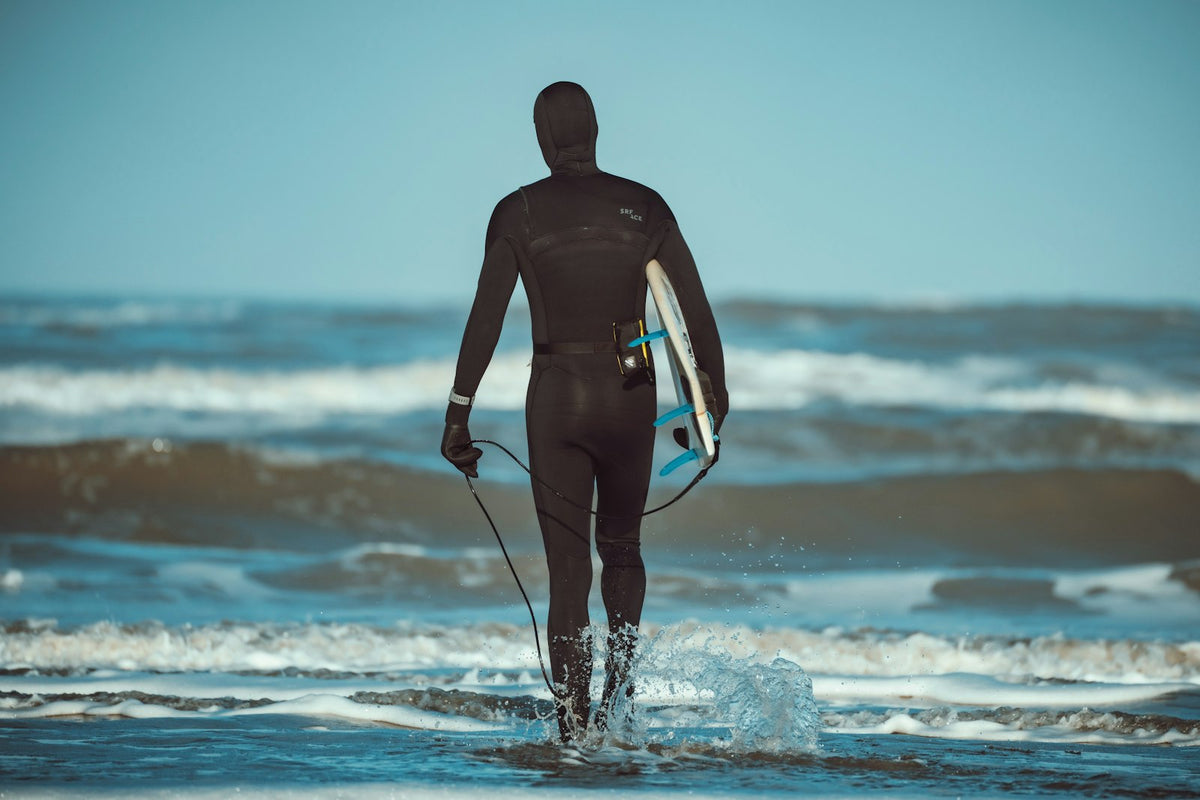
Note to travelling surfers
- Ecosystem first. Be kind to the environment you’re visiting: don’t leave any trash behind.
- Be kind to locals. Every lineup has an order and it was earned over years. Wait your turn, and respect local etiquette.
- Fly less, stay longer. The flight is the biggest impact of any surf trip. Two weeks once beats one week twice!
For surfing, wear no wetsuit above about 24°C, a 2 mm shorty or spring suit from 18 to 24°C, a 3/2 from 16 to 18°C, a 4/3 from 13 to 16°C, a 4/3 or 5/4 with boots and gloves from 9 to 13°C, and a hooded 5/4 or 6/5 with boots and gloves below 9°C.
Those bands come from Rip Curl's published chart, which we've converted from Fahrenheit. O'Neill, Patagonia and Srface publish their own, and they differ by a few degrees. That's why you and a friend can stand on the same beach in different suits and both be right.
Below we compare the four guides, then get to the useful bit: what to pack for the Dutch coast, Brittany, Biarritz, Peniche, Morocco and the Canaries, season by season, using average sea temperatures from seatemperature.org. Prefer no neoprene at all? See our best places to surf without a wetsuit.
- 1. What wetsuit thickness do you need at each water temperature?
- 2. What do the numbers on a wetsuit mean?
- 3. Why do the wetsuit guides disagree?
- 4. When do you need boots, gloves and a hood?
- 5. What wetsuit should you pack for popular surf destinations?
- 6. Showers, drying and wetsuit care on a trip
- 7. Summary
- 8. Frequently asked questions

What wetsuit thickness do you need at each water temperature?
Match the suit to the water temperature first: the colder the water, the thicker the neoprene and the more of you it should cover.
The table follows Rip Curl's wetsuit temperature and thickness guide, with each band converted to Celsius and rounded to the nearest degree.
| Water temperature | Thickness | Type of suit | Extras |
|---|---|---|---|
| 24°C and warmer | 0 to 1 mm | Boardshorts or rash vest | None |
| 18 to 24°C | 2 mm | Spring suit, short-arm suit or neoprene top | None |
| 16 to 18°C | 3/2 mm | Full suit | Boots optional |
| 13 to 16°C | 4/3 mm | Full suit | Boots recommended |
| 9 to 13°C | 4/3 or 5/4 mm | Full suit | Boots and gloves |
| Below 9°C | 5/4 or 6/5 mm | Hooded full suit | Boots, gloves and hood |
Using it is simple: look up the sea temperature, then read across. Seatemperature.org gives Scheveningen an average of about 18°C in September, right on the line between a 2 mm suit and a 3/2, so if there's any wind, take the 3/2. Our guide to surfing in the Netherlands and Belgium covers the spots.
What do the numbers on a wetsuit mean?
They are the neoprene thickness in millimetres: the first number is the torso, the second the arms and legs.
O'Neill explains it this way: "the first number refers to the thickness of the core and torso area, the second to the thickness of the extremities". So a 4/3 is 4 mm around your chest and back, where you need to hold on to warmth, and 3 mm on your arms and legs, so you can still paddle. Suits with three numbers, such as the 5/4/3 and 6/5/4 that Srface lists, add one more step.
Fit matters as much as thickness. Srface explains that wetsuits "keep you warm by trapping a thin layer of water between your skin and the suit", and Rip Curl warns that "A loose wetsuit lets cold water flush in and out with every duck-dive".
Why do the wetsuit guides disagree?
Because water temperature is only one of the things that decide how warm you feel, and every brand draws its lines a little differently.
Here are the four published guides side by side, in °C. Rip Curl's figures are our conversion from Fahrenheit.
| Suit | O'Neill | Rip Curl | Patagonia | Srface |
|---|---|---|---|---|
| 1 to 2 mm | 1 mm: 21 to 25. 2 mm or shorty: 18 to 20 | 18 to 24 | 18 to 23 | 18 and warmer |
| 3/2 | 12 to 17 | 16 to 18 | 13 to 18 | 14 to 20 |
| 4/3 | 12 to 17, or 8 to 11 | 13 to 16, or 9 to 13 | 10 to 16 | 10 to 18 |
| 5/4 | 8 to 11, or 4 to 7 | 9 to 13, or below 9 | 7 to 13, hooded | 5 to 13 |
| 6/5 | 4 to 7 | Below 9 | Below 7, hooded | 2 to 8, hooded |
Take 14°C as an example. Rip Curl says 4/3 with boots. O'Neill, Patagonia and Srface all allow a 4/3 too, but each would also let you get away with a 3/2. Nobody is wrong. They're describing different surfers on different days, and the guides themselves name what moves you up or down a row:
- Wind. Rip Curl says a cold offshore wind "can shift your recommendation up a full step".
- Session length. Heat loss adds up, and Rip Curl suggests a heavier suit for sessions longer than 90 minutes.
- You. Srface's advice: "If you're someone who gets cold easily, it's worth going a millimeter thicker."
When do you need boots, gloves and a hood?
Boots come first at around 16°C, gloves at around 13°C and a hood at around 10°C, going by Rip Curl's guide.
Converted from Fahrenheit, the advice reads like this. Boots go on below about 16°C, or earlier if your break involves a long walk over cold sand or sharp rocks. Below about 13°C, gloves move from optional to essential for sessions longer than an hour. Below about 10°C, the guide says, the head becomes the single biggest source of heat loss in your suit.
O'Neill agrees that in cold winter water "a hooded 5/4 mm suit is a must", along with surf gloves and surf boots.
For a real-world case, look north. Surf-Forecast says that in early March, when the sea at Klitmøller drops to between 2 and 6°C, you'll need "a flexible 6/5/4mm wetsuit or a well fitting 5/4mm wetsuit with gloves and 5mm neoprene booties and a hood". That's what surfing Cold Hawaii in Denmark asks of you in winter.
All of that neoprene comes home wet, in one dripping bag in the boot with your towel and wash things squeezed in beside it. A bottle of shower gel doesn't love being squashed under a winter wetsuit. A solid 3-in-1 bar for hair, body and face has nothing in it that can leak.

Shampoo, body and face wash, all in one bar. Cooling, refreshing and designed for those always on the go.
So much for the cold end of the chart. Now, what goes in the bag for where you're actually going?
What wetsuit should you pack for popular surf destinations?
For most of Atlantic Europe a 4/3 covers the longest part of the year, with a 3/2 or thinner for summer and a hooded 5/4 for northern winters.
The temperatures below are monthly averages from seatemperature.org for the town named, rounded to the nearest degree. The suits are our reading of those numbers against the chart at the top, so treat them as a starting point.
| Where | January to March | April to June | July to September | October to December |
|---|---|---|---|---|
| Scheveningen, Netherlands | 6°C: hooded 5/4 or 6/5, boots, gloves | 9 to 15°C: 5/4, then 4/3 by June | 17 to 18°C: 3/2 | 9 to 16°C: 4/3, then 5/4 by December |
| Brest, Brittany | 10 to 11°C: 5/4 or 4/3, boots, gloves | 11 to 14°C: 4/3, boots | 16 to 17°C: 3/2 | 13 to 15°C: 4/3, boots |
| Biarritz, France | 12 to 13°C: 4/3 or 5/4, boots, gloves | 14 to 19°C: 4/3, then 3/2, 2 mm by June | 21°C: 2 mm | 14 to 19°C: 3/2, then 4/3 by December |
| Peniche, Portugal | 14 to 15°C: 4/3, boots | 16 to 18°C: 4/3, then 3/2 from May | 19 to 20°C: 3/2 or 2 mm | 16 to 19°C: 3/2 |
| Taghazout, Morocco | 18°C: 3/2 | 18 to 20°C: 3/2 or 2 mm | 20 to 21°C: 2 mm | 18 to 21°C: 2 mm, then 3/2 |
| Corralejo, Fuerteventura | 19°C: 2 mm or 3/2 | 19 to 21°C: 2 mm | 21 to 23°C: 2 mm | 20 to 23°C: 2 mm |
Two things jump out. The first is how late the sea warms up. In Biarritz, the April average is about 14°C while October is still close to 19°C, so an autumn trip is far kinder than a spring one. The same pattern holds in Brittany, where March is the coldest month and August the warmest.
The second is that Portugal is cooler than it looks on a postcard. Peniche averages 19 to 20°C in summer, which the chart would call spring-suit water, but seatemperature.org's Peniche page also shows monthly minimums of around 16.5°C in July and August. That's why we'd still pack the 3/2.
Further afield it gets easy: seatemperature.org puts Kuta in Bali at 27 to 29°C all year, which needs nothing more than a rash vest. Morocco and Indonesia are outside the EU, so check your own government's travel advice before you book.
Whatever you choose, a 4/3 and a pair of boots take up a big part of a cabin bag. If you're flying with hand luggage only, everything else has to shrink. A solid bar is not a liquid at airport security, and one bar covers hair, body and face. Our carry-on surf trip wash kit shows how the rest fits around the neoprene.

Shampoo, body and face wash, all in one bar. Keep your hair and skin healthy on the go. Monoï-infused scent with a touch of vanilla. Designed for those always on the go.
One caution before you zip that bag: these are long-term averages for one town, and a given week can sit a degree or two either side. Look at a current reading before you leave.
Showers, drying and wetsuit care on a trip
Rinse the suit in fresh, cold water after every session, dry it inside out in the shade, and keep it away from heat.
That's O'Neill's care advice in one sentence. Dry the suit on a wide plastic hanger or folded at the waist over a horizontal one, and avoid wire hangers, hot water, washing machines, tumble dryers, direct sunlight and leaving it in the boot of the car.
Rip Curl adds a travel-friendly tip: hang it in the shade over a smooth, rounded surface such as a balcony railing, and make sure both sides are dry before you pack it.

On a trip, the rinse happens wherever there's fresh water: a beach shower, a hose at the surf school, or the shower in your room. Keep the beach rinse to fresh water only. Don't rinse shampoo or soap directly into the ocean or into beach showers that drain to the sea. Save the lather for a bathroom where the water goes into a drain, as we explain in how to rinse off after a surf.
That bathroom is rarely big. At a surf camp or in a small apartment, the shower doubles as the wetsuit rinse station, and there's usually one narrow shelf beneath a row of dripping suits. One bar for hair, body and face takes up a corner of it.
Shampoo, body and face wash, all in one bar. Cooling, refreshing and designed for those always on the go.
Keep that bar for you, though, and not for the suit: O'Neill recommends a specific wetsuit cleaning product every three to five sessions. And if the suit has already picked up a smell, here's how to get rid of wetsuit smell.
Summary
Start with the water temperature, then adjust for wind, session length and how easily you get cold, because the makers' guides differ by a few degrees and all of them are right for somebody. Make sure the suit fits, rinse it in cold fresh water and dry it in the shade. Once you're dressed for it, the only thing left to pack is good manners: our guide to surf etiquette covers the rules of the line-up.
Frequently asked questions
What does 4/3 mean on a wetsuit?
It's the neoprene thickness in millimetres: 4 mm around your torso and 3 mm on your arms and legs.
What wetsuit do I need for 15°C water?
A 4/3 full suit, ideally with boots, according to Rip Curl's chart. O'Neill, Patagonia and Srface also allow a 3/2 at that temperature.
When do I need boots, gloves and a hood?
Going by Rip Curl's guide: boots below about 16°C, gloves below about 13°C and a hood below about 10°C.
Is a 3/2 enough for Portugal in summer?
Usually, yes. Seatemperature.org gives Peniche an average of 19 to 20°C from July to September, with monthly minimums around 16.5°C. In winter and early spring you'll want a 4/3.
How do I dry a wetsuit on a surf trip?
Rinse it in fresh, cold water, turn it inside out and hang it in the shade, folded at the waist. Keep it out of direct sun and away from tumble dryers.
Sources
The facts in this article are based on the sources below, checked in October 2026.
- Wetsuit temperature and thickness guide. Rip Curl, 2026.
- What thickness wetsuit do I need at which water temperature?. O'Neill, 2026.
- A wetsuit thickness guide for surfing. Patagonia, 2026.
- What thickness wetsuit do I need? A complete guide. Srface, 2026.
- Monthly sea temperatures: Scheveningen, Brest, Biarritz, Peniche, Taghazout, Corralejo, Kuta. SeaTemperature.org, 2026.
- Klitmøller sea temperature and wetsuit guide. Surf-Forecast.com, 2026.
- Wetsuit care instructions: how to wash and clean your wetsuit. O'Neill, 2026.
- How to store wetsuits. Rip Curl, 2026.



