


Note to travelling surfers
- Ecosystem first. Be kind to the environment you’re visiting: don’t leave any trash behind.
- Be kind to locals. Every lineup has an order and it was earned over years. Wait your turn, and respect local etiquette.
- Fly less, stay longer. The flight is the biggest impact of any surf trip. Two weeks once beats one week twice!
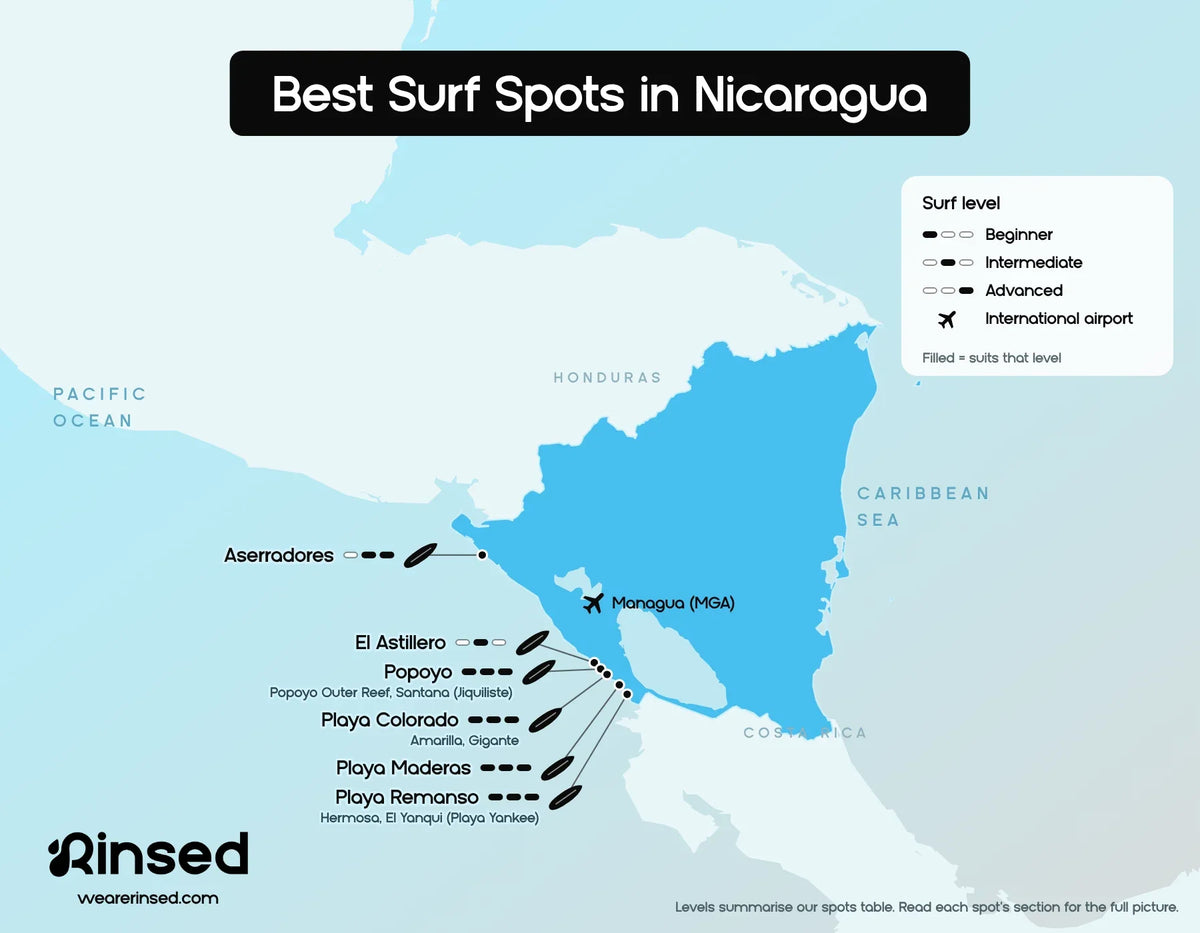
The best surf spots in Nicaragua are on the Pacific coast in two clusters: around Popoyo and Tola, with El Astillero, Popoyo and its Outer Reef, Playa Santana, Playa Colorado, Playa Amarilla and Playa Gigante; and around San Juan del Sur, with Playa Maderas, Playa Remanso, Playa Hermosa and Playa El Yanqui. Further north, near Chinandega, Aserradores (The Boom) is a powerful beach break for confident surfers.
What makes Nicaragua different from its neighbours is the wind. Lake Nicaragua sits just inland from the Pacific, and the surf forecasters credit it with keeping northeast offshore breezes going for more than 300 days a year. Add warm water and a steady diet of southern groundswell, and you get a coast where clean waves are the normal state of things rather than a lucky morning.
This guide is part of our wider guide to the best surfing destinations in Central America, and it sits next to our guides to the best surf spots in Costa Rica and surfing in El Salvador. It covers beginners and experienced surfers, with a clear note on which beach suits whom.
What are the best surf spots in Nicaragua?
This table covers twelve breaks we could verify from surf forecasters, spot guides and surf schools. "Works best on" comes from the forecasters' and spot guides' break pages. The level comes from the spot guides and surf schools; where they disagree, we give the range and explain it in the spot's section. "Best months" is the forecasters' most consistent month unless a spot guide gives a season.

| Spot | Area | Type | Level | Works best on | Best months |
|---|---|---|---|---|---|
| El Astillero | Tola, north of Popoyo | Reef and river mouth, lefts and rights | Intermediate | SSW swell, NE wind, around low tide | Summer, most often July |
| Popoyo | Popoyo, Tola | Reef, A-frame peaks, lefts and rights | Intermediate to advanced | SW swell, NE wind, all tides | Summer, most often July |
| Popoyo Outer Reef | Popoyo, Tola | Outer reef, big waves | Experienced | Big rainy-season swells | May to September |
| Playa Santana (Jiquiliste) | Rancho Santana, Tola | Beach break, lefts and rights, rocks inside | Intermediate (beginners on small days) | S to W swell, light NE wind, rising tide | Spring to autumn |
| Playa Colorado | Hacienda Iguana, Tola | Sandbar by a river mouth, fast and hollow lefts and rights | Intermediate to advanced | SW swell, NE wind, all tides | May to September, most often July |
| Playa Amarilla | Gigante, Tola | Beach break, lefts and rights | All levels (beginners on small days) | SW swell, NE wind, mid to high tide | Summer, most often July |
| Playa Gigante | Gigante, Tola | Beach and reef, lefts and rights | Not stated by the sources | SSW swell, NE wind | Summer, most often July |
| Playa Maderas | North of San Juan del Sur | Beach break over sand and rock, lefts and rights | All levels | S to W swell, NE wind, mid incoming tide | Not stated for this break |
| Playa Remanso | South of San Juan del Sur | Beach break in a small bay, lefts and rights | Beginner to intermediate | SSW swell, NE wind, mid to high tide | Summer, most often July |
| Playa Hermosa | South of San Juan del Sur | Exposed beach break, lefts and rights | All levels | SSW swell, NE wind | Summer, most often July |
| Playa El Yanqui (Playa Yankee) | South of San Juan del Sur | Exposed beach break, lefts and rights | Intermediate and up | SSW swell, NE wind | Summer, most often July |
| Aserradores (The Boom) | Chinandega, north-west | Beach break over sand, lefts and rights | Intermediate to advanced | S to SW swell, NE wind, mid to high tide | March to October |
Almost every break here wants the same thing: a southern groundswell and a northeast wind. Once you know how to read a surf forecast, the real question each morning is how big the swell is and how hard the offshore is blowing.
Why Nicaragua gets so many offshore days
The northeast wind that blows off the land and holds the waves open is fed by Lake Nicaragua, which sits only a short way inland from the Pacific. Lake Nicaragua covers more than 8,000 square kilometres, and it is known for sizeable waves driven by easterly winds blowing west toward the Pacific.
Surf-Forecast looked at its own long-term data to find the cleanest waves on earth, and Nicaragua made its shortlist. At Playa Gigante it registers offshore winds 78% of the time across the year, rising to 83% in summer, and it credits the temperature difference between the lake and the coast, plus Caribbean trade winds funnelled through low terrain, with keeping that northeast breeze going for more than 300 days a year. Its own verdict: not good for airs, but very good for clean waves.
Surfing around Popoyo and Tola
The Tola coast, from El Astillero down to Gigante, packs the most varied waves in this guide into a short stretch, with Popoyo as its best-known reef and several beach breaks for every level. The roads between the beaches are dirt in places, and the spot guides recommend a 4x4 for several of them.
El Astillero is the quiet northern end of the zone, a reef and river mouth break near the village of the same name, on the border between the Rivas and Carazo provinces. The left reef is the better wave. Its spot guide rates it intermediate, warns about rocks in the lineup and says there are no facilities, so most surfers stay in Popoyo. Forecasters say it is rarely crowded.
Popoyo is the best-known wave on this coast. Forecasters call it an exposed, very consistent reef break that works on all stages of the tide, best on a southwest swell with a northeast wind. The spot guide describes A-frame peaks over coral reef and sand, rates it world class and calls the main reef intermediate; a surf school in the south rates it for intermediate and advanced surfers pushing their limits, so we give the range. Watch for rips, undertow and rocks, and expect company: forecasters say it is sometimes crowded.
Popoyo Outer Reef is a different animal. The spot guide says it can reach about 20 feet in the rainy season, from May to September, is about a 15-minute paddle from shore and is for experienced surfers only. Treat it as a wave to watch from the beach unless you have real big-wave experience.
Playa Santana, also called Playa Jiquiliste, lies in front of the Rancho Santana estate. Two spot guides rate it intermediate and describe a heavy, peaky beach break with rocks on the inside, urchins and strong rips, while one surf camp calls it a playful beach for beginners on small days. Access is easiest if you stay on the estate; otherwise there is a marked dirt road with restricted parking.
Playa Colorado is the hollow one. Forecasters call it a very consistent break by a river mouth that works at all tides. One spot guide rates it intermediate, with fast, hollow waves up to double overhead in the rainy season; two surf schools call it a heavy, regularly tubing wave for advanced surfers. Access is through the private Hacienda Iguana development or by boat from Rancho Santana or Gigante, and the spot guide warns it can get very crowded at peak times.
Playa Amarilla, just north of Gigante, is the friendly option in this stretch. One surf camp lists it as a beginner beach with gentle lefts and rights over sand and several peaks; the spot guide says it suits all levels, with heavier waves on bigger swells. Forecasters say it never gets crowded but warn about dangerous rips.
Playa Gigante fronts the village of Gigante, a handy base for this end of the coast. Forecasters call it an exposed beach and reef break with lefts and rights, rarely crowded, with rips and rocks. None of our sources gives it a level. At its southern end, the reef and sand setup of Pie de Gigante is rated intermediate by its spot guide.
Days on the Tola coast mean a lot of sandy, dusty hops between beaches. A solid bar that washes hair, body and face sits in a small wash bag and can't leak into the rest of your kit on a bumpy track.

Shampoo, body and face wash, all in one bar. Cooling, refreshing and designed for those always on the go.
From Tola, the coast runs south towards the Costa Rican border and the busier surf town of San Juan del Sur.
Surfing around San Juan del Sur
San Juan del Sur is the easiest base in Nicaragua, with schools, rentals and places to stay in town, and a ring of beach breaks within a short drive: Maderas to the north, and Remanso, Hermosa and El Yanqui to the south. The town sits on the narrow strip of land between the Pacific and Lake Nicaragua, about 140 km south of Managua.
The bay in town is not the reason to come. Its spot guide calls it a sheltered, mostly closing-out beach break that suits beginners and longboarders, and forecasters warn about dangerous rip currents. The good waves are out of town.
Playa Maderas, about 12 km north of San Juan del Sur, is one of the busiest and best loved. The spot guide describes a very consistent beach break with a right in the middle of the beach and a faster left just south of it, best on a mid incoming tide. It rates Maderas for all levels, with the northern peaks easier for beginners. Watch the rocks at the south end and the stingrays one surf camp mentions, and expect 20 to 30 people out on busy days.
Playa Remanso is the gentle one, a sandy bay a short drive south of town. Its spot guide rates it for beginners and intermediates: beginners on the inside on smaller days, intermediates on the outside when it is bigger. High tide gives softer waves, low tide faster ones, and there are pebbles and rocks at both ends of the bay. One surf camp says it picks up a lot of swell, so it is worth a look when other beaches are flat.
Playa Hermosa is a wide beach with several peaks. Forecasters call it exposed and consistent, best on a south-southwest groundswell and a northeast wind, and warn about dangerous rips and busy lineups when the surf is up. Two surf schools say it works for mixed levels, with gentle waves near the shore on small days and tubing waves up and down the beach on bigger ones. One of them notes the access road can be rough after heavy rain.
Playa El Yanqui, often written Playa Yankee, is the heavier beach break further south. A surf school says its powerful lefts and rights suit intermediate surfers and up, and that on the right tide and swell you can have it almost to yourself. Forecasters list rips and rocks.
Further north: Aserradores (The Boom)
In the north-west near Chinandega, Aserradores, home to the wave surfers call The Boom, is a powerful sand-bottom beach break for confident surfers. One spot guide rates it intermediate with a note for beginners to take care; another rates it advanced and expert, not for beginners, and describes a busy, fairly closed lineup. We give the range. Both agree it works best from mid to high tide, and the season is roughly March to October. Access is along an unpaved road off the Chinandega to Potosí highway.
When is the best time to surf in Nicaragua?
For size and consistency, aim for the rainy season, roughly May to November; for smaller waves, sun and an easier time as a beginner, go in the dry season, roughly December to April. The offshore wind blows in both seasons.
A surf school in the south puts the main wave season from March to November: March and November bring smaller waves, and June and July are the peak, with regular overhead surf. For beginners it suggests March, April or December for mellow waves. Another surf camp says the rainy season brings the most consistent and biggest swells, roughly 4 to 12 feet, with the heaviest rain in September and October. Forecasters name July as the most consistent month at almost every break in our table.
The rainy season is also storm season. The Dutch and British governments both put the hurricane season at roughly June to November, and advise checking forecasts and following local news if you travel then.
The water is warm all year. The averages below are long-term figures for San Juan del Sur; wetsuit advice is from the surf forecasters.
| Months | Water, San Juan del Sur | Rain | Surf | Wetsuit |
|---|---|---|---|---|
| December to April | About 26 to 27°C | Dry, 5 to 9 rainy days a month | Smaller swell, steady offshores, best for beginners | None needed: rash vest and boardshorts |
| May to August | About 28°C | Wet, 17 to 23 rainy days a month | Bigger, more consistent swell, peak in June and July | Rash vest, mainly for sun protection |
| September and October | About 28°C | Wettest months, 21 to 24 rainy days | Swell continues, heaviest rain and storm risk | Rash vest, mainly for sun protection |
| November | About 27°C | Drying out, around 12 rainy days | Smaller waves as the season winds down | Rash vest and boardshorts |
Forecasters note that water near the shore can differ by several degrees from these averages, especially near river mouths and after long spells of strong offshore wind. With no wetsuit, the sun becomes the thing to protect against: read our guide to the best places to surf without a wetsuit and our sunscreen rules for surf trips.
Is it safe to surf in Nicaragua?
The biggest risk on these beaches is the current, and you should not count on a lifeguard. The British government says there are strong currents off sections of Nicaragua's Pacific coast and people have drowned, and that there are no warning signs or lifeguards and rescue equipment is hard to find. The Dutch government adds that beaches often have few or no lifeguards and advises asking locals where it is unsafe to swim.
Nearly every break page in our table mentions rips, and several mention rocks or urchins. Check the conditions with a local school or the people you are staying with, and paddle out with someone else when you can.
Is Nicaragua good for beginner surfers?
Yes, at the right beaches and on smaller days, with a lesson. The sources point to Playa Remanso and the northern peaks of Playa Maderas around San Juan del Sur, and Playa Amarilla and small days at Playa Santana on the Tola coast. Playa Hermosa works for mixed levels on small days.
Leave Popoyo's Outer Reef, Playa Colorado, Playa El Yanqui and The Boom for later: the sources describe them as heavy, hollow or for experienced surfers. If it is your first surf camp, our guide on what to expect at your first surf camp helps.
Getting to Nicaragua from Amsterdam, Brussels and Paris
There is no direct flight from Amsterdam, Brussels or Paris to Managua, so you connect through a hub in the Americas, or fly into Liberia in north-west Costa Rica and continue overland.
Flying to Managua. Augusto C. Sandino International Airport in Managua is the main gateway. Its current airline list shows connections via Miami, Houston, Mexico City, Panama City, San Salvador and San José, but no European routes. From Managua, San Juan del Sur is about 140 km to the south.
Flying to Liberia, Costa Rica. KLM sells flights from Amsterdam to Liberia; when the route started they stopped in San José on the way, so check the routing when you book. Liberia is in north-west Costa Rica, and from there you continue by road and cross the land border into Nicaragua. If you go this way, check the border rules for your nationality before you travel, and combine it with our Costa Rica surf guide.
Costa Esmeralda Airport. This small airport about 10 km west of Tola, close to Rancho Santana and the Popoyo coast, operates commercial flights from Costa Rica and Managua. It can save you the drive, but we couldn't confirm a current timetable.
Entry. The Dutch and British governments both say tourists from their countries don't normally need a visa for short stays of up to 90 days, and that your passport needs at least six months' validity. The 90 days are shared across Nicaragua, El Salvador, Guatemala and Honduras, counted from the first of those countries you enter (British travellers should note the UK says they need a visa for Honduras), which matters if you are combining Nicaragua with El Salvador. The Dutch advice also notes that drones and vapes are not allowed. The British government adds that you may be refused entry without an onward ticket. Rules change, so check your own government's travel advice before you book.
Two or three flights each way makes this a hand-luggage trip if you can manage it. One solid bar for hair, body and face isn't a liquid at airport security, so it stays out of the plastic bag.

Shampoo, body and face wash, all in one bar. Keep your hair and skin healthy on the go. Monoï-infused scent with a touch of vanilla. Designed for those always on the go.
Our guides on whether you can take soap on a plane and on packing a carry-on surf wash kit have the detail. Once you land, the next choice is where to sleep.
Where to stay for surfing in Nicaragua
Pick one coast and stay close to the waves: Popoyo or Gigante for the Tola breaks, San Juan del Sur or a camp near Maderas for the south.
Popoyo and Tola: Popoyo has restaurants by the break with parking, and the spot guides say most surfers heading to El Astillero stay in Popoyo. Gigante is a village base for Playa Amarilla, Playa Gigante and boat trips to Playa Colorado. Playa Santana is easiest from the Rancho Santana estate, and Playa Colorado from the Hacienda Iguana development.
San Juan del Sur: the town has surf schools, board rentals and accommodation, and the beaches north and south are a short drive away. Surf camps sit near Playa Maderas, and there is a hotel with parking by the beach at Playa Remanso.
The Boom: the access road ends at Marina Puesta del Sol, on the long sandy stretch by the estuary.
Showers, rinsing and washing up
Plan your washing around proper showers with a drain, not the beach. Don't rinse shampoo or soap directly into the ocean or into beach showers that drain to the sea. Lather only where the water goes into a drain: a surf camp, a hotel or your rented room.
With water this warm, it is easy to surf twice a day, and salt and sun build up fast in your hair. Our guide on how to rinse off after a surf helps. In a humid surf camp room, one bar in a damp wash bag is simpler than three bottles sweating on a shelf.
Shampoo, body and face wash, all in one bar. Cooling, refreshing and designed for those always on the go.
With the washing sorted, the last thing is how you behave in the water and on land.
Surfing in Nicaragua: locals and the environment
Respect the locals
The spot guides for Popoyo, Santana, Maderas and Remanso all ask the same thing: respect the locals and follow surf etiquette, especially when it is crowded. Popoyo, Colorado and Maderas can all get busy when the swell is good, so wait your turn, don't drop in and don't paddle around people to the peak. Our surf etiquette guide covers the basics.
On land, several of the best beaches are reached through private estates or developments. Use the official access roads and parking, and ask when you are not sure.
Respect the environment
This coast is an important nesting ground for olive ridley sea turtles. The La Flor Wildlife Refuge, about 18 km south of San Juan del Sur, sees mass nesting arrivals: in October 2026 Nicaragua's environment ministry counted almost 33,000 nesting females there in a single arrival. The nesting season runs roughly from July to February. If you go to watch, go with a reputable guide and don't use a camera flash. Take your rubbish with you from every beach, and keep sunscreen and soap out of the sea.
Summary
Nicaragua's surf is on its Pacific coast, in two main clusters: the Popoyo and Tola coast, with Popoyo, Playa Santana, Playa Colorado and the Gigante beaches, and the beaches around San Juan del Sur, with Maderas, Remanso, Hermosa and El Yanqui. The Boom near Chinandega is the northern outlier. Lake Nicaragua helps keep the northeast offshore wind blowing for most of the year. Experienced surfers should aim for May to October for size; beginners should go from December to April and stick to Remanso, Maderas or Amarilla. You won't need a wetsuit, but you will need to respect the rips. Compare with Costa Rica, Panama and the rest of Central America.
Frequently asked questions
Where is the best surfing in Nicaragua?
On the Pacific coast. The two main areas are the Popoyo and Tola coast, with Popoyo, Playa Santana, Playa Colorado and Playa Amarilla, and the beaches around San Juan del Sur, with Playa Maderas, Playa Remanso, Playa Hermosa and Playa El Yanqui.
Is Popoyo good for beginners?
Not really. The main reef is rated intermediate to advanced, and the Outer Reef is for experienced surfers only. Beginners nearby are better off at Playa Amarilla or on small days at Playa Santana.
Where can beginners surf near San Juan del Sur?
Playa Remanso is the gentlest, with soft waves on the inside, and the northern peaks of Playa Maderas are easier and less crowded. Playa Hermosa works for mixed levels on smaller days.
Can you surf in San Juan del Sur town?
Only just. The spot guide calls the bay a sheltered, mostly closing-out beach break for beginners and longboarders. The better waves are at the beaches north and south of town.
When is the best time to surf in Nicaragua?
For bigger, more consistent swell, the rainy season from about May to November, with June and July the peak. For beginners, the dry season from about December to April brings smaller waves.
Why does Nicaragua have so many offshore days?
Surf forecasters credit Lake Nicaragua and Caribbean trade winds with keeping a northeast offshore breeze going for more than 300 days a year. At Playa Gigante, offshores are registered 78% of the time across the year.
Do I need a wetsuit to surf in Nicaragua?
No. Long-term sea temperatures at San Juan del Sur average about 26 to 28°C, and forecasters say a rash vest and boardshorts are fine all year. A rash vest also helps with the sun.
Is there a hurricane season in Nicaragua?
Yes. The Dutch and British governments put the hurricane season at roughly June to November, so check forecasts and follow local news if you travel then.
How do I get to Nicaragua from the Netherlands, Belgium or France?
There is no direct flight to Managua from Amsterdam, Brussels or Paris, so you connect through a hub such as Miami, Houston, Mexico City or Panama City. Another option is flying into Liberia in Costa Rica and continuing overland.
Should I stay in Popoyo or San Juan del Sur?
San Juan del Sur is the easier base, with schools, rentals and places to stay in town. Popoyo and Gigante put you closer to the stronger, more varied waves of the Tola coast.
Are there lifeguards on Nicaraguan surf beaches?
Generally not. The British government says there are no warning signs or lifeguards, and both the Dutch and British governments warn about strong currents on the Pacific coast.
Sources
The facts in this article are based on the sources below, checked in October 2026.
- Popoyo surf guide. Surf-Forecast, 2026.
- El Astillero surf guide. Surf-Forecast, 2026.
- Playa Colorado surf guide. Surf-Forecast, 2026.
- Playa Amarilla surf guide. Surf-Forecast, 2026.
- Playa Gigante surf guide. Surf-Forecast, 2026.
- San Juan del Sur surf guide. Surf-Forecast, 2026.
- Playa Remanso surf guide. Surf-Forecast, 2026.
- Playa Hermosa (Nicaragua) surf guide. Surf-Forecast, 2026.
- Playa El Yanqui surf guide. Surf-Forecast, 2026.
- San Juan del Sur water temperature and wetsuit guide. Surf-Forecast, 2026.
- Using Surf-Forecast's historical surf data to find the cleanest waves on earth. Surf-Forecast, 2026.
- Astillero surf spot guide. Mondo Surf, 2026.
- Popoyo surf spot guide. Mondo Surf, 2026.
- Santana surf spot guide. Mondo Surf, 2026.
- Playa Colorado surf spot guide. Mondo Surf, 2026.
- Playa Amarillo surf spot guide. Mondo Surf, 2026.
- Pie de Gigante Point surf spot guide. Mondo Surf, 2026.
- San Juan del Sur surf spot guide. Mondo Surf, 2026.
- Playa Maderas surf spot guide. Mondo Surf, 2026.
- Playa Remanso surf spot guide. Mondo Surf, 2026.
- Aserradores surf spot guide. Mondo Surf, 2026.
- Playa Santana surf spot. Surfnerd, 2026.
- The Boom surf spot. Surfnerd, 2026.
- When is the best time of year to surf in Nicaragua?. Chica Brava, 2026.
- 6 best surf spots in southern Nicaragua. Chica Brava, 2026.
- The 6 best beginner surf beaches in Nicaragua. Rapture Surfcamps, 2026.
- Surf in Nicaragua in the rainy season. Rapture Surfcamps, 2026.
- San Juan del Sur weather by month. Weather2Travel, 2026.
- Nicaragua travel advice: safety and security. GOV.UK (FCDO), 2026.
- Nicaragua travel advice: entry requirements. GOV.UK (FCDO), 2026.
- Reisadvies Nicaragua. Nederland Wereldwijd, 2026.
- Augusto C. Sandino International Airport. Wikipedia, 2026.
- Costa Esmeralda Airport. Wikipedia, 2026.
- Guanacaste Airport. Wikipedia, 2026.
- Flights from Amsterdam to Liberia (LIR). KLM, 2026.
- KLM volará a Liberia a partir de octubre. La República, 2019.
- San Juan del Sur. Wikipedia, 2026.
- Lake Nicaragua. Wikipedia, 2026.
- Refugio de Vida Silvestre La Flor. Frommer's, 2026.
- Tortugas paslama en San Juan del Sur. La Prensa, 2026.