

Note to travelling surfers
- Ecosystem first. Be kind to the environment you’re visiting: don’t leave any trash behind.
- Be kind to locals. Every lineup has an order and it was earned over years. Wait your turn, and respect local etiquette.
- Fly less, stay longer. The flight is the biggest impact of any surf trip. Two weeks once beats one week twice!
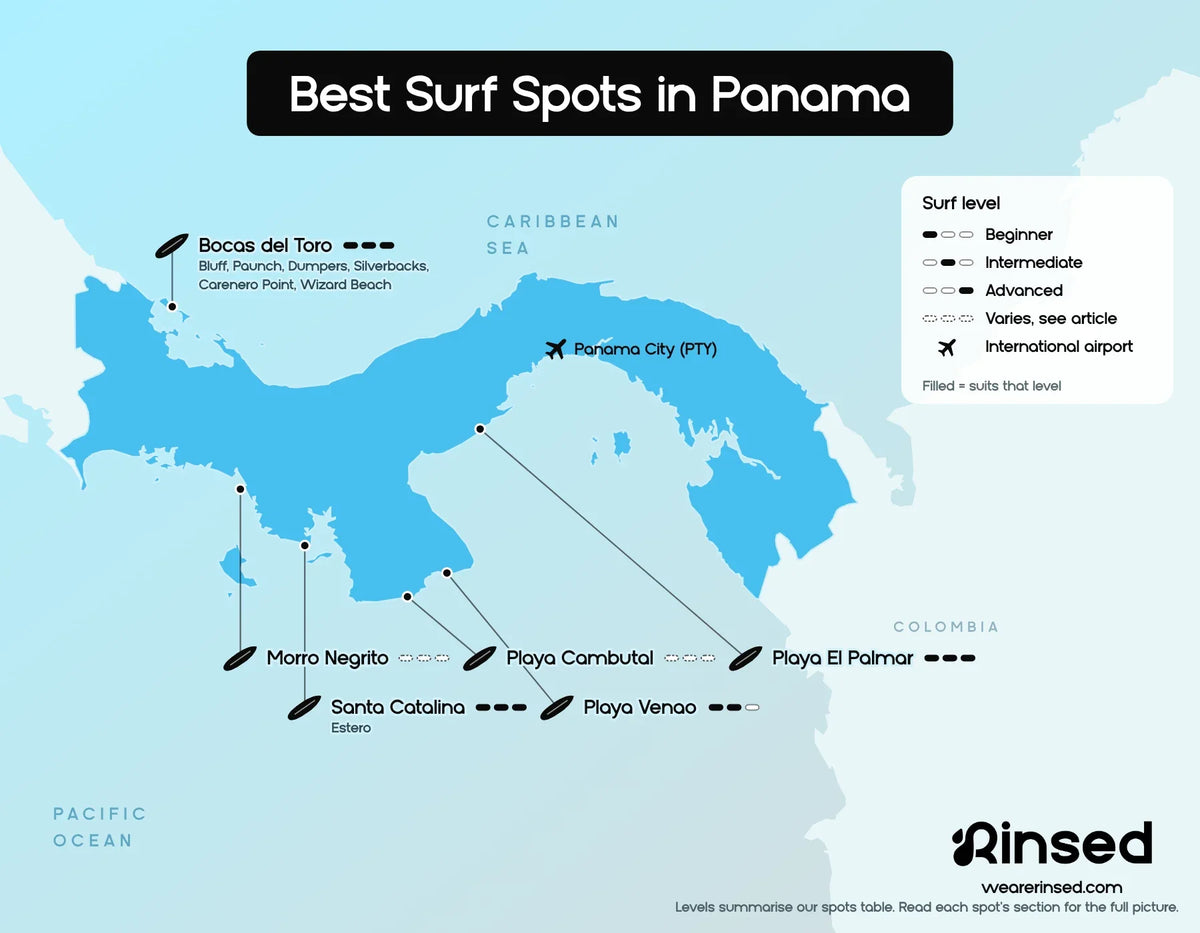
The best surf spots in Panama sit on two coasts: on the Pacific, Santa Catalina and Playa Estero in Veraguas, Playa Venao and Playa Cambutal on the Azuero Peninsula, Morro Negrito in the Gulf of Chiriquí and Playa El Palmar near Panama City; on the Caribbean, Bluff, Paunch, Dumpers, Silverbacks, Carenero Point and Wizard Beach in Bocas del Toro.
What makes Panama different from its neighbours is that you can pick a coast to suit the calendar. Panama's tourism board says Bocas del Toro is at its best from December to March, right in the middle of the European winter, while it recommends March to October for the prime swells at Santa Catalina on the Pacific side. The water is warm all year, so board shorts or a rash vest will do.
This guide is part of our wider guide to the best surfing destinations in Central America, next to our guides to the best surf spots in Costa Rica and Nicaragua.
What are the best surf spots in Panama?
This table covers twelve breaks we could verify from Panama's tourism board and surf forecasters, six on each coast. "Works best on" comes from the surf forecasters' break pages, with tide notes from the tourism board where it gives them. The level comes from the tourism board or a surf spot guide; where none gives one, we say so. "Best months" combines the tourism board's season with the forecasters' cleanest or most consistent month.

| Spot | Area | Type | Level | Works best on | Best months |
|---|---|---|---|---|---|
| Santa Catalina (La Punta) | Santa Catalina, Veraguas | Point break over rock, rights and lefts | Intermediate to advanced (rocky bottom) | SSW swell, N wind, mid to high tide | March to October for swell, cleanest in January |
| Playa Estero | Santa Catalina, Veraguas | Beach break, sand bottom, lefts and rights | Beginners | SW to W swell, NE to E wind | February to August |
| Playa Venao | Azuero Peninsula, Los Santos | Beach break, lefts and rights | Beginner to intermediate | S swell, NNW wind, mid tide on the fall | February to August for swell, cleanest in December |
| Playa Cambutal | Tonosí, Los Santos | Beach and reef break, lefts and rights | Not stated by the sources | S swell, N wind, all tides | All year |
| Morro Negrito | Gulf of Chiriquí | Reef and point break, lefts | Not stated by the sources | SW swell, NE wind | Northern winter, cleanest in January |
| Playa El Palmar | San Carlos, Riviera Pacífica | Three breaks, rights and lefts | All levels | W, SW and S swell, mid to high tide | Not stated by the sources |
| Bluff (Playa Bluff) | Isla Colón, Bocas del Toro | Exposed beach break, lefts and rights | Experienced | NE swell, SW wind, all tides | December to March, most consistent in March |
| Paunch | Isla Colón, Bocas del Toro | Reef break, lefts and rights | All levels | NE swell, W wind, all tides | December to March, cleanest in December |
| Dumpers | Isla Colón, Bocas del Toro | Exposed reef break, lefts | Not stated (rocks, reef, rips) | NE swell, SW wind | December to March, most consistent in March |
| Silverbacks | Off Isla Bastimentos, Bocas del Toro | Exposed reef break, rights | Expert (big-wave reef) | NE swell, SW wind, all tides | December to March, most consistent in March |
| Carenero Point | Isla Carenero, Bocas del Toro | Point break, long lefts | Intermediate to advanced | NE swell, WSW wind, all tides | December to March, cleanest in December |
| Wizard Beach (First Beach) | Isla Bastimentos, Bocas del Toro | Beach and reef break, lefts and rights | Intermediate | E swell, NW wind, all tides | December to March, cleanest in January |
The forecasters' "cleanest month" is about wind as much as swell. If the charts confuse you, start with our guide on how to read a surf forecast.
Surfing in Santa Catalina and Veraguas
Santa Catalina is one of the most reliable surf towns on the Pacific, with a heavy point break for confident surfers and a sandy beach next door for learners. Panama's tourism board calls it one of the most reliable surf spots on the Pacific coast and says you can surf year round, but recommends March to October for the prime swells.
Santa Catalina (La Punta) is the wave the town is known for. The tourism board describes strong, long rights and lefts over a rocky bottom, best at medium or high tide, and recommends booties. Its Santa Catalina page says the point has powerful tubes and has hosted national and international championships. Surf forecasters list it as an exposed, very consistent point break, best on a south-south-west swell with a north wind, and warn about sea urchins and rocks. In January they count clean surf about 78% of the time. A surf spot guide rates it for intermediate and advanced surfers and notes that even small days can break overhead, which is why our table says "Intermediate to advanced".
Playa Estero is where you learn. The tourism board says it has smaller waves and a sand bottom, recommends it for beginners in summer, and notes that the area has surf schools. A surf spot guide puts its main season from February to August, with the best swell from the south-west and west.
Two more names come up on the tourism board's list. Punta Roca is a larger point about a 30-minute walk north-east of town, rideable only at medium or low tide, and Punta Brava, about a 30-minute walk south-east, has lefts that can get twice as big as Santa Catalina and suits experienced surfers. We couldn't confirm these on a forecaster's break page, so they stay out of the table.
Santa Catalina is also the gateway to Coiba National Park, a UNESCO World Heritage site since 2005, made up of Coiba Island, 38 smaller islands and the surrounding waters of the Gulf of Chiriquí. The tourism board says humpback whales pass from July to October, so a flat day still has something to offer.
Surfing on the Azuero Peninsula: Playa Venao and Cambutal
Playa Venao is one of the easiest Pacific beaches to learn on, and Cambutal, an hour further along the coast, is where you go for fewer people.
Playa Venao is a horseshoe-shaped beach with long, easy rides that the tourism board says suit beginner and intermediate surfers, with lefts and rights over sand. Surf forecasters call it a very consistent exposed beach break, best on a south swell with a north-north-west wind, around mid tide on the fall. They also say it is popular, can get crowded and has dangerous rips. In December they count clean waves about 86% of the time, while a surf spot guide puts the main swell season from February to August. The tourism board adds that surf schools and shops line the sand.
Playa Cambutal, near Tonosí, is about an hour's drive from Venao. The tourism board describes it as rarely crowded and good year round, with beach breaks and point breaks. Forecasters list a consistent beach and reef break with lefts and rights, best on a south swell with a north wind and not affected by the tide, and say it is not likely to be crowded. None of our sources gives it a level, so plan for a mix of sand and reef and ask locally.
Azuero is car country, with long drives between beach and town. A damp wash bag on the back seat is easier with one solid bar for hair, body and face than with three bottles that can leak into your kit.

Shampoo, body and face wash, all in one bar. Cooling, refreshing and designed for those always on the go.
From Azuero, the rest of the Pacific coast splits into two very different trips: islands to the west, and city beaches to the east.
Morro Negrito and the Riviera Pacífica
Morro Negrito is a boat-access island setup in the Gulf of Chiriquí for surfers who want reef and point waves, while Playa El Palmar is the easy weekend option within reach of Panama City.
Morro Negrito is an island the tourism board says has consistent swells, with nearby islands offering everything from fast, hollow point breaks to sandy beach breaks. Surf forecasters list a left-hand reef and point break, best on a south-west swell with a north-east wind, and warn about urchins and rocks. They also say it can get busy when the surf is up. January is its most consistent month, with clean surf about 77% of the time. SurferToday notes that the islands are reached only by sailboat, yacht or a specialised tour operator, so this is a trip you book as a package rather than turn up for.
Playa El Palmar, on the Riviera Pacífica west of Panama City, has three breaks, Frente Palmar, Punta Palmar and Hawaiisito, which the tourism board says offer a varied sampling of waves for every type of surfer. It picks up swell from the west, south-west and south, works best at medium to high tide, and has a surf school and board rental. The tourism board puts the Riviera Pacífica beaches about one to two hours from the capital. We couldn't find a forecaster's page for El Palmar, so we left its best months open.
Surfing in Bocas del Toro: the Caribbean side
Bocas del Toro is Panama's winter surf destination, an archipelago of reef, point and beach breaks that works best from December to March, exactly when Europe is cold and dark. The tourism board says the main surf spots sit on three islands, Isla Colón, Isla Carenero and Isla Bastimentos, and that Bocas has a considerable number of surf spots compared with the rest of Panama.
The tourism board describes December to March as the optimal period, with high and constant waves. It says good sessions are also possible from June to August, and that the waves are usually even better in July despite heavy rain, while from September to November the waves are quite scarce and the calm sea suits snorkelling and diving instead.
Bluff is the big beach on the far side of Isla Colón. The tourism board describes an exposed, north-east facing beach with powerful, fast-breaking waves only suitable for experienced surfers. Forecasters list it as a consistent beach break with lefts and rights, best on a north-east swell with a south-west wind, not affected by the tide, usually uncrowded, and with rips to watch. Its most consistent month is March.
Paunch is the closest surf spot to Bocas Town. The tourism board says it has long waves suitable for all experience levels, with a left that turns into big, powerful barrels when the swell is big, so "all levels" here means small days. Forecasters list a reef break with lefts and rights, best on a north-east swell with a west wind, at all tides, and warn about urchins and rocks. They count clean surf about 91% of the time in December.
Dumpers, close to Paunch, is an exposed left-hand reef. The tourism board doesn't give it a level but warns about rips, rocks and reef, and forecasters repeat the same warning.
Silverbacks is a 25-minute boat ride from Bocas Town. The tourism board says its waves can reach six metres and calls it difficult, for professional big-wave riders only. Forecasters list an exposed right-hand reef, best on a north-east swell with a south-west wind, at all stages of the tide, and warn about rocks and rips.
Carenero Point, on Isla Carenero, is the longest left-hander in Bocas according to the tourism board, for intermediate to advanced surfers. Forecasters call it a very consistent point break, best on a north-east swell with a west-south-west wind, at all tides, and warn about rocks and rips. The island is a two-minute water taxi from town. The tourism board also lists two gentler waves on Carenero: Old Man's, a calm left point it calls the ideal spot to learn how to surf a point break, and Black Rock, with rights and lefts along a deep reef for beginners and intermediates.
Wizard Beach on Isla Bastimentos, which forecasters list as First Beach, is an exposed beach and reef break the tourism board aims at intermediate surfers. Forecasters say it works best on an east swell with a north-west wind, at all tides, with rocks and rips, and January is its cleanest month.
A Bocas week means a short domestic flight, water taxis and a wet bag under the boat seat. One bar for hair, body and face keeps it simple, and it isn't a liquid when you go through security at Tocumen.

Shampoo, body and face wash, all in one bar. Keep your hair and skin healthy on the go. Monoï-infused scent with a touch of vanilla. Designed for those always on the go.
Our guide on whether you can take soap on a plane has the detail for the flights. Next, the question of which coast to pick for your dates.
When is the best time to surf in Panama?
For a European winter trip, go to Bocas del Toro from December to March; for the biggest Pacific swell, go to Santa Catalina or Venao between March and October. Both coasts have surf in March, which Lonely Planet also points out, so that month is the one to choose if you want to see both.
The weather runs on a different clock from the surf. Lonely Planet gives the dry season as December to April and the rainy season as May to November, and says the Caribbean coast can be damp at any time of year. On the Pacific, the forecasters' cleanest months for Venao, Santa Catalina and Morro Negrito fall in December and January, in the dry season, even though the bigger south swells arrive later.
Water temperatures below are long-term averages from Seatemperature.org for Bocas del Toro on the Caribbean and Puerto Armuelles in Chiriquí on the Pacific. Wetsuit advice is from the surf forecasters, who say the water is warm all year.
| Months | Water, Bocas del Toro | Water, Puerto Armuelles (Pacific) | Surf | What to wear |
|---|---|---|---|---|
| December to March | 27.5 to 28.2°C | 28.1 to 28.9°C | Peak season in Bocas; clean, offshore days on the Pacific | Board shorts or bikini and a rash vest |
| April to May | 28.2 to 28.7°C | 28.8 to 28.9°C | Pacific swell building; Bocas quieter | Board shorts or bikini and a rash vest |
| June to August | 28.9 to 29.3°C | 28.6 to 28.8°C | Pacific swell season; a second, smaller season in Bocas | Board shorts or bikini and a rash vest |
| September to November | 28.3 to 29.3°C | 27.8 to 28.7°C | Pacific still working at Santa Catalina; Bocas mostly flat | Board shorts or bikini and a rash vest |
One thing to know about the Gulf of Panama: the forecasters' Playa Venao page puts its coldest water around late February, at 24 to 28°C, so the Azuero coast can feel a little cooler than our table during the dry season. Our guides to warm-water winter surf escapes and surfing without a wetsuit compare Panama with other options, and our sunscreen guide for surf trips matters more than any wetsuit here.
Is Panama good for beginner surfers?
Yes, as long as you pick the right beach: Playa Venao, Playa Estero, Playa El Palmar, and in Bocas, Paunch on small days and Old Man's and Black Rock on Carenero. The tourism board advises beginners in Bocas to take a class in Bocas Town on Isla Colón, which it says has the most surf schools and gear rentals in the area. Santa Catalina, Venao and El Palmar all have surf schools too.
Bluff is for experienced surfers only, Silverbacks for big-wave specialists, and Dumpers, La Punta and Morro Negrito have reef, rocks or urchins. The Dutch government's travel advice warns about dangerous sea currents on the Pacific and in Bocas del Toro province, and the forecasters flag rips at Venao, Bluff and several Bocas reefs, so learn in the water with an instructor.
Getting to Panama from Amsterdam, Brussels and Paris
Fly direct to Panama City's Tocumen airport from Amsterdam or Paris, then take a domestic flight or drive to the coast. Panama's tourism board lists direct flights from Amsterdam with KLM, from Paris with Air France, and from Madrid and Istanbul. We couldn't find a direct route from Brussels, so from Belgium you connect through one of those cities. Routes change, so check before you book.
To Bocas del Toro. The tourism board says a direct flight of about 45 minutes runs from Marcos A. Gelabert airport in Panama City to Bocas Town on Isla Colón. By road it is about six hours on the Pan-American Highway, then a boat from one of two ports to Isla Colón. Water taxis connect the islands: two minutes to Carenero, about seven to Bastimentos.
To Santa Catalina. The tourism board puts the drive at about six hours via Santiago de Veraguas and the La Peña turnoff, or you take a bus from Albrook terminal to Soná and a local bus or taxi from there.
To Playa Venao and Cambutal. The tourism board says the drive takes about five hours via Divisa, or you can take a bus towards Tonosí from Albrook, or a flight of under an hour to Pedasí, which runs Sunday to Friday.
To Morro Negrito. The islands are reached by boat through a camp or tour operator, usually from the Chiriquí coast.
Entry. Panama's tourism board says most nationalities can stay up to 90 days without a visa, with a passport valid for at least three months, a ticket home or onwards, proof of funds and an address where you are staying. The Dutch and French governments both advise a passport valid for six months, so go with six. Check your own government's advice before you travel.
Where to stay for surfing in Panama
Base yourself in Santa Catalina for Veraguas, at Playa Venao or Cambutal for Azuero, and in Bocas Town or on Carenero for the Caribbean.
Santa Catalina: the tourism board describes simple cabins, rental homes, boutique hotels and larger hotels, some on the beach or a few steps from it.
Playa Venao and Cambutal: the tourism board says Venao has accommodation, surf camps and plenty of places to eat, and that Cambutal has a surf and yoga resort.
Bocas del Toro: the tourism board says surf and yoga classes and retreats operate on all three surf islands, some hotels are dedicated to surf travel, and you can rent a board instead of flying with yours. Staying in Bocas Town puts you closest to Paunch and the water taxis; Carenero puts you on the point.
Showers, salt and washing up
Plan your washing around the shower at your surf camp or guesthouse, not the beach. Don't rinse shampoo or soap directly into the ocean or into beach showers that drain to the sea. Lather only where the water goes into a drain: a campsite, a surf camp or your accommodation shower.
Many surf beaches in Panama are wild, and the tourism board tells you to bring food and water to deserted beaches in Bocas, so don't count on a beach shower either. A big bottle of fresh water in the car or the boat is enough to rinse salt off your feet and board shorts. Our guide to surf camp showers goes further. For the shower itself, a bar that does hair, body and face is one less thing in a wash bag that never quite dries in the humidity.
Shampoo, body and face wash, all in one bar. Cooling, refreshing and designed for those always on the go.
With the washing sorted, the last thing is how you behave in the water and on land.
Surfing in Panama: locals and the environment
Respect the locals
The forecasters say Santa Catalina is sometimes crowded, Venao can get crowded, and Morro Negrito gets busy when the surf is up. Those are the places where manners matter most. Wait your turn, don't drop in and pick waves that match your level. Our surf etiquette guide covers the rules. On land, use local surf schools, guides and boat operators: the tourism board recommends booking Azuero's hikes and the turtle patrols with local guides and community volunteers.
Respect the environment
A lot of Panama's surf sits next to protected nature. Santa Catalina looks out on Coiba National Park, a UNESCO World Heritage site with its own zone of marine protection. Isla Bastimentos National Marine Park, created in 1988, protects mangroves, coral reefs and forest on the same island as Wizard Beach. On the Azuero coast, the tourism board says visitors can join hatchling releases near Venao from October to December, and turtle patrols with the Isla Cañas community from July to November. Keep off nesting beaches at night unless you are with a guide, don't stand on coral, and take all rubbish with you, especially from the deserted Bocas beaches.
Summary
Panama gives you two surf trips in one country. In the European winter, Bocas del Toro's reefs and beaches are at their best from December to March, with Paunch and Carenero for most surfers and Bluff and Silverbacks for the experienced. From March to October, the Pacific swell lights up Santa Catalina, Playa Venao, Cambutal and Morro Negrito, with Playa Estero, Venao and El Palmar for learners. The water is warm all year, Amsterdam and Paris fly direct, and a domestic flight or a long drive gets you to the coast. Compare with Costa Rica, El Salvador and the rest of Central America.
Frequently asked questions
Where is the best surfing in Panama?
On the Pacific, Santa Catalina in Veraguas, Playa Venao and Cambutal on the Azuero Peninsula, and Morro Negrito in the Gulf of Chiriquí. On the Caribbean, Bocas del Toro, with Bluff, Paunch, Silverbacks and Carenero Point.
Is Santa Catalina good for beginners?
The point at Santa Catalina is a rocky, powerful wave for intermediate and advanced surfers. Beginners should go to Playa Estero next door, which the tourism board recommends for learners and where there are surf schools.
Where can beginners surf in Bocas del Toro?
Take a class in Bocas Town first. The tourism board says Paunch has waves for all levels on smaller days, and that Old Man's and Black Rock on Isla Carenero suit beginners and intermediates.
Is Playa Venao good for learning to surf?
Yes. The tourism board says Venao's long, easy rides suit beginner and intermediate surfers, and surf schools line the beach. Forecasters warn about rips and crowds, so learn with an instructor.
When is the best time to surf in Panama?
December to March for Bocas del Toro on the Caribbean, and March to October for the prime Pacific swells at Santa Catalina. March works on both coasts.
Can you surf in Panama in the European winter?
Yes. December to March is Bocas del Toro's best season, according to the tourism board, and the Pacific breaks have their cleanest, offshore conditions in December and January.
Do I need a wetsuit to surf in Panama?
No. Average sea temperatures stay around 27 to 29°C all year in Bocas del Toro and on the Chiriquí coast, and the surf forecasters say board shorts or a rash vest will do year round.
Is there surf in Bocas del Toro in September and October?
Not much. The tourism board says waves are quite scarce from September to November, when the calm sea is better for snorkelling and diving. That is a good time to be on the Pacific side instead.
Can you fly direct to Panama from Europe?
Yes. The tourism board lists direct flights to Tocumen from Amsterdam with KLM and from Paris with Air France, as well as from Madrid and Istanbul. From Brussels you connect via one of these.
How do I get from Panama City to Bocas del Toro?
The quickest way is a direct flight of about 45 minutes from Marcos A. Gelabert airport to Bocas Town. By road, it is about six hours to the coast, then a boat to Isla Colón.
Do I need a visa to surf in Panama?
Not for stays of up to 90 days for most European passports. You need a valid passport, a ticket home or onwards and proof of funds. The Dutch and French governments advise a passport valid for six months.
Sources
The facts in this article are based on the sources below, checked in October 2026.
- World-Class Surfing in Panamá. Tourism Panamá, 2026.
- Surfing in Bocas del Toro. Tourism Panamá, 2026.
- Bocas del Toro: Beach and Adventure. Tourism Panamá, 2026.
- 7 Days in the Pacific Coast of Veraguas. Tourism Panamá, 2026.
- Playa Venao. Tourism Panamá, 2026.
- 7 Days in Pedasi, Venao and Cambutal. Tourism Panamá, 2026.
- How to get to Panamá on a direct flight from Europe. Tourism Panamá, 2026.
- Requirements to Travel to Panamá. Tourism Panamá, 2026.
- Reisadvies Panama. Nederland Wereldwijd, Government of the Netherlands, 2026.
- Conseils aux voyageurs: Panama. France Diplomatie, 2026.
- Coiba National Park and its Special Zone of Marine Protection. UNESCO World Heritage Centre, 2026.
- Isla Bastimentos National Marine Park. Wikipedia, 2026.
- Best time to visit Panama. Lonely Planet, 2026.
- The best surf spots in Panama. SurferToday, 2026.
- Playa Santa Catalina surf guide. Surf-Forecast, 2026.
- Playa Venao surf guide. Surf-Forecast, 2026.
- Playa Cambutal surf guide. Surf-Forecast, 2026.
- Morro Negrito surf guide. Surf-Forecast, 2026.
- Bluff surf guide. Surf-Forecast, 2026.
- Paunch Reef surf guide. Surf-Forecast, 2026.
- Dumpers surf guide. Surf-Forecast, 2026.
- Silverbacks surf guide. Surf-Forecast, 2026.
- Careneros Point Break surf guide. Surf-Forecast, 2026.
- First Beach (Wizard Beach) surf guide. Surf-Forecast, 2026.
- Playa Venao water temperature and wetsuit guide. Surf-Forecast, 2026.
- Bluff water temperature and wetsuit guide. Surf-Forecast, 2026.
- Santa Catalina surf spot guide. Mondo Surf, 2026.
- Playa El Estero surf spot guide. Mondo Surf, 2026.
- Playa Venao surf spot guide. Mondo Surf, 2026.
- Bocas del Toro sea temperature. Seatemperature.org, 2026.
- Puerto Armuelles sea temperature. Seatemperature.org, 2026.