

Note to travelling surfers
- Ecosystem first. Be kind to the environment you’re visiting: don’t leave any trash behind.
- Be kind to locals. Every lineup has an order and it was earned over years. Wait your turn, and respect local etiquette.
- Fly less, stay longer. The flight is the biggest impact of any surf trip. Two weeks once beats one week twice!
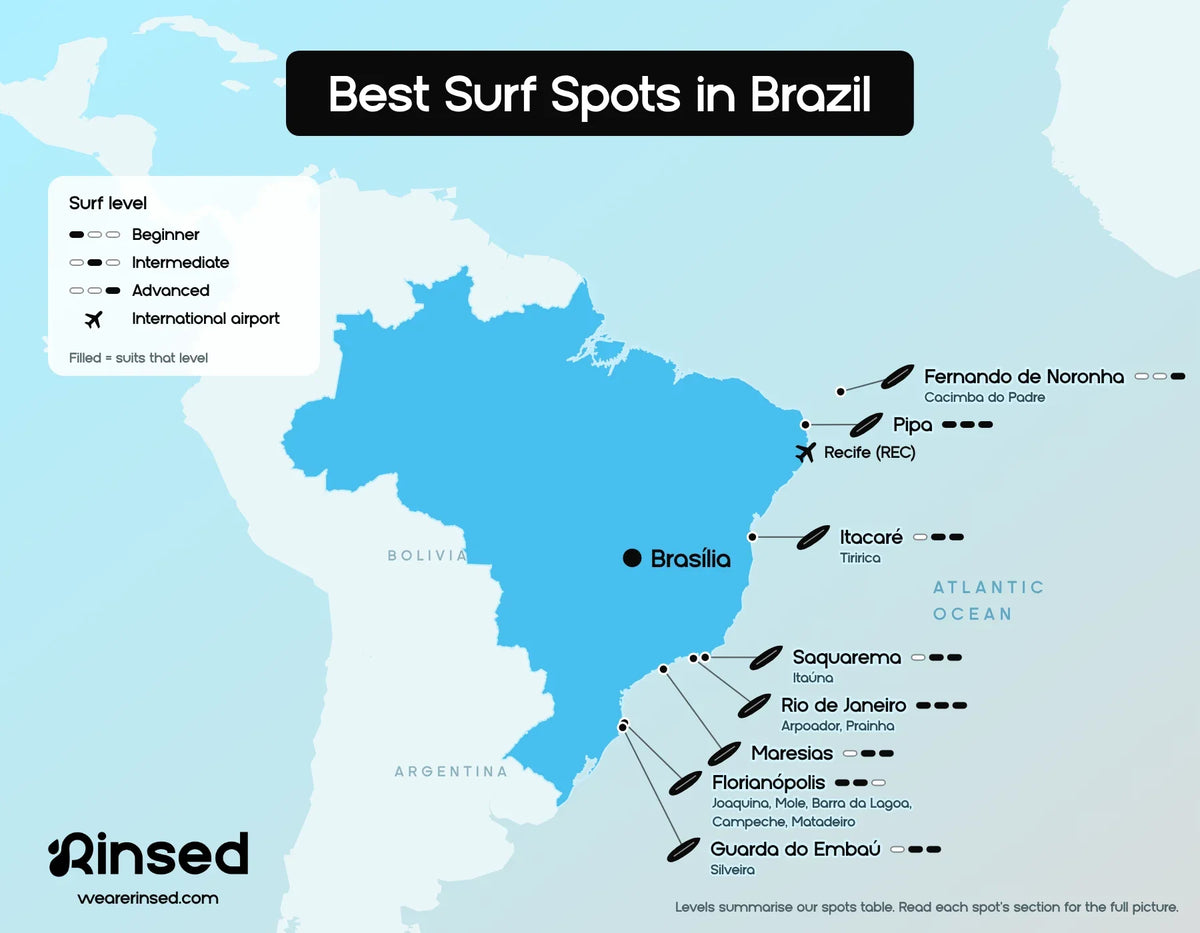
The best surf spots in Brazil sit in five areas: Joaquina, Praia Mole, Barra da Lagoa, Campeche and Matadeiro on Florianópolis, with Guarda do Embaú and Silveira just south in Santa Catarina; Maresias on the São Paulo coast; Arpoador, Prainha and Itaúna (Saquarema) around Rio de Janeiro; Tiririca in Itacaré and Pipa in the northeast; and Cacimba do Padre on the island of Fernando de Noronha.
Brazil is a big country with two surf seasons. Surf travel specialists put the best time for most of the coast, from Rio down to the south, between April and October, while Fernando de Noronha and the north pick up northern swells from November to March. The south needs a wetsuit in winter; the northeast is warm all year.
This guide is part of our wider guide to the best surfing destinations in South America, and it sits next to our guide to the best surf spots in Peru. It is a country overview: we cover the main regions and the breaks we could verify, with notes for beginners where the sources give them.
What are the best surf spots in Brazil?
This table covers fourteen breaks we could verify from surf forecasters, surf atlases and the national tourism board. "Works best on" comes from the surf forecasters' break pages. The level comes from the tourism board or a surf atlas where they give one; where the sources disagree or say nothing, we say so in the region sections. "Best months" is the forecasters' most consistent month and season.

| Spot | Area | Type | Level | Works best on | Best months |
|---|---|---|---|---|---|
| Joaquina | Florianópolis, Santa Catarina | Exposed beach break | Intermediate (dangerous rips) | SE swell, NW wind | Winter, most often June |
| Praia Mole | Florianópolis, Santa Catarina | Exposed beach break, lefts and rights | Intermediate (beginners on small days) | ESE swell, WNW wind | Winter, most often June |
| Barra da Lagoa | Florianópolis, Santa Catarina | Beach break, lefts and rights | Beginners | E swell, W to WSW wind, all tides | March to September |
| Campeche | Florianópolis, Santa Catarina | Beach break, favours rights | Not stated (strong rips) | S swell, NW wind | Winter, most often May |
| Matadeiro | South Florianópolis, Santa Catarina | River-mouth break, lefts | Intermediate | SE swell, SW wind | Spring, most often September |
| Guarda do Embaú | Palhoça, south of Florianópolis | River-mouth break, mainly lefts | Intermediate | SE swell, WNW wind, around low tide | Autumn and winter, most often June |
| Silveira | Garopaba, Santa Catarina | Point break | Advanced (rocks) | SE swell, WNW wind, all tides | Autumn and winter, most often June |
| Maresias | São Sebastião, São Paulo | Beach break, lefts and rights | Intermediate to advanced | S swell, N wind, all tides | Autumn, most often May |
| Arpoador | Ipanema, Rio de Janeiro | Beach break, mainly lefts | All levels | SE swell, NNE wind, all tides | Winter, most often May |
| Prainha | West zone, Rio de Janeiro | Beach and reef, lefts and rights | Intermediate and up (beginners on small days) | S swell, NW wind, all tides | Autumn, most often May |
| Itaúna | Saquarema, Rio de Janeiro state | Exposed beach break, lefts and rights | Intermediate to advanced | E swell, N wind, around low tide | Autumn and winter (stats favour January) |
| Tiririca | Itacaré, Bahia | Beach break, lefts and rights | Intermediate and up | E swell, WSW wind | All year, most often April |
| Pipa (Praia de Pipa) | Tibau do Sul, Rio Grande do Norte | Beach break | All levels | NE swell, SW wind, all tides | All year |
| Cacimba do Padre | Fernando de Noronha, Pernambuco | Beach break, favours rights | Experienced | NNW swell, SSE wind | November to March, most often February |
Almost every break page on this list warns about rips, and the wind decides more sessions than the swell does, so it pays to know how to read a surf forecast before you go.
Surfing in Florianópolis and Santa Catarina
Florianópolis is one of the most consistent surf regions in Brazil, with Barra da Lagoa for learning, Praia Mole, Joaquina and Matadeiro for intermediates, and Guarda do Embaú and Silveira a short drive south. Surf travel specialists call it the most consistent surf on Brazil's Atlantic side, and the season peaks in the southern winter, when the south and south-east groundswells arrive.
Joaquina is the island's best-known beach and, the tourism board says, a regular host of surf championships with strong waves. Surf forecasters call it a very consistent exposed beach break, best on a south-east swell with a north-west offshore wind, often crowded, with dangerous rips. A surf atlas rates it intermediate. June is its most consistent month, with clean waves about 28% of the time.
Praia Mole, just north of Joaquina, is a consistent beach break with lefts and rights, best on an east-south-east swell and a west-north-west wind. Forecasters say it is unlikely to be too crowded, even when the surf is up, but they also warn about dangerous rip currents. One surf atlas calls it good for all levels, another beginner to intermediate and more forgiving than Joaquina on smaller days. In June, its best month, forecasters count clean waves about 40% of the time.
Barra da Lagoa, further north where the lagoon meets the sea, is where most people learn. A surf atlas describes short lefts and rights over sand that suit beginners, working best at about 1 to 3 feet and closing out on bigger swells. A Brazil travel specialist adds that several schools there teach in English.
Campeche, on the south-east coast, is a fairly exposed beach break that favours rights, best on a south swell and a north-west wind. It gets busy when the surf is up, and the forecasters tell you to take care of the strong rips. No source we trust gives it a level, so we don't either.
Matadeiro, near Armação in the south of the island, is a small river-mouth break with lefts. Its break page says it is rarely crowded, with dangerous rips, and a surf atlas rates it best for intermediates because of the wave's power and the local crowd. Its break page disagrees with itself on swell direction and season, so watch the charts.
Guarda do Embaú, which the tourism board places about 40 km from downtown Florianópolis, is a river-mouth left with a relaxed village behind it. Forecasters call it very consistent, best around low tide on a south-east swell, and say it is often crowded, enough to make surfing hazardous. A surf atlas rates it intermediate.
Silveira, near Garopaba about 42 km south of Florianópolis airport as the crow flies, is a very consistent point break, good at all stages of the tide. Forecasters warn about rips and rocks, and a surf atlas lists it as advanced and not recommended for beginners.
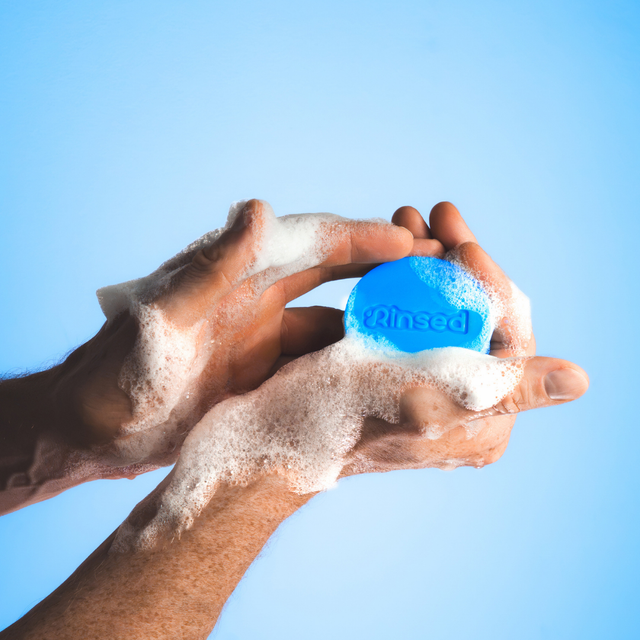
Moving between these beaches means a lot of time in the car with a damp wetsuit and a wet wash bag. A solid bar that does hair, body and face takes up almost no space and can't leak into the rest of your kit.

Shampoo, body and face wash, all in one bar. Cooling, refreshing and designed for those always on the go.
From Santa Catarina, the next big surf coast is a long way north, past São Paulo.
Surfing in São Paulo and Rio de Janeiro: Maresias, Arpoador, Prainha and Itaúna
The south-east coast mixes city surf in Rio with powerful beach breaks at Maresias and Saquarema, and it works best from autumn into winter on south and south-east swells.
Maresias, in São Sebastião on the São Paulo coast, is a very consistent beach break with lefts and rights, best on a south swell with a north wind, at any tide. The tourism board calls the waves powerful and consistent. Forecasters say it is often crowded and even suggest a helmet because of the crowds in the water. Forecasters' reviewers rate it 4 out of 5 for difficulty, so we put it at intermediate to advanced.
Arpoador, on the rocky point between Ipanema and Copacabana, is the classic city wave. The tourism board says it has waves of various sizes and shapes that suit both beginners and professionals. Forecasters list a consistent beach break, mainly lefts, best on a south-east swell with a north-north-east wind at any tide. Their page also tells you to be careful around local surfers and pollution, and it can get crowded. May is its most consistent month.
Prainha, in Rio's west zone between Recreio dos Bandeirantes and Grumari, is a small beach with beach and reef peaks. Forecasters call it very consistent, best on a south swell with a north-west wind, and note that summer tends to be mostly flat. They list localism and rips among the hazards and say smaller days may suit beginners, so we treat it as an intermediate wave that opens up to beginners only when it is small.
Itaúna, in Saquarema about 100 km east of Rio by road, is the wave that gave the town its nickname, "Capital Nacional do Surfing". The tourism board says its waves are often used for international competitions, and Saquarema joined the world tour circuit in 2017. Forecasters list a very consistent beach break with lefts and rights, best around low tide on an east swell with a north wind, with submerged rocks and crowds when it works. A surf atlas warns that the currents and power can challenge beginners, so we rate it intermediate to advanced; beginners should stick to quieter sections with an instructor.
Surfing in Bahia and the northeast: Itacaré and Pipa
The northeast trades cooler water for warm water all year, with Itacaré in Bahia and Pipa in Rio Grande do Norte as the two names that come up most.
Itacaré is a small town on the Bahia coast with a string of beaches backed by Atlantic rainforest. Tiririca is its main surf beach: forecasters list an exposed beach break with lefts and rights, best on an east swell with a west-south-west wind, that can work at any time of year and is most consistent in April. A Brazilian travel guide describes strong, frequent waves that have hosted competitions and are better for experienced surfers, while a surf atlas says all levels but warns the waves get hollow and fast in bigger swell. We settle on intermediate and up.
For beginners, the same guide points to Praia da Ribeira, with fairly gentle waves for people starting out, and Praia do Resende, among the calmest in town, especially at low tide. The rural beaches further south, such as Engenhoca and Itacarezinho, need a car, a taxi or a forest trail, and the guide warns that the beaches around town have strong currents: check the flags and follow the lifeguards.
Pipa, about 85 km south of Natal, is known for its cliffs and clear water. The tourism board says it suits all levels, from gentler waves for beginners to challenges for experienced surfers, with consistent waves all year. Forecasters list a very consistent beach break, best on a north-east swell with a south-west wind at any tide, and they mention localism.
Surfing in Fernando de Noronha: Cacimba do Padre
Fernando de Noronha is an archipelago 545 km off Recife, and Cacimba do Padre is its headline wave: a powerful beach break for experienced surfers that works best on northern swells from November to March.
The tourism board says the island's beaches Cacimba do Padre and Boldró are for experienced surfers, with tubing waves. A surf forecaster's guide goes further and calls Cacimba an expert's wave, advising beginners to stay closer to town. Forecasters list an exposed beach break that favours rights (though one surf travel specialist describes a barrelling left), best on a north-north-west swell with a south-south-east wind, rarely crowded, with dangerous rips. In February, its most consistent month, they count clean waves about 49% of the time.
Two charges apply on Noronha, and they are easy to mix up. The island's administration charges every non-resident visitor an environmental preservation fee, the Taxa de Preservação Ambiental (TPA). It is charged per person per day and rises with the length of your stay. A Pernambuco newspaper reports that it can be paid online, ideally before you travel, and that visitors with foreign-issued credit cards have to pay at the airport counter. Separately, the marine national park sells an access ticket for the beaches and trails inside the park. Cacimba do Padre and Boldró are outside the park, in the environmental protection area, so you don't need the park ticket just to surf there. We leave the amounts out on purpose: check the official sites for the current rates before you book.
When is the best time to surf in Brazil?
For Rio, São Paulo and Santa Catarina, aim for April to October; for Fernando de Noronha, November to March; for Itacaré and Pipa, any time of year. The forecasters' month-by-month data agrees with the surf travel specialists: June is the most consistent month at Joaquina, Praia Mole, Guarda do Embaú and Silveira, May at Arpoador, Prainha and Maresias, April at Tiririca, and February at Cacimba do Padre.
If you want warm water and waves in our winter, Noronha in February is one of the stronger options in our guide to warm-water winter surf trips.
Average sea temperatures below are long-term monthly data; the wetsuit advice comes from the surf forecasters and the sea temperature sites.
| Months | Water, Florianópolis | Water, Rio de Janeiro | Water, Itacaré | Water, Fernando de Noronha | Wetsuit |
|---|---|---|---|---|---|
| December to March | 24 to 26°C | 24.1 to 25.9°C | 27 to 29°C | 27 to 29°C | Rash vest and boardshorts at the warmest point |
| April and May | 22 to 24°C | 24.2 to 25.5°C | 28 to 29°C | 29°C | No wetsuit in the north; a thin shorty for long sessions further south |
| June to September | 18 to 20°C | 21.3 to 23.1°C | 25 to 27°C | 27 to 28°C | 3/2 full suit in Florianópolis in August; a thin shorty in Rio for long sessions |
| October and November | 21 to 22°C | 22.5 to 23.1°C | 26°C | 27°C | Summer wetsuit in the south, none in the north |
Forecasters note that water near the shore can differ by several degrees from these averages, especially after heavy rain or near river mouths, which matters at Guarda do Embaú and Matadeiro. For the warm end of the trip, see our guide to surfing without a wetsuit, and for the south in winter, our wetsuit thickness guide.
Is Brazil good for beginner surfers?
Yes, if you pick the right beach and take lessons: Barra da Lagoa, Praia Mole on small days, Arpoador, Pipa and the town beaches in Itacaré are the easiest places to start. A Brazil travel specialist also suggests Praia do Rosa in Santa Catarina, with gentle waves in a sheltered spot, and the quieter sections of Saquarema with experienced instructors.
Sources disagree on Praia da Concha in Itacaré: one calls it excellent for first attempts, another a pool-like beach with almost no waves, so ask a local school which beach is working that day. Cacimba do Padre, Silveira and Itaúna on a solid day are not places to learn.
Rips, lifeguards and staying safe
Rips are the main hazard on Brazilian beaches, and the advice from the Santa Catarina fire brigade's lifeguards is clear: don't fight the current. They explain that rip currents pull people out of shallow water within seconds, and that the danger is exhaustion, not the current dragging you under. If you are caught, don't swim against it: wave for a lifeguard, then swim parallel to the beach or float until help arrives. Where lifeguards work, red flags mark the areas with rip currents.
On land, the Dutch government's travel advice warns that robberies often happen at tourist spots in Rio, including the beaches, and advises against dark or deserted beaches. Don't leave a bag on the sand while you surf.
Getting to Brazil from Amsterdam, Brussels and Paris
Fly long haul into Rio de Janeiro or São Paulo, then take a domestic flight or drive to the surf; from Paris there are more direct options, including Salvador and Fortaleza in the northeast.
From Amsterdam. KLM's route page lists flights from Amsterdam to São Paulo, Rio de Janeiro and Curitiba when we checked in October 2026.
From Paris. A French travel site lists non-stop Air France flights from Paris Charles de Gaulle to Rio de Janeiro, São Paulo, Salvador and Fortaleza, and notes that schedules change every season. A Brazilian travel news site reports that Air France has announced a temporary pause on its Salvador route in 2027, so check the current schedule before you book.
From Brussels. We couldn't confirm a direct flight to Brazil from Brussels, so connect via Amsterdam, Paris or Lisbon. For Florianópolis, a Brazilian aviation news site reports that TAP has flown directly between Lisbon and Florianópolis since 2024; otherwise you connect through São Paulo or Rio.
To the surf. Saquarema is about 100 km east of Rio by road. Itacaré is 64 km from Ilhéus airport, which has domestic flights. For Pipa, fly to Natal. Fernando de Noronha is reached by small domestic flights, mainly from Recife; routes have changed several times recently, and Azul suspended its Natal route in 2025, so check the airlines before you plan.
Entry. The Dutch government says you don't need a visa for a stay of up to 90 days on a Dutch passport, and that your passport must be valid for your whole stay. Belgian and French travellers should check their own government's travel advice before booking.
With a long-haul flight and one or two domestic hops, hand luggage keeps things simple. One solid bar for hair, body and face isn't a liquid at airport security, so it stays out of the plastic bag.

Shampoo, body and face wash, all in one bar. Keep your hair and skin healthy on the go. Monoï-infused scent with a touch of vanilla. Designed for those always on the go.
Our guide on whether you can take soap on a plane has the detail. Once you land, the next question is where to base yourself.
Where to stay for surfing in Brazil
Base yourself near the beach you want to surf, because distances are big and traffic is slow: Barra da Lagoa or Lagoa da Conceição on Florianópolis, Saquarema town for Itaúna, Itacaré town for Tiririca, and Pipa village for Pipa.
Florianópolis: Barra da Lagoa has the beginner beach and the surf schools on its doorstep. Lagoa da Conceição, which the tourism board names for its nightlife, sits between the east coast beaches. Guarda do Embaú is a quieter base for the south, which the tourism board describes as a tranquil retreat with a welcoming community.
Rio and Saquarema: Arpoador is a walk from anywhere in Ipanema. Prainha is far west of the centre, so plan for a car, and if Itaúna is the goal, stay in Saquarema.
Itacaré: the town beaches, including Tiririca and Ribeira, are a walk from the centre, so you can manage without a car. The rural beaches need a car or a taxi.
Showers, wetsuits and washing up
Plan your washing around proper showers and drains, not the beach. Don't rinse shampoo or soap directly into the ocean or into beach showers that drain to the sea. Lather only where the water goes into a drain: a campsite, a surf camp, a hostel or your accommodation.
In the south in winter, a full suit that stays damp in a hot car for days starts to smell. Our guides on how to rinse off after a surf and packing a carry-on surf wash kit help. For your own shower, one bar in a damp wash bag is simpler than three bottles.
Shampoo, body and face wash, all in one bar. Cooling, refreshing and designed for those always on the go.
With the washing sorted, the last thing is how you behave in the water and on land.
Surfing in Brazil: locals and the environment
Respect the locals
Brazil has a huge surf community, and the best-known breaks are busy. The forecasters' pages mention locals or localism at Arpoador, Prainha and Pipa, and heavy crowds at Joaquina, Guarda do Embaú and Maresias. Wait your turn, don't drop in, paddle wide of the peak, and be honest about your level before you paddle out at a crowded wave. Our surf etiquette guide covers the basics.
Respect the environment
Fernando de Noronha has the clearest rules. The island's administration bans single-use plastics and asks visitors to use reusable bags, cups and straws, to use the bins and never leave rubbish on land or in the sea, not to feed, touch, chase or deliberately swim with wild animals, and not to take shells, stones or coral. About 70% of the archipelago is inside the marine national park, which needs its own ticket.
Everywhere else, take your rubbish with you. For sun protection on any surf trip, see our guide to sunscreen rules for surf trips.
Summary
Brazil has two surf trips in one country. From April to October, go south: Florianópolis for consistency and lessons, Guarda do Embaú and Silveira just beyond, and Maresias, Rio and Saquarema further north, with a 3/2 in the southern winter. From November to March, go north to Fernando de Noronha for Cacimba do Padre, with the island's daily environmental fee paid before you fly. Itacaré and Pipa work all year in warm water. Compare with Peru and the rest of South America.
Frequently asked questions
Where is the best surfing in Brazil?
The main regions are Florianópolis and the Santa Catarina coast, the São Paulo and Rio de Janeiro coast with Maresias, Arpoador, Prainha and Itaúna in Saquarema, Itacaré and Pipa in the northeast, and Cacimba do Padre on Fernando de Noronha.
Where can beginners learn to surf in Brazil?
Barra da Lagoa on Florianópolis is the classic learning beach, with several schools. Arpoador in Rio and Pipa in Rio Grande do Norte are described by the tourism board as suitable for beginners too, and Itacaré has gentle town beaches such as Ribeira and Resende.
Which beach in Florianópolis is best for surfing?
Joaquina is the best known and hosts championships, Praia Mole is often less crowded and works on smaller days, and Barra da Lagoa is the beginner beach. Forecasters warn about dangerous rips at Joaquina, Praia Mole and Campeche.
Is Fernando de Noronha good for beginners?
Not at Cacimba do Padre. The tourism board says its waves are for experienced surfers, and one forecaster calls it an expert's wave and advises beginners to stay closer to town.
When is the best time to surf in Brazil?
April to October for the south and south-east, including Florianópolis, Rio and Saquarema. November to March for Fernando de Noronha and the north. Itacaré and Pipa can work all year.
When is the surf season in Fernando de Noronha?
November to March, when northern swells arrive. Forecasters name February as the most consistent month at Cacimba do Padre, with clean waves about half the time.
Do I need a wetsuit to surf in Brazil?
In the northeast and on Noronha, no: average water stays around 25 to 29°C all year. In Florianópolis in winter, the water drops to about 18°C and forecasters suggest a 3/2 full suit in August. In Rio, a thin shorty helps on long winter sessions.
How cold is the water in Florianópolis?
Long-term averages run from about 26°C in January to February down to about 18°C in July and August.
How do I get to Brazil for a surf trip from the Netherlands, Belgium or France?
KLM's route page lists flights from Amsterdam to Rio, São Paulo and Curitiba, and Air France flies non-stop from Paris to Rio, São Paulo, Salvador and Fortaleza. From Brussels, connect via Amsterdam, Paris or Lisbon; TAP flies directly from Lisbon to Florianópolis. Routes change, so check before you book.
Do I have to pay a fee to visit Fernando de Noronha?
Yes. Every non-resident visitor pays a daily environmental preservation fee (TPA), which rises with the length of stay and should be paid online before you travel. The marine national park has a separate ticket for its beaches and trails, but Cacimba do Padre and Boldró are outside the park. Check the official sites for current rates.
Do Dutch travellers need a visa for Brazil?
The Dutch government says not for a stay of up to 90 days, and your passport must be valid for your whole stay. Belgian and French travellers should check their own government's travel advice.
Sources
The facts in this article are based on the sources below, checked in October 2026.
- Surfing in Brazil: Must-Visit Destinations for Wave Lovers. Visit Brasil, 2024.
- Brazil Surf Travel Guide. Perfect Wave Travel, 2026.
- Joaquina surf guide. Surf-Forecast, 2026.
- Praia Mole surf guide. Surf-Forecast, 2026.
- Campeche surf guide. Surf-Forecast, 2026.
- Matadeiro surf guide. Surf-Forecast, 2026.
- Guarda do Embau surf guide. Surf-Forecast, 2026.
- Silveira surf guide. Surf-Forecast, 2026.
- Maresias surf guide. Surf-Forecast, 2026.
- Arpoador surf guide. Surf-Forecast, 2026.
- Prainha (Rio de Janeiro) surf guide. Surf-Forecast, 2026.
- Itaúna surf guide. Surf-Forecast, 2026.
- Tiririca surf guide. Surf-Forecast, 2026.
- Praia de Pipa surf guide. Surf-Forecast, 2026.
- Cacimba do Padre surf guide. Surf-Forecast, 2026.
- Joaquina water temperature and wetsuit guide. Surf-Forecast, 2026.
- Joaquina surf guide. Mondo Surf, 2026.
- Praia Mole surf guide. Mondo Surf, 2026.
- Barra da Lagoa surf guide. Mondo Surf, 2026.
- Matadeiro surf guide. Mondo Surf, 2026.
- Guarda do Embau surf guide. Mondo Surf, 2026.
- Praia do Silveira surf guide. Mondo Surf, 2026.
- Maresias surf guide. Mondo Surf, 2026.
- Arpoador surf guide. Mondo Surf, 2026.
- Prainha (Rio de Janeiro) surf guide. Mondo Surf, 2026.
- Itaúna surf guide. Mondo Surf, 2026.
- Tiririca surf guide. Mondo Surf, 2026.
- Pipa surf guide. Mondo Surf, 2026.
- Cacimba do Padre surf forecast and guide. Surfnerd, 2026.
- Surfing in Florianópolis. Tripbase, 2026.
- Surfing in Brazil for beginners: the best places to learn. Aventura do Brasil, 2026.
- Praias de Itacaré. 360meridianos, 2026.
- Planning a trip to Itacaré. Frommer's, 2026.
- Saquarema. Wikipedia, 2026.
- Informações turísticas. Administração de Fernando de Noronha, 2026.
- Viajante comprometido. Administração de Fernando de Noronha, 2026.
- Visitante. Parque Nacional Marinho de Fernando de Noronha, 2026.
- Turistas passam a pagar mais caro pela Taxa de Preservação Ambiental em Noronha. Diario de Pernambuco, 2026.
- Acesso aéreo para Noronha será apenas por Recife e Fortaleza. Movimento Econômico, 2025.
- Flights from Amsterdam to Brazil. KLM, 2026.
- Quelles sont les destinations desservies par Air France en 2026 ?. Milesopedia, 2026.
- Air France anuncia a suspensão temporária dos voos entre Salvador e Paris. Passageiro de Primeira, 2026.
- Floripa Airport atinge marca histórica de 1 milhão de passageiros internacionais em 2025. Panrotas, 2025.
- Reisadvies Brazilië. Nederland Wereldwijd, 2026.
- Como identificar as correntes de retorno, responsáveis pela maioria dos afogamentos em SC. NSC Total, with the Corpo de Bombeiros Militar de Santa Catarina, 2026.
- Florianópolis sea temperature. Seatemperature.net, 2026.
- Rio de Janeiro sea temperature. Seatemperature.org, 2026.
- Itacaré sea temperature. Seatemperature.net, 2026.
- Fernando de Noronha sea temperature. Seatemperature.net, 2026.