

Note to travelling surfers
- Ecosystem first. Be kind to the environment you’re visiting: don’t leave any trash behind.
- Be kind to locals. Every lineup has an order and it was earned over years. Wait your turn, and respect local etiquette.
- Fly less, stay longer. The flight is the biggest impact of any surf trip. Two weeks once beats one week twice!
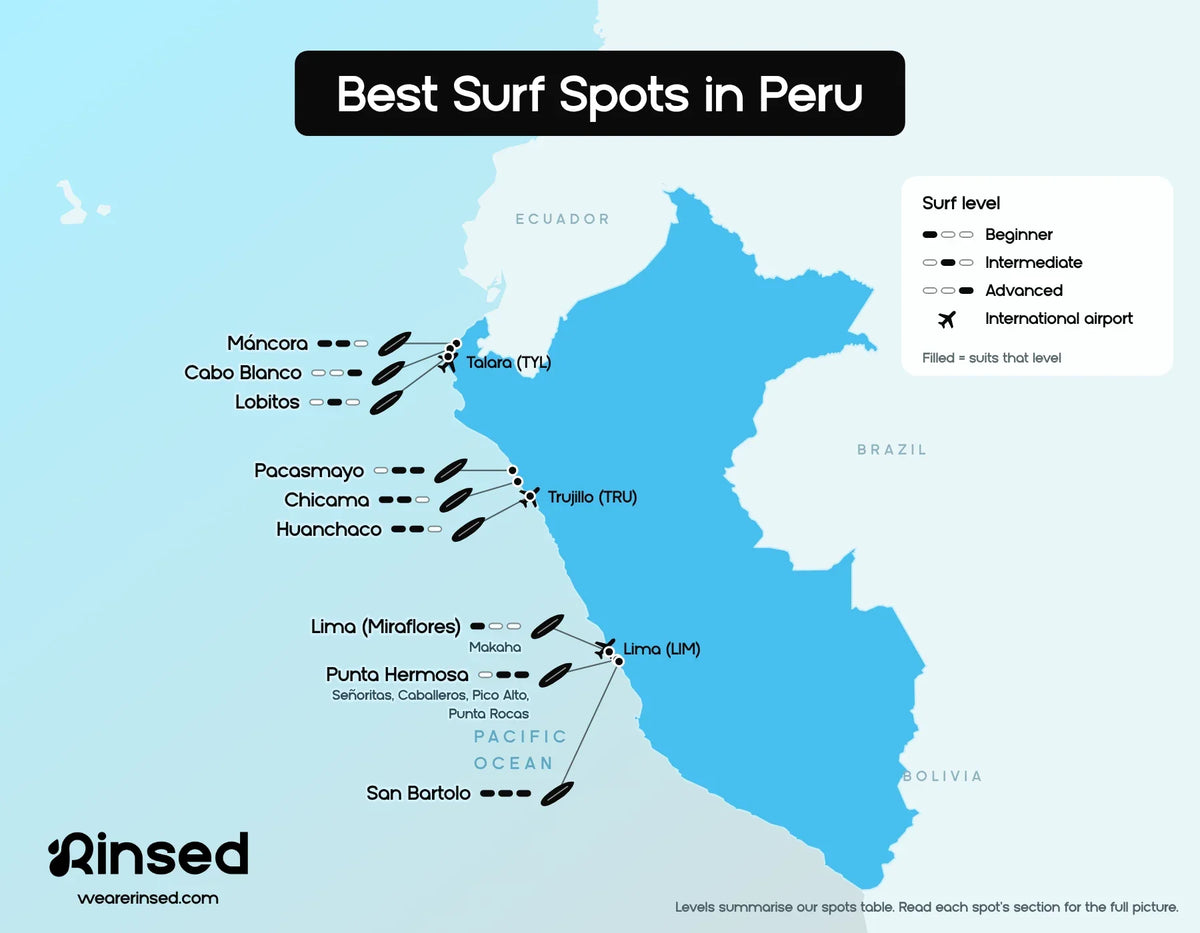
The best surf spots in Peru sit in two regions: in the north, Chicama, Pacasmayo and Huanchaco in La Libertad, and Lobitos, Cabo Blanco and Máncora in Piura; and around Lima, Señoritas, Caballeros, Pico Alto and Punta Rocas near Punta Hermosa, San Bartolo further south, and Makaha on the Miraflores beaches in the city itself.
Peru is a left-hand point country. Chicama, the headline wave, is widely called the longest left in the world, and most of the north coast is a string of rocky points that peel the same way. The water is cooler than the latitude suggests because of the cold Humboldt Current, so for most of the year you will want a wetsuit, even close to the equator.
This guide is part of our wider guide to the best surfing destinations in South America, and it sits next to our guide to the best surf spots in Brazil. It is written for surfers of every level, with clear notes on which breaks are for learners and which are not.
What are the best surf spots in Peru?
This table covers twelve breaks we could verify on surf forecasters' break pages, Peruvian adventure guides and surf travel guides. "Works best on" comes from the forecasters. The level comes from the spot guides; where they disagree, we explain it in the section below. "Best months" follows the spot guides' main season.

| Spot | Area | Type | Level | Works best on | Best months |
|---|---|---|---|---|---|
| Chicama (Puerto Malabrigo) | Puerto Malabrigo, La Libertad | Long left point, several sections | Beginner to intermediate | SSW swell, ENE wind, all tides | April to October |
| Pacasmayo | Pacasmayo, La Libertad | Left point and reef | Intermediate and up | SSW swell, NE wind, low to mid tide | April to September |
| Huanchaco (Punta Huanchaco) | Huanchaco, near Trujillo | Left point, plus reef and pier waves | Beginner to intermediate | SSW swell, easterly wind, all tides | March to October |
| Lobitos | Lobitos, near Talara | Left point and reef | Intermediate | SSW or NW swell, ESE wind | April to September |
| Cabo Blanco | El Alto, Piura | Hollow left over shallow reef | Advanced (shallow reef) | NNW swell, ESE wind | November to March |
| Máncora | Máncora, Piura | Left point | Beginner to intermediate | NW swell, ESE wind, any tide | All year |
| Señoritas | Punta Hermosa, south of Lima | Left reef point | Advanced | SSW swell, NE wind | April to October |
| Caballeros | Punta Hermosa, south of Lima | Right reef point | Intermediate | SSW swell, ENE wind, all tides | All year |
| Pico Alto | Punta Hermosa, south of Lima | Big-wave outer reef, mainly rights | Expert | SSW swell, E wind, all tides | April to October, peak around August |
| Punta Rocas | Punta Negra, south of Lima | Reef point, mainly rights | Intermediate and up | SSW swell, E wind | April to October |
| San Bartolo | San Bartolo, south of Lima | Reef, lefts and rights | All levels | SSW swell, ENE wind, mid to high tide | All year |
| Makaha | Miraflores, Lima | Boulder and sand break, lefts and rights | Beginner | SW swell, ENE wind, all tides | All year |
Peru's points need the swell angle and the wind to line up, so it pays to know how to read a surf forecast before you choose where to base yourself.
Surfing in La Libertad: Chicama, Pacasmayo and Huanchaco
The coast north of Trujillo is where Peru's long lefts live: Chicama is the famous one, Pacasmayo is the faster and heavier neighbour, and Huanchaco is the friendly town you can base yourself in. All three are best from about April to October, when the southern hemisphere swells arrive.
Chicama breaks at Puerto Malabrigo, a fishing port that surfers still call Puerto Chicama. The length claims depend on who you read, so here they are as each source states them. SurferToday says the left peels for up to 2.5 miles (four kilometres) and that a perfect ride could last four minutes. Peruvian adventure guide Deaventura gives a 2 km ride. The Surf Atlas says rides can reach about 4,000 m on the best days, but that most people spend their time on Keys, a section of about 600 m. What every source agrees on: it rarely links up from end to end, so a full run usually means three or four separate rides. Surf-Forecast lists it as best on a south-south-west groundswell with an east-north-east wind, says it is rarely crowded, and warns about rocks.
The sections have their own names. Guinness World Records lists four: Malpaso, Keys, El Point and El Hombre. SurferToday names five: La Isla, El Cape, El Point, El Hombre and El Pueblo. The Surf Atlas calls Malpaso the heaviest and the main point the mellowest. On level, the guides lean friendly: SurferToday says an average intermediate surfer can enjoy it fully, and Deaventura's top ten list rates it beginner to intermediate. The Surf Atlas calls it accessible for intermediates and up, and a midlength board's dream. We like that mix: it's a wave where an improving surfer can link more turns on one wave than on a whole week at home.
Chicama also has a place in law. Peru's official state newspaper says Peru was the first country with a law protecting its surf breaks, the Ley de Rompientes of 2000, and that Chicama was the first wave to be protected under it, in 2016.
Pacasmayo sits just north of Chicama and is the more serious of the two. Deaventura describes a long, well-formed left point with a tubular section that surfers compare to a train, and puts it at intermediate to advanced. Mondo.surf says it is fast and powerful, with a strong current that gets stronger as the swell grows, and suggests booties for the reef. Surf-Forecast warns of submerged rocks and says it is rarely crowded.
Huanchaco is a beach town a short ride from Trujillo and the easiest place in the north to learn. The Surf Atlas lists several waves here: La Curvita, a mellow left just inside the pier that is the town's main learner wave, and Punta Huanchaco, a longer left off the headland for intermediates and longboarders, with shifty peaks and strong rips. Surf-Forecast says it works at all stages of the tide and warns about urchins and pollution. Huanchaco was dedicated as a World Surfing Reserve in 2013, the first in Latin America. The Peruvian state news agency Andina says its ocean heritage goes back more than 3,000 years and calls it the birthplace of the caballito de totora, the reed craft local fishermen still paddle out to fish near the shore.
A Chicama trip is usually a few days in one town with a damp wetsuit and a wash bag that never quite dries. One bar for hair, body and face takes up almost nothing in that bag and has no cap to come loose.

Shampoo, body and face wash, all in one bar. Cooling, refreshing and designed for those always on the go.
From La Libertad, the far north is a domestic flight or a long bus ride away, and the water gets a little warmer.
Surfing in Piura: Lobitos, Cabo Blanco and Máncora
The far north has three very different waves within an hour of each other: Lobitos for intermediates, Cabo Blanco for experts, and Máncora as the easy-going beach town where beginners can start.
Lobitos is a small town near Talara with a cluster of left points. The Surf Atlas describes the main point, La Punta, as consistent and forgiving for intermediates, with a tricky take-off over rocks, and says the heavier waves further along, Baterías and El Hueco, are for intermediate-plus and advanced surfers. Deaventura rates Lobitos intermediate. Its best season is April to September, when southern hemisphere swells are bigger and more reliable, and the Surf Atlas says December to March has smaller waves that suit beginners better. Surf-Forecast warns about rocks in the line-up and says it is rarely crowded.
Cabo Blanco is the one to watch rather than paddle out at unless you are very sure of yourself. Deaventura says it is not suitable for beginners and describes a tubular left breaking close to the reef. Surfnerd calls it an expert-only wave, heavy and fast, with late take-offs straight into the barrel. Unlike most of Peru, it works best in the southern summer, roughly November to March, on a north-north-west swell. Surf-Forecast says it is often crowded and warns of rocks and rips.
Máncora is the busiest beach town on this coast. The Surf Atlas calls its main point a mini version of the bigger northern lefts, suited to beginners through intermediates, generally not very busy and easy to reach, and says nearby Pocitas has mellow waves for beginners and longboarders. Surf-Forecast says Máncora can get crowded when it works, that the tide doesn't matter much, and to watch out for rocks. It has waves all year.
We'd pick Lobitos for an intermediate who wants a week of reps on a good left, and Máncora for a mixed group where some of you are still learning.
Surfing near Lima: Punta Hermosa, San Bartolo and Miraflores
Lima is one of the few capital cities where you can surf before breakfast: Makaha in Miraflores for learners, and the reefs of Punta Hermosa, Punta Negra and San Bartolo about an hour south for everyone else.
Señoritas and Caballeros share one bay in Punta Hermosa. Most sources describe Señoritas as the left and Caballeros as the right; Surfnerd calls Caballeros a right-hand reef point and a great intermediate wave, and says Señoritas, the left off the southern headland, is for expert surfers, with a long paddle, strong currents, urchins and barnacles. Deaventura says Señoritas is suitable for all levels, but recommends it for advanced surfers in the best swell season. Surf-Forecast's pages list lefts and rights at both and warn about rips, rocks and urchins. The line-ups get busy, especially at weekends.
Pico Alto breaks about 800 metres offshore from the same stretch of coast, and it is Peru's big-wave spot. Deaventura gives waves of 8 to 10 metres in high season, recommends it for professionals once it is big, and names August as the peak. You get there through Señoritas beach. For everyone else, it's a place to watch from the shore.
Punta Rocas, in the district of Punta Negra, is the most consistent break in the area according to Culture Trip, and one of the most crowded. Deaventura says it is only recommended for surfers of intermediate level and above. Surfnerd describes thick, powerful rights over an uneven reef, with tubier lefts on smaller south-west swells, and warns of fishing lines on the inside.
San Bartolo, a little further south, is the gentlest of these reefs. Mondo.surf lists it as good for all levels, with usually small lefts and rights over boulders, short rides and urchins at the entry, and says weekdays are quiet. Its neighbour Peñascal is a different story: Surfnerd rates it advanced.
Makaha sits below the cliffs of Miraflores, next to Waikiki and Redondo. Surfnerd calls it a good place to learn, with rolling, slopey walls over boulders and sand, and Deaventura's top ten rates it beginner. Culture Trip says Waikiki next door is the place to go for beginners, with surf schools on the beach renting boards and wetsuits. Surf-Forecast warns about rocks, buoys and pollution at both. If you are only in Lima for a couple of days, this is where we would book a lesson.
When is the best time to surf in Peru?
For most of the spots in this guide, April to October: the Peruvian winter, when long south and south-west groundswells hit the points. Deaventura gives April to October as the best season for Chicama, Pacasmayo, Señoritas, Pico Alto and Punta Rocas. The exceptions are in the far north: Cabo Blanco works best from November to March, and Máncora has waves all year. December to March is also when the Surf Atlas says Lobitos is smallest and kindest for beginners.
The water is the surprise. Britannica describes the Peru Current, also called the Humboldt Current, as a cold-water current that brings deep water to the surface along the coast and helps make it one of the driest regions in the world. Máncora, at about four degrees south of the equator, is the warm exception at around 22 to 25°C all year, while Lima drops to about 16°C in late winter. The Dutch government's travel advice notes that El Niño brings warmer seawater, and heavy rain mainly from December to April.
Average sea temperatures below are long-term averages; wetsuit advice combines the forecasters' and spot guides' recommendations.
| Months | Water, Máncora | Water, Huanchaco | Water, Lima | Wetsuit |
|---|---|---|---|---|
| January to March | 24.4 to 25.5°C | about 21 to 23°C | 21.8 to 22.3°C | Boardshorts or a shorty in the north, a spring suit in Lima |
| April and May | 23.8 to 24.4°C | about 21 to 22°C | 19.8 to 20.7°C | Shorty or spring suit, a 3/2 for long sessions |
| June to August | 22.0 to 23.3°C | about 17.5 to 19.5°C | 16.3 to 18.8°C | 3/2 full suit; 4/3 at Chicama and Huanchaco if you feel the cold |
| September and October | 22.2 to 22.5°C | about 17°C | 15.9 to 16.8°C | The coldest months: 4/3, or a 3/2 with 3 mm boots |
| November and December | 22.6 to 23.2°C | about 18 to 20°C | 18.2 to 20.0°C | 3/2 or spring suit |
Forecasters note that the water near the shore can differ by several degrees from these averages. For more on choosing a suit, see our wetsuit thickness guide.
Is Peru good for beginner surfers?
Yes, if you pick the right beach: Makaha and Waikiki in Lima, Huanchaco's inside wave, Máncora, and San Bartolo on small days are the sources' beginner picks. Chicama on a small, clean day is also rated beginner-friendly by some guides, a rare chance for a learner to ride a point wave.
Peru's points almost all break over rock, boulders or reef, and the guides keep coming back to urchins, so booties are worth packing. Culture Trip's Punta Hermosa guide says the big waves there are not for novices. Pico Alto, Cabo Blanco, Señoritas in the swell season and El Hueco at Lobitos are for experienced surfers only.
The RNLI's advice on rip currents is worth knowing before any trip: don't swim against the current, hold onto your board, swim parallel to the shore until you are out of it, and raise a hand and shout for help. If it's your first surf trip, our guide to what to expect at your first surf camp helps.
Getting to Peru from Amsterdam, Brussels and Paris
Fly into Lima's Jorge Chávez International Airport, then take a domestic flight north: Trujillo for Huanchaco and Chicama, Talara for Lobitos, Cabo Blanco and Máncora.
Flying to Lima. The airport opened a new terminal in June 2025. Its route list on Wikipedia, which we checked in October 2026, shows KLM flying from Amsterdam and Air France from Paris Charles de Gaulle, with several airlines from Madrid. It lists no direct flight from Brussels, so from Belgium you connect through Amsterdam, Paris or Madrid. Routes change, so check before you book.
Flying north. The same list shows domestic flights from Lima to Trujillo, Talara, Piura, Tumbes and Chiclayo with Peruvian airlines including LATAM and JetSMART. Surf-Forecast puts Trujillo airport about 2 km from Huanchaco and about 57 km from Chicama, and Talara airport about 14 km from Lobitos and about 57 km from Máncora.
Getting to Punta Hermosa. Deaventura's directions take you south from Lima on the Panamericana Sur to kilometre 36, then onto the old Panamericana for Señoritas and Pico Alto. The Dutch government advises using only official taxis booked through a company, your hotel or an app, not taxis hailed on the street. The same advice notes that a state of emergency is in force in Lima and Callao because of rising violence and serious crime, so check the latest advice before you go.
Entry. The Dutch government says Dutch passport holders don't need a visa for a tourist stay of up to 90 days, and the passport must be valid for at least six months on arrival. If you travel on a Belgian or French passport, check your own government's travel advice before you go.
Two flights there and a domestic hop north is a hand-luggage trip if you can manage it. A solid bar isn't a liquid at airport security, so it stays out of the little plastic bag.

Shampoo, body and face wash, all in one bar. Keep your hair and skin healthy on the go. Monoï-infused scent with a touch of vanilla. Designed for those always on the go.
Our guides on whether you can take soap on a plane and packing a carry-on surf wash kit have the detail. Once you land, the next question is where to sleep.
Where to stay for surfing in Peru
Stay in the town next to the wave: Puerto Malabrigo or Huanchaco for Chicama, Lobitos or Máncora in the far north, Punta Hermosa or San Bartolo south of Lima, and Miraflores if you want the city.
Chicama and Huanchaco: the Surf Atlas recommends staying in Puerto Malabrigo itself, and notes that boats wait at the end of the ride to take surfers back to the take-off. Huanchaco has more choice of places to stay and surf schools, and the Surf Atlas says surf camps there run day trips to Chicama when the swell lines up.
Lobitos and Máncora: in Lobitos, the Surf Atlas suggests staying right in front of the main point so you can surf early, when conditions are usually best. Máncora is the bigger town, with more places to eat and sleep, and Lobitos and Cabo Blanco are within driving distance.
Lima: Miraflores puts you on the cliffs above Makaha and Waikiki. For the reefs, Punta Hermosa is the base; Culture Trip mentions a hotel that looks straight onto the La Isla wave.
Showers, wetsuits and washing up
Plan your washing around proper showers and drains, not the beach. Don't rinse shampoo or soap directly into the ocean or into beach showers that drain to the sea. Lather only where the water goes into a drain: your hostel, surf camp or hotel shower.
Don't count on a beach shower: none of our sources mention them at these breaks. The north coast is desert, so a big bottle of fresh water in the car or the room is useful for rinsing salt off your wetsuit and feet. Our guides on how to rinse off after a surf and how to get rid of wetsuit smell help, because a wetsuit that never fully dries between sessions starts to smell within days.
In a shared hostel bathroom, one bar in a small wet bag is simpler than three bottles on a crowded shelf.
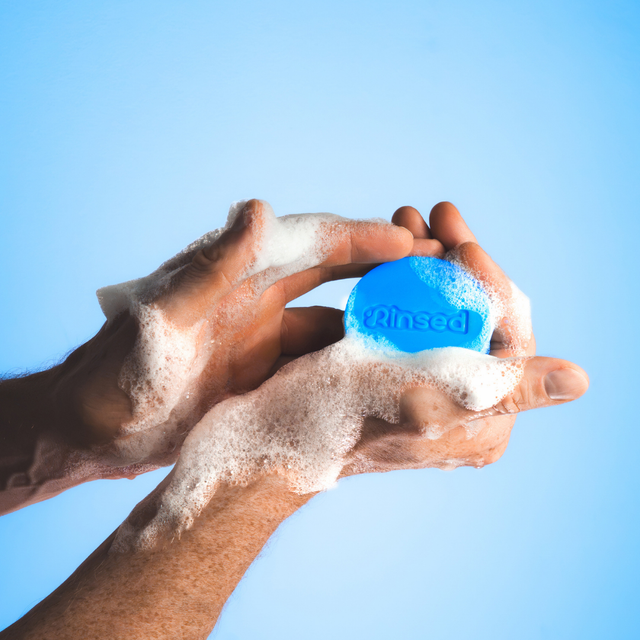
Shampoo, body and face wash, all in one bar. Cooling, refreshing and designed for those always on the go.
With the washing sorted, the last thing is how you behave in the water and on land.
Surfing in Peru: locals and the environment
Respect the locals
The forecasters say several of Peru's best-known line-ups get crowded, Punta Rocas, Señoritas, Caballeros and Cabo Blanco among them, and in all of them you are a guest. Wait your turn, don't drop in, paddle wide of the peak, and don't take every wave on a point where everyone is waiting for the same set. Our surf etiquette guide covers the basics.
At Huanchaco and Puerto Malabrigo the beach is also a workplace. Give the fishermen and their reed boats room when they launch and land.
Respect the environment
Peru protects its surf breaks by law, and Chicama was the first wave registered under it. The state newspaper says 43 waves are now protected, with a goal of 100 by 2030. Forecasters list pollution as a hazard at Huanchaco, Makaha and Waikiki, which is one more reason to take every piece of rubbish home or to a bin, and to keep sunscreen and soap out of the sea. Our guide to sunscreen rules for surf trips covers the first.
Summary
Peru has two surf regions worth the long flight: the north, with Chicama, Pacasmayo and Huanchaco in La Libertad and Lobitos, Cabo Blanco and Máncora in Piura; and the reefs around Lima, from Makaha in Miraflores to Punta Hermosa and San Bartolo. Go from April to October for the south swells, pack a 3/2 or a 4/3 for the Humboldt chill and booties for the urchins, and fly into Lima, then north to Trujillo or Talara. Compare it with Brazil and the rest of South America.
Frequently asked questions
Where is the best surfing in Peru?
The north coast, with Chicama, Pacasmayo, Huanchaco, Lobitos, Cabo Blanco and Máncora, and the reefs south of Lima around Punta Hermosa, Punta Negra and San Bartolo.
How long is the wave at Chicama?
The sources differ. SurferToday says it peels for up to 2.5 miles (four kilometres), Deaventura gives a 2 km ride, and the Surf Atlas says rides can reach about 4,000 m on the best days. The sections rarely link up, so most surfers do several rides to cover the whole point.
Is Chicama good for beginners?
On small, clean days, yes, according to several guides: Deaventura rates it beginner to intermediate and SurferToday says an average intermediate can enjoy it fully. The Surf Atlas puts it at intermediates and up. Huanchaco nearby has an easier learner wave.
Where can beginners surf in Lima?
Makaha and Waikiki on the Miraflores beaches, where surf schools rent boards and wetsuits. San Bartolo, south of the city, is listed as good for all levels on small days.
When is the best time to surf in Peru?
April to October for most spots, when the southern hemisphere swells arrive. Cabo Blanco is the exception, working best from November to March, and Máncora has waves all year.
How cold is the water in Peru?
Cooler than you'd expect, because of the Humboldt Current. Long-term averages for Lima range from about 15.9°C in September to 22.3°C in February, while Máncora in the far north stays around 22 to 25°C all year.
Do I need a wetsuit to surf in Peru?
For most of the year, yes. A 3/2 covers most trips, with a 4/3 or a 3/2 with boots in the coldest months, September and October. In the southern summer, a shorty or even boardshorts can work in the far north.
Does El Niño change the surf in Peru?
El Niño brings warmer seawater along the equator and heavy rain in parts of Peru, mainly from December to April, according to the Dutch government's travel advice. Britannica notes that the Humboldt Current is not cold during El Niño events.
How do I get to Chicama from Europe?
Fly to Lima, then take a domestic flight to Trujillo. Surf-Forecast puts Trujillo airport about 57 km from Chicama, and Huanchaco, right next to the airport, makes a good base.
Do I need a visa to surf in Peru?
The Dutch government says Dutch passport holders don't need a visa for a tourist stay of up to 90 days, with a passport valid for at least six months. Belgian and French travellers should check their own government's advice.
Can I fly direct to Lima from Amsterdam, Brussels or Paris?
When we checked in October 2026, KLM flew from Amsterdam and Air France from Paris. We found no direct flight from Brussels. Routes change, so check before you book.
Sources
The facts in this article are based on the sources below, checked in October 2026.
- Chicama: the world's longest wave. SurferToday, 2026.
- Discovering the best waves of Peru. SurferToday, 2026.
- The 10 best waves for surfing in Peru. Deaventura, 2026.
- Surfing at Chicama Beach. Deaventura, 2026.
- Surfing at Pacasmayo Beach. Deaventura, 2026.
- Surfing at Cabo Blanco Beach. Deaventura, 2026.
- Surfing at Señoritas Beach. Deaventura, 2026.
- Surfing at Pico Alto Beach. Deaventura, 2026.
- Surfing at Punta Rocas Beach. Deaventura, 2026.
- Surfing in Miraflores. Deaventura, 2026.
- Chicama surf. The Surf Atlas, 2026.
- Huanchaco surf. The Surf Atlas, 2026.
- Lobitos surf. The Surf Atlas, 2026.
- Mancora surf. The Surf Atlas, 2026.
- The best surf spots in Lima, Peru. Culture Trip, 2026.
- Punta Hermosa: why this is Peru's best big-wave shrine. Culture Trip, 2026.
- Punta Hermosa: a Hawaii in the south of Lima. Duke Surf, 2026.
- San Bartolo surf spot guide. Mondo.surf, 2026.
- Pacasmayo surf spot guide. Mondo.surf, 2026.
- Chicama surf guide. Surfnerd, 2026.
- Punta Huanchaco surf guide. Surfnerd, 2026.
- Pacasmayo surf guide. Surfnerd, 2026.
- Lobitos surf guide. Surfnerd, 2026.
- Cabo Blanco surf guide. Surfnerd, 2026.
- Máncora surf guide. Surfnerd, 2026.
- Señoritas surf guide. Surfnerd, 2026.
- Caballeros surf guide. Surfnerd, 2026.
- Pico Alto surf guide. Surfnerd, 2026.
- Punta Rocas surf guide. Surfnerd, 2026.
- Peñascal surf guide. Surfnerd, 2026.
- Makaha surf guide. Surfnerd, 2026.
- Chicama: El Point surf guide. Surf-Forecast, 2026.
- Pacasmayo surf guide. Surf-Forecast, 2026.
- Punta Huanchaco surf guide. Surf-Forecast, 2026.
- Lobitos surf guide. Surf-Forecast, 2026.
- Cabo Blanco surf guide. Surf-Forecast, 2026.
- Mancora surf guide. Surf-Forecast, 2026.
- Señoritas surf guide. Surf-Forecast, 2026.
- Caballeros surf guide. Surf-Forecast, 2026.
- Pico Alto surf guide. Surf-Forecast, 2026.
- Punta Rocas surf guide. Surf-Forecast, 2026.
- San Bartolo: Derechitas surf guide. Surf-Forecast, 2026.
- Makaha surf guide. Surf-Forecast, 2026.
- Waikiki surf guide. Surf-Forecast, 2026.
- Chicama water temperature and wetsuit guide. Surf-Forecast, 2026.
- Lima sea temperature. Seatemperature.org, 2026.
- Sea water temperature Máncora. Seatemperature.info, 2026.
- Huanchaco sea temperature. Seatemperature.org, 2026.
- Peru Current. Encyclopaedia Britannica, 2026.
- ¿Sabías que el Perú es el único país con 43 olas protegidas por ley?. El Peruano, 2026.
- First protected waves. Guinness World Records, 2026.
- Peru's Huanchaco to become 5th World Surfing Reserve. Andina, 2026.
- Jorge Chávez International Airport. Wikipedia, 2026.
- Capitán FAP Carlos Martínez de Pinillos International Airport (Trujillo). Wikipedia, 2026.
- Capitán FAP Víctor Montes Arias International Airport (Talara). Wikipedia, 2026.
- Huanchaco, Peru. Worldly Adventurer, 2026.
- Reisadvies Peru. Government of the Netherlands (Nederland Wereldwijd), 2026.
- Rip currents. RNLI, 2026.