



Note to travelling surfers
- Ecosystem first. Be kind to the environment you’re visiting: don’t leave any trash behind.
- Be kind to locals. Every lineup has an order and it was earned over years. Wait your turn, and respect local etiquette.
- Fly less, stay longer. The flight is the biggest impact of any surf trip. Two weeks once beats one week twice!
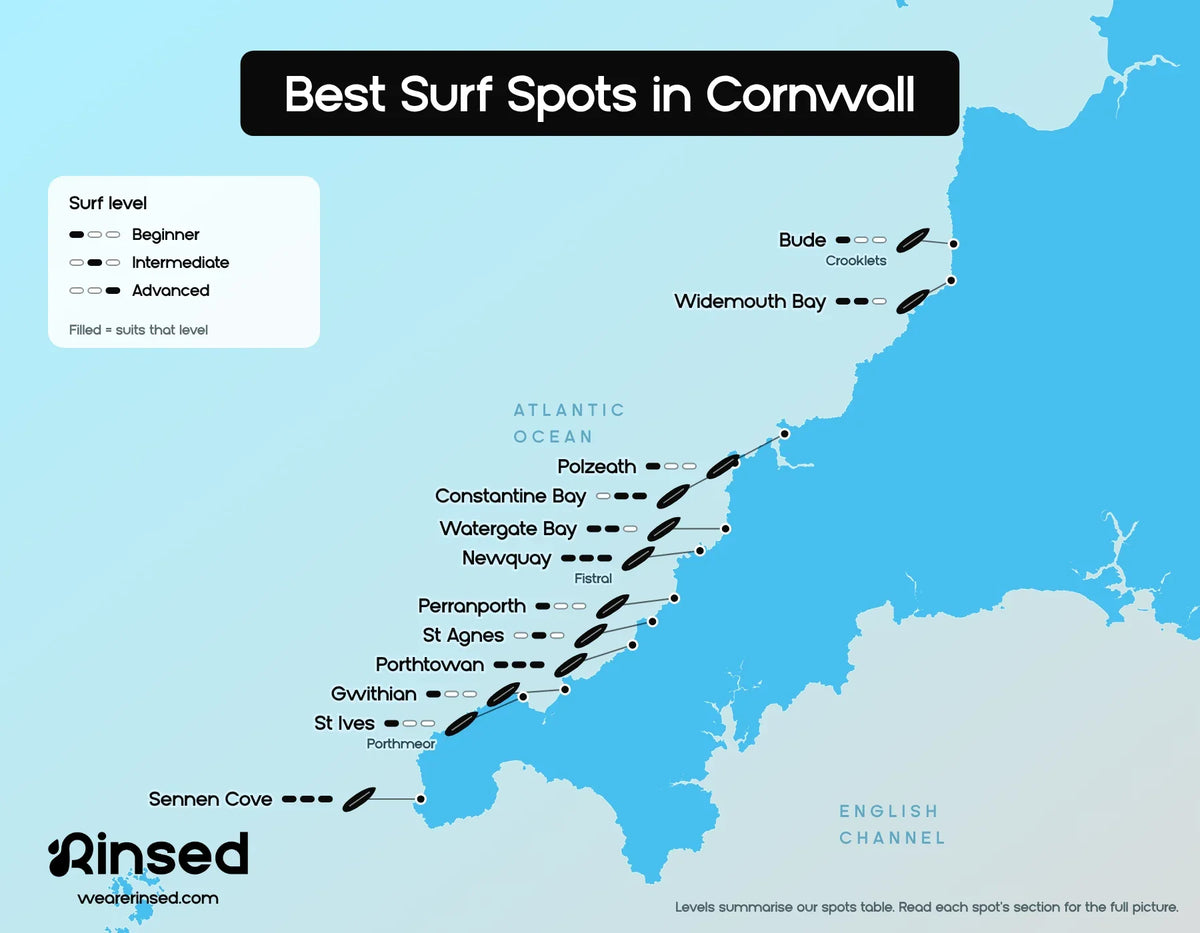
The best surf spots in Cornwall run along the north coast from Bude to Land's End: Crooklets in Bude, Widemouth Bay, Polzeath, Constantine Bay, Watergate Bay, Fistral, Perranporth, St Agnes, Porthtowan, Gwithian, Porthmeor in St Ives and Sennen Cove. Polzeath, Porthmeor and Porthtowan on calm days suit beginners best, and Sennen and Constantine are the spots to save for bigger swells.
Almost all of them are open beach breaks facing the Atlantic. Surf forecasters rate most of them as consistent and able to work at any time of year, and they pick winter, usually February, as the month with the best surf. Summer brings smaller waves, warmer water, crowds and lifeguards on most of these beaches. From the Netherlands, Belgium and France you can get here without flying, by ferry or by Eurostar and trains.
This is the Cornwall chapter of our guide to the best surfing destinations in the UK. If you're surfing your way around the Celtic Sea, our guides to Brittany and Ireland cover the coasts on either side.
What are the best surf spots in Cornwall?
This table covers twelve north coast breaks, from Bude in the north-east to Sennen near Land's End. "Works best on" and "best months" come from the surf forecasters' break pages. For level, we use the National Trust and Cornwall's tourism guides where they rate a beach. Elsewhere we follow the forecasters, who say that on small days nearly all of these breaks can suit beginners and groms, and that bigger days with rips belong to experienced surfers.

| Spot | Area | Type | Level | Works best on | Best months |
|---|---|---|---|---|---|
| Crooklets | Bude | Beach break, lefts and rights | Beginners on small days; rocks and rips | W swell, E wind | Winter (February) |
| Widemouth Bay | South of Bude | Beach break plus right-hand reef | Intermediate; beginners on small days | WNW swell, E wind, all tides | Winter (February) |
| Polzeath | Camel estuary, north | Beach and point, lefts and rights | Beginners (National Trust) | WNW swell, E wind, all tides | Winter (February) |
| Constantine Bay | West of Padstow | Beach break plus left-hand reef | Intermediate and experienced | W swell, E wind, all tides | Spring (April) |
| Watergate Bay | North of Newquay | Beach break, lefts and rights | Intermediate; beginners on small days | WNW swell, SE wind | Winter (February) |
| Fistral | Newquay | Beach break, mostly lefts | All levels on small days; crowded | WSW swell, SE wind, all tides | Winter (February) |
| Perranporth | South of Newquay | Beach break, lefts and rights | Beginners on small days; rips | W swell, ESE wind | Winter (February) |
| St Agnes | St Agnes | Beach break, favours rights | Intermediate; rocks | WSW swell, SSE wind, mid tide | Winter (February) |
| Porthtowan | West of St Agnes | Beach break, lefts and rights | Beginners in light winds; advanced on big days | WNW swell, SE wind | Winter (February) |
| Gwithian | St Ives Bay, east | Beach break, lefts and rights | Beginners on small days; rips over 4ft | WNW swell, ESE wind | Winter (February) |
| Porthmeor | St Ives | Beach break, lefts and rights | Beginners (tourism guide) | WNW swell, S wind | Winter (December) |
| Sennen Cove | Land's End | Exposed beach break | Experienced; beginners check with lifeguards | W swell, E wind, low to mid tide | Spring (April) |
Forecasters warn of rips at most of these beaches, so read our sibling guide to beach flags and rip currents before your first session. If the swell and wind columns look like code, our guide on how to read a surf forecast explains them.
Bude to Padstow: Crooklets, Widemouth, Polzeath and Constantine
The north-east corner of Cornwall has four reliable breaks, with Polzeath the softest of them and Constantine the one for bigger swells.
Crooklets, right in Bude, is a fairly exposed beach break with lefts and rights that can work at any time of year. Forecasters say it gets windswell and groundswell in equal measure, works best on a west swell with an east wind, and warn of rocks and rips.
Widemouth Bay is just south of Bude. It has a beach break with lefts and rights plus a right-hand reef, and works on all tides. Reviewers note that lower tides can bring fast, hollow close-outs, and that rocks on the right side of the bay are a hazard at high tide. It's often busy, with parking right by the beach. In February, its best month, the forecasters count clean waves only 12% of the time and blown-out ones 61% of the time, which tells you how much Cornwall depends on the wind.
Polzeath, on the Camel estuary, is the beginner's pick in this stretch. The National Trust says its gentle waves make it ideal for beginners. Forecasters call it a beach and point break that works on all tides, is partly sheltered from north-west winds and is often crowded, with dangerous rips on bigger days.
Constantine Bay, west of Padstow, is where the National Trust sends you for the biggest swells, with waves breaking left and right at mid and high tide. The forecasters rate it very consistent and add a left-hand reef to the beach break, with dangerous rips and a busy line-up when the surf is up. April is its best month, with clean waves 32% of the time.
Next door, Harlyn is a sheltered beach break that forecasters say only works once in a while, but it can be the place to look when a big swell and a southerly wind make everything else too much. Reviewers rate it easy, though submerged rocks are a hazard.
Newquay and around: Watergate Bay, Fistral and Perranporth
Newquay is Cornwall's surf town, and its beaches are busy, consistent and well lifeguarded.
Fistral is the best-known beach in Cornwall. The tourism board says it's well known among avid surfers and that families love it too. The forecasters' page for the south end describes a fairly exposed, consistent beach break whose waves usually peel left, with good surf at all stages of the tide, crowds and dangerous rips. Fistral is one of the few Cornish beaches the RNLI already patrolled daily before the main season started in May 2026.
Watergate Bay, north of town, is a fairly exposed beach break with lefts and rights that can reach about one and a half times overhead. A reviewer notes the crowds thin out towards the north end, and another warns that paddling out can be very hard when two swells are running. Forecasters rate its difficulty at 3 out of 5.
Perranporth, south of Newquay, is a fairly exposed beach break with lefts and rights. Forecasters say small days can suit beginners, but warn plainly that rips make surfing here dangerous. Like Fistral, it was patrolled daily by lifeguards before May in 2026.
A Newquay surf week often means a shared bathroom in a rental, a wetsuit drying on the balcony and a bag that's never quite dry. One solid bar for hair, body and face is one thing to remember, with nothing to leak into your kit.

Shampoo, body and face wash, all in one bar. Cooling, refreshing and designed for those always on the go.
From Perranporth, the coast road carries on west to St Agnes.
St Agnes to Land's End: St Agnes, Porthtowan, Gwithian, Porthmeor and Sennen
West Cornwall has the county's most exposed beach (Sennen) and some of its most forgiving ones (Porthmeor and Gwithian on small days).
St Agnes is a fairly exposed beach break that favours rights and is best around mid tide. Forecasters say summer is usually mostly flat here, and they flag rocks. In February, clean waves turn up 29% of the time.
Porthtowan faces west into the Atlantic swell. The tourism board calls it a fantastic place to learn to surf when the wind is lighter, but says strong-wind days may be too much for beginners. Forecasters list rips, rocks and pollution among its hazards, which is a good reason to check water quality alerts first (more on that below).
Gwithian, on the east side of St Ives Bay below Godrevy, usually has waves. Cornwall's tourism video guide says it works in light winds and most Atlantic swells, can hold larger surf that gets risky in winter, and has rips when it's over 4ft. The RNLI lifeguards the northern end.
Porthmeor sits right in St Ives, next to the Tate. The tourism board says its headlands shelter it from strong south-westerly winds, giving much less chop than nearby beaches, and the tourism video guide rates it suitable for beginners, with a rip once it's over 4ft. It's best with a south wind, and December is its best month on the forecasters' numbers.
Sennen Cove, just north of Land's End, is among the most exposed beaches in the country, according to the tourism video guide. Sennen works up to about 6ft from low to mid tide and gets fast and peaky at high tide. Gwenver, at the north end of the bay, is not for beginners, and beginners at Sennen should check with the lifeguards first when the surf is big. Forecasters rate it very consistent and pick April as its best month.
What about the south coast?
The south coast needs a south-westerly swell and is often flat in summer, but it's a useful backup when the north coast is blown out. Praa Sands, near Porthleven, is an exposed beach break that works best on a south-south-west swell with a north-east wind, according to the forecasters. They also say it's too small about 71% of the time in April. The National Trust suggests it as the gentler option to Porthleven, whose powerful right-hand reef is not for beginners. Far to the east, near Plymouth, the tourism board says Whitsand Bay is best from September to February, from low to mid tide, with rips that are a particular concern for beginners.
Is Cornwall good for beginner surfers?
Yes, as long as you pick the right beach for the day and stay inside the lifeguarded surf zone. Polzeath, Porthmeor and Porthtowan in light winds are the beaches Cornwall's own guides point beginners to, and most other breaks here can work for beginners on small days. The big beaches have rips on every forecaster page, though, and that's the part to take seriously.
On a lifeguarded beach, the RNLI uses two flags you need to know. Red and yellow flags mark the lifeguard-patrolled area for swimming and bodyboarding. Black and white chequered flags mark the zone for surfboards and other craft, where you should never swim or bodyboard. A red flag means dangerous conditions: do not enter the water. The RNLI's advice if you get into trouble is to float to live (lean back with your ears under water, spread your arms and legs, and float until you can control your breathing), and in an emergency to dial 999 or 112 and ask for the Coastguard.
When is the best time to surf in Cornwall?
Autumn to spring for the best waves, summer for warmer water, small surf and lifeguards on almost every beach.
Surf forecasters pick February as the best month at most north coast breaks, with April at Sennen and Constantine and December at Porthmeor. But even in the best month, these exposed beaches are blown out more than half the time on their numbers, so a winter trip needs a few spare days and a willingness to drive to whichever beach is offshore.
Lifeguards follow the summer. Cornwall Council says the main RNLI season runs from May to September, varying by beach. In 2026, daily patrols started on 2 May at beaches including Polzeath, Constantine, Harlyn, Widemouth, Summerleaze in Bude, Watergate Bay, Porthtowan, Gwithian North and Praa Sands, while Fistral, Perranporth, Porthmeor and Sennen were already patrolled daily. In 2025, many of these beaches kept weekend patrols into October and daily patrols over the October half-term holiday.
Water temperature in Newquay ranges from about 10°C in late winter to 17°C in July to September. The RNLI counts anything below 15°C as cold water, cold enough to cause cold water shock, which covers most of the year here.
| Season | Average water temperature (Newquay) | Surf | Wetsuit (our rule of thumb) |
|---|---|---|---|
| Winter (December to February) | 10 to 12°C | Peak swell, often windy | 5/4mm with boots, gloves and hood |
| Spring (March to May) | 10 to 12°C | Good swell, April strong at Sennen and Constantine | 5/4mm with boots, 4/3mm by late May |
| Summer (June to August) | 14 to 17°C | Smaller, crowded, most beaches lifeguarded | 4/3mm, 3/2mm on warm days |
| Autumn (September to November) | 14 to 17°C | Swell returns, quieter beaches | 4/3mm, boots by November |
The wetsuit column is a general guide rather than a rule from any of our sources; our wetsuit thickness guide explains the numbers, and our sibling guide to cold-water surfing covers staying warm between sessions.
Getting to Cornwall from Amsterdam, Brussels and Paris
You can reach Cornwall by ferry, by Eurostar and trains, or by car, and from most of Europe you'll connect through London or another UK airport if you fly.
By ferry from France. Brittany Ferries sails from Roscoff to Plymouth, right on the Cornish border. The route is seasonal, running roughly from spring to November, and crossings take from about 5 hours 15 minutes up to around 9 hours depending on the ship. For Belgian and French surfers with a car and boards, it's the most direct way in.
By ferry from the Netherlands. Stena Line sails every day between Hook of Holland and Harwich. From Harwich you drive across southern England to Cornwall.
By train. Eurostar takes you to London St Pancras International. From there you cross London to Paddington, where Great Western Railway runs frequent trains to Cornwall. The tourism board says St Ives, Newquay, Falmouth and Looe are all reachable by train. The Night Riviera sleeper runs overnight from London Paddington to Penzance in about 8 hours 10 minutes, every night except Saturday, which puts you a short trip from Sennen and St Ives by morning. Our guide to surf trips without flying has more on travelling with a board.
By plane. When we checked the Newquay airport's own route map in October 2026, it listed no direct flights from the Netherlands, Belgium or France. Its 2026 routes include London Gatwick and Stansted, Manchester, Dublin, Düsseldorf in summer and Zürich in summer, so you'd connect through one of those. The airport is about 10 miles from Newquay. Routes change, so check before you plan.
A trip with a ferry, three trains or a connecting flight is easier with less in your bag. One solid bar for hair, body and face isn't a liquid at airport security and takes up hardly any space.

Shampoo, body and face wash, all in one bar. Keep your hair and skin healthy on the go. Monoï-infused scent with a touch of vanilla. Designed for those always on the go.
Our guide on whether you can take soap on a plane has the detail if you're flying in.
Where to stay for surfing in Cornwall
Base yourself by area, because Cornwall's lanes make long daily drives slow.
- Bude for Crooklets and Widemouth Bay. The forecasters point out that Bude, a short drive from Widemouth, has the accommodation and amenities.
- Padstow and Polzeath for Polzeath, Constantine and Harlyn. The National Trust puts Newquay about 30 minutes' drive from Constantine if the surf there is inconsistent.
- Newquay for Fistral, Watergate Bay and a quick hop to Perranporth. It's also where the airport is.
- St Agnes and Perranporth for St Agnes, Porthtowan and Perranporth, a quieter middle ground.
- St Ives and Hayle for Porthmeor and Gwithian, with a train station in St Ives.
- Penzance for Sennen, Praa Sands and Porthleven, at the end of the main line and the sleeper.
Showers, wetsuits and washing up in Cornwall
Beach showers are for sand and salt, and the real wash happens back at your place. Don't rinse shampoo or soap directly into the ocean or into beach showers that drain to the sea. Lather only where the water goes into a drain.
A Cornish surf day often means two sessions, a wet suit in the boot of the car and a towel that never quite dries. Rinse your wetsuit in fresh water after each session and hang it in the shade; our guide on how to get rid of wetsuit smell covers the routine. A bar is happy in a damp wash bag between sessions.
Shampoo, body and face wash, all in one bar. Cooling, refreshing and designed for those always on the go.
With the kit sorted, the last part is how to fit in once you're in the water.
Surfing in Cornwall: locals and the environment
Respect the locals
Forecasters describe almost every break in this guide as crowded or often crowded, so etiquette matters here. Don't drop in, paddle wide of the people riding waves, and if you're a beginner stay in the black and white chequered zone on the inside rather than paddling out to the main peak at Fistral or Sennen. On big days at Gwenver, Sennen or Constantine, sit on the beach and watch first. Read our surf etiquette guide before you go.
Respect the environment
Much of this coast is protected, and sewage alerts are a real part of planning a session. The Cornwall National Landscape, formerly called an Area of Outstanding Natural Beauty and still one in law, is made up of 12 separate sections covering almost a third of Cornwall, with the same protected status as a National Park. Park in car parks, stay on the paths and take your rubbish home.
Surfers Against Sewage runs the Safer Seas & Rivers Service, a free app and website with real-time water quality information for more than 850 UK locations. A sewage alert stays up while a sewage discharge is active and for 48 hours afterwards. The charity is clear that it can't guarantee the water is safe, so treat it as one input, and look at it before you paddle out after heavy rain.
Summary
Cornwall's best surf runs along the north coast from Crooklets and Widemouth near Bude, through Polzeath, Constantine, Watergate Bay, Fistral and Perranporth, to St Agnes, Porthtowan, Gwithian, Porthmeor and Sennen. Beginners do best at Polzeath, Porthmeor and Porthtowan on calm days, between the chequered flags. Winter and spring bring the best swell, summer the warmest water and the most lifeguards. Come by ferry from Roscoff or Hook of Holland, or by Eurostar and the train to Penzance. For the rest of Britain, see our UK surf guide.
Frequently asked questions
What is the best surf spot in Cornwall?
Fistral in Newquay is the best known, and forecasters rate it consistent with good surf on all tides. For the biggest swells, the National Trust points to Constantine Bay, and Sennen Cove is among the most exposed beaches in the country.
Where should beginners surf in Cornwall?
Polzeath, which the National Trust calls ideal for beginners, Porthmeor in St Ives, and Porthtowan on light-wind days. Stay on a lifeguarded beach and surf between the black and white chequered flags.
Is Sennen Cove good for beginners?
Only on small days. Cornwall's tourism video guide says Sennen suits experienced surfers, that beginners should check with the lifeguards when the surf is big, and that Gwenver next door is unsuitable for beginners.
Can you surf on Cornwall's south coast?
Yes, but less often. Praa Sands needs a south-south-west swell and forecasters say it's too small most of the time in spring, while Porthleven's reef is not for beginners.
When is the best time to surf in Cornwall?
Autumn to spring. Surf forecasters pick February as the best month at most north coast breaks, with April at Sennen and Constantine, but the wind blows many days out, so keep your plans flexible.
How cold is the sea in Cornwall?
Around Newquay the water averages about 10°C from January to April and 17°C from July to September. The RNLI counts anything below 15°C as cold water, so you'll want a good wetsuit for most of the year.
When are Cornish beaches lifeguarded?
Cornwall Council says the main RNLI season runs from May to September, varying by beach. Fistral, Perranporth, Porthmeor and Sennen were patrolled daily even before May in 2026, and some beaches keep weekend patrols into October.
Can you get to Cornwall without flying from the Netherlands, Belgium or France?
Yes. Brittany Ferries sails Roscoff to Plymouth in season, Stena Line sails Hook of Holland to Harwich daily, and Eurostar to London connects with Great Western Railway trains and the Night Riviera sleeper to Penzance.
Are there direct flights to Newquay from Amsterdam, Brussels or Paris?
Not when we checked the airport's route map in October 2026. You'd connect through London, Manchester, Dublin, Düsseldorf or Zürich, and routes change, so check before you book.
How do I check water quality before surfing in Cornwall?
Use Surfers Against Sewage's Safer Seas & Rivers Service, which shows sewage alerts for more than 850 UK locations. An alert stays up for 48 hours after a discharge stops.
Sources
The facts in this article are based on the sources below, checked in October 2026.
- Crooklets-Bude surf guide. Surf-Forecast, 2026.
- Widemouth Bay surf guide. Surf-Forecast, 2026.
- Polzeath surf guide. Surf-Forecast, 2026.
- Constantine Bay surf guide. Surf-Forecast, 2026.
- Harlyn surf guide. Surf-Forecast, 2026.
- Watergate Bay surf guide. Surf-Forecast, 2026.
- Fistral-South surf guide. Surf-Forecast, 2026.
- Perranporth surf guide. Surf-Forecast, 2026.
- St Agnes surf guide. Surf-Forecast, 2026.
- Porthtowan surf guide. Surf-Forecast, 2026.
- Gwithian surf guide. Surf-Forecast, 2026.
- Porthmeor surf guide. Surf-Forecast, 2026.
- Sennen Cove surf guide. Surf-Forecast, 2026.
- Praa Sands surf guide. Surf-Forecast, 2026.
- Surfing and water sports in Cornwall. Visit Cornwall, 2026.
- Surfers guide West Cornwall. Visit Cornwall TV, 2026.
- Surfing holidays in Cornwall. National Trust, 2026.
- RNLI issue bank holiday safety advice as lifeguards return to south west coast. RNLI, 2026.
- 38 RNLI lifeguarded beaches in south west prepare to end main season patrols. RNLI, 2026.
- Beach flags and signs. RNLI, 2026.
- Beach safety. Cornwall Council, 2026.
- Newquay water temperature in January. Seatemperature.net, 2026.
- Newquay water temperature in February. Seatemperature.net, 2026.
- Newquay water temperature in March. Seatemperature.net, 2026.
- Newquay water temperature in April. Seatemperature.net, 2026.
- Newquay water temperature in May. Seatemperature.net, 2026.
- Newquay water temperature in June. Seatemperature.net, 2026.
- Newquay water temperature in July. Seatemperature.net, 2026.
- Newquay water temperature in August. Seatemperature.net, 2026.
- Newquay water temperature in September. Seatemperature.net, 2026.
- Newquay water temperature in October. Seatemperature.net, 2026.
- Newquay water temperature in November. Seatemperature.net, 2026.
- Newquay water temperature in December. Seatemperature.net, 2026.
- Route map. Cornwall Airport Newquay, 2026.
- Flying to Cornwall and how to get around once you have arrived. Cornwall Airport Newquay, 2026.
- Travel by train. Visit Cornwall, 2026.
- Night Riviera sleeper. Interrail, 2026.
- Ferry from Plymouth to Roscoff. Ferryhopper, 2026.
- Ferries from Hook of Holland to Harwich. Netferry, 2026.
- Amsterdam to London by train. Eurostar, 2026.
- Cornwall National Landscape. Cornwall National Landscape, 2026.
- Sewage Data HQ and Safer Seas & Rivers Service. Surfers Against Sewage, 2026.