



Note to travelling surfers
- Ecosystem first. Be kind to the environment you’re visiting: don’t leave any trash behind.
- Be kind to locals. Every lineup has an order and it was earned over years. Wait your turn, and respect local etiquette.
- Fly less, stay longer. The flight is the biggest impact of any surf trip. Two weeks once beats one week twice!
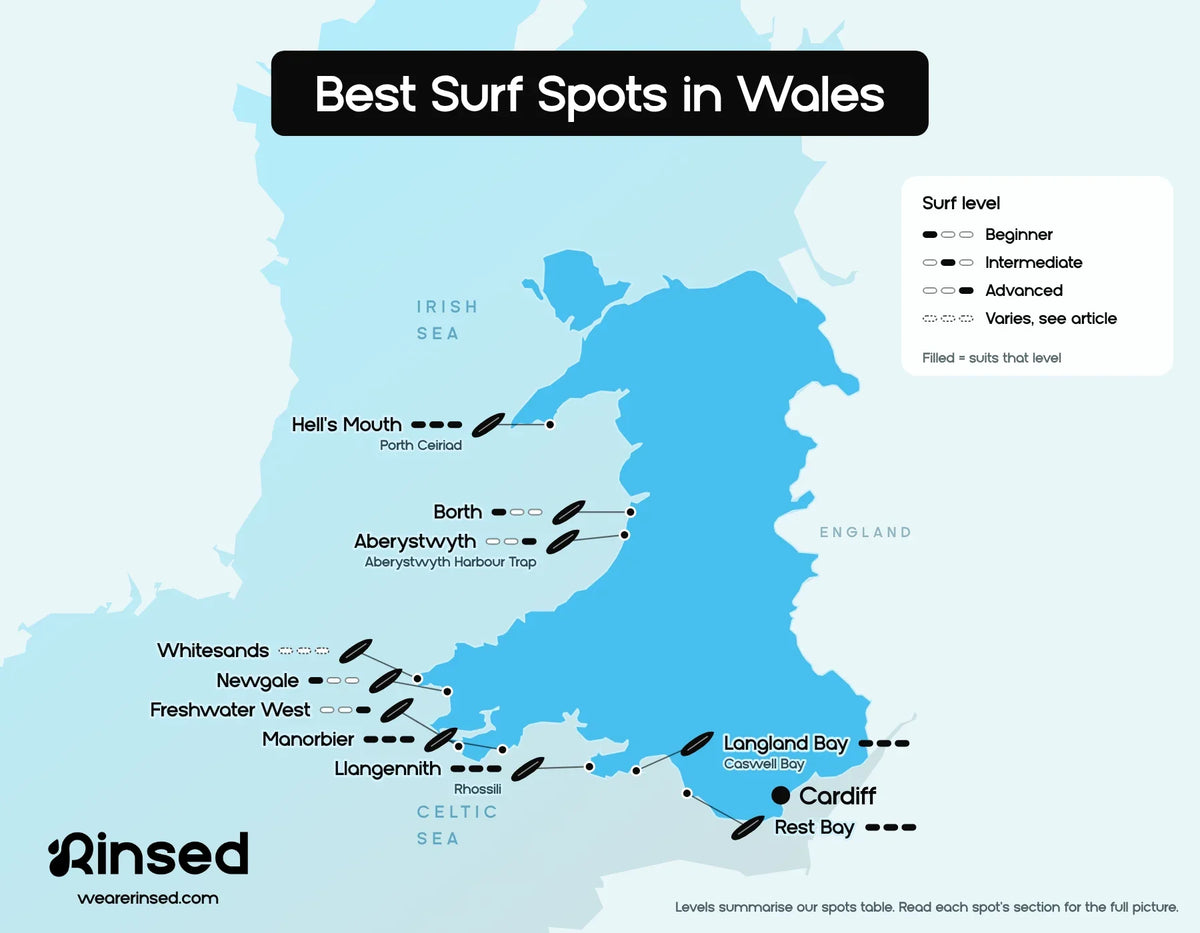
The best surf spots in Wales sit in five areas: Llangennith, Rhossili, Caswell Bay and Langland Bay on the Gower peninsula; Rest Bay at Porthcawl in south Wales; Manorbier, Freshwater West, Whitesands and Newgale in Pembrokeshire; Borth and the Harbour Trap at Aberystwyth in Ceredigion; and Hell's Mouth (Porth Neigwl) and Porth Ceiriad on the Llŷn peninsula in north Wales.
The Welsh coast faces south, west and north-west, so when the wind is wrong on one side it is often right on another. Visit Wales says winter brings the big days and the best point breaks. Summer is when the beginner beaches come into their own, with lifeguards and surf schools on the sand.
This guide is part of our wider guide to the best surfing destinations in the UK, and it sits next to our guides to the best surf spots in Cornwall and the best surf spots in Scotland. We wrote it for anyone driving or taking the train over from the Netherlands, Belgium or France, from first lesson to winter reef sessions.
What are the best surf spots in Wales?
This table covers thirteen breaks we could verify from Visit Wales, the National Trust, the RNLI and the surf forecasters. "Works best on" comes from the forecasters' break pages. The level comes from the tourism boards and the National Trust where they give one; where they don't, we say so. "Best months" is the forecasters' most consistent month for clean waves.

| Spot | Area | Type | Level | Works best on | Best months |
|---|---|---|---|---|---|
| Llangennith | Gower, north end of Rhossili Bay | Exposed beach break, lefts and rights | All levels | W swell, E wind, mid tide | Spring, most consistent in April |
| Rhossili | Gower, south end of Rhossili Bay | Beach break, lefts and rights | Beginners | W swell, E wind, all tides | All year, most consistent in February |
| Caswell Bay | Gower, near Swansea | Beach break, lefts and rights | Beginners | SW swell, NE wind, mid tide | Winter, most consistent in February |
| Langland Bay | Gower, Mumbles | Beach break, with reefs and points nearby | Intermediate and up | SW swell, N wind, all tides | Winter, most consistent in January |
| Rest Bay | Porthcawl, south Wales | Beach and point, lefts and rights | All levels | SW swell, ENE wind, all tides | Winter, most consistent in February |
| Manorbier | South Pembrokeshire | Beach, reef and point, lefts and rights | All levels | SW swell, NE wind, around high tide | Winter, most consistent in February |
| Freshwater West | South-west Pembrokeshire | Beach and reef, lefts and rights | Experienced (strong rips) | W swell, ENE wind, all tides | All year, most consistent in April |
| Whitesands (Porth Mawr) | Pembrokeshire, near St Davids | Exposed beach break, lefts and rights | Not stated by the sources | WSW swell, E wind | Winter, most consistent in February |
| Newgale | Pembrokeshire, St Brides Bay | Beach and point, lefts and rights | Beginners | WSW swell, ENE wind, mid tide | Spring, most consistent in March |
| Borth | Ceredigion, north of Aberystwyth | Beach and point, beach favours rights | Beginners | SW swell, E wind, all tides | Winter, most consistent in January |
| Aberystwyth Harbour Trap | Aberystwyth, Ceredigion | Reef | Experienced (reef, locals) | SW swell, ESE wind | Winter, most consistent in January |
| Hell's Mouth (Porth Neigwl) | Llŷn peninsula, near Abersoch | Beach and reef, lefts and rights | All levels | SW swell, NE wind | Spring, most consistent in March |
| Porth Ceiriad | Llŷn peninsula, near Abersoch | Exposed beach break, favours lefts | Intermediate and up (gets heavy on big swells) | SW swell, N wind, around high tide | Spring, most consistent in March |
A reality check: even in their best months, the forecasters count clean surf at most Welsh breaks under one day in ten, and even the most consistent, Llangennith and Freshwater West, only about one day in four, because the wind is so often onshore. The trick is to stay flexible and drive to whichever coast is offshore, and our guide on how to read a surf forecast helps you make that call.
Surfing on the Gower peninsula: Llangennith, Rhossili, Caswell and Langland
Gower, just west of Swansea, is the best place to start a Welsh surf trip: one long west-facing bay for consistency, and a sheltered south coast for when the westerlies blow. Visit Wales says its breaks suit everyone from beginners to pros.
Llangennith is the north end of Rhossili Bay. Visit Wales describes a sand-bottom horseshoe bay with three zones of beach break, more high-performance the further north you walk. The forecasters call it consistent, best on a west swell and an east wind around mid tide, and warn that the paddle out can be hard work, and that once it goes over about four feet the rips against the cliffs at both ends get dangerous. On a small day it is friendly enough: Visit Wales tells learners to shift towards Llangennith when the surf is small.
Rhossili is the southern, village end of the same bay. The National Trust says its exposed beach break offers consistent waves all year that are small enough for beginners, and points you to Llangennith if you want bigger swell and a longer ride. Visit Wales describes sheltered, gentle beginner waves here. At about 4.5 km of sand, there is usually room to walk away from the crowd.
Caswell Bay is on the sheltered south side of Gower, close to Swansea. Visit Wales calls it perfect for juniors: the car park is close, there are lifeguards and the water is clean. The forecasters list a beach break best on a south-west swell and a north-east wind around mid tide, and they are blunt about one thing: it is often crowded.
Langland Bay, next door at Mumbles, is where things get more serious. Visit Wales says that in stormy conditions you can find points, reefs and beach breaks within a single tide here, and that pro surfers are often in the water. The forecasters say it works at all tides, best on a south-west swell with a north wind, and warn about crowds and rocks. We put it at intermediate and up because of that mix.
Surfing in south Wales: Rest Bay, Porthcawl
Porthcawl is the surf town of south Wales, and Rest Bay is its main beach for all abilities, less than five minutes from the motorway. Visit Wales calls Rest Bay the best spot for beginners in the region, a Blue Flag beach with a watersports centre, surf school and café overlooking the bay, and its beach listing says lessons and hire run all year.
The forecasters describe a beach and point break, best on a south-west swell and an east-north-east wind, that usually builds as the tide pushes in and is often flat in summer. They list rips, rocks, crowds and pollution, with the rip by the rocky headland on the left of the beach worst on an incoming tide.
Surfing in south Pembrokeshire: Manorbier and Freshwater West
South Pembrokeshire has Freshwater West, one of the top surf spots in Wales and known for big surf, and a castle beach at Manorbier that works for every level.
Manorbier sits below its castle on the south Pembrokeshire coast. Visit Wales says it suits everyone from beginners to advanced surfers, and the National Trust mentions a reef break here that produces bigger waves. The forecasters list a beach and point setup, best on a south-west swell and a north-east wind around high tide, with rips, rocks and crowds when it is good.
Freshwater West is the one everyone talks about. The National Trust calls it one of the top surf spots in Wales, with consistent swell and strong waves on a wild south-west-facing beach, and the Pembrokeshire Outdoor Charter says it is regularly used for competitions. Visit Wales is clear on the level: it is for experienced, strong-swimming surfers, the large waves are dangerous for beginners, and there are strong rip currents. The forecasters call it consistent at any tide, best on a west swell and an east-north-east wind.
The Freshwater West car park is National Trust land with toilets, but overnight parking and camping aren't allowed. The Trust's Gupton Farm campsite, a ten minute walk through the fields from the beach, has space to dry wetsuits and a hot outdoor shower. On a trip like that, your wash kit lives in a damp bag between the van and the shower block, and one solid bar for hair, body and face takes up almost no room and can't leak over everything else.

Shampoo, body and face wash, all in one bar. Cooling, refreshing and designed for those always on the go.
Further north, the Pembrokeshire beaches face a different way, which is useful when the wind turns.
Surfing in north Pembrokeshire: Whitesands and Newgale
North Pembrokeshire has two big, popular beaches: Whitesands near St Davids, with the better shape, and Newgale in St Brides Bay, the easier one for families and learners.
Whitesands (Porth Mawr), about two miles west of St Davids, is one of the best surf beaches in the country, its Visit Wales listing says, and the board's guide for experienced surfers praises its shape for shortboarders. None of our sources gave it a level, so we haven't either. The forecasters describe a fairly consistent beach break, best on a west-south-west swell and an east wind, that gets busy in the water when it's on, with dangerous rips. There are toilets, a café and surf hire behind the beach, and the car park fills in summer.
Newgale is a long beach at the back of St Brides Bay. Visit Wales says it is good for children, with good shelter in the bay. The forecasters list a beach and point setup, best on a west-south-west swell and east-north-east wind around mid tide, and rarely crowded, though one reviewer points out that the sandbanks make a big difference to the waves at different tides. The RNLI lifeguards it in summer.
Surfing in Ceredigion: Borth and Aberystwyth
Cardigan Bay is the quieter middle of Welsh surfing: mellow beaches for learning, a couple of reef and point waves for big days, and fewer people than Gower or Pembrokeshire. Visit Wales says the bay has several flat, sandy, sheltered beaches with mellow waves for beginners, but warns that strong tides and south-westerly winds can also produce some of the biggest waves on the west coast.
Borth, north of Aberystwyth, is known for fairly consistent surf, which Visit Wales says is great for beginners looking for regular waves. The forecasters list a beach that favours rights plus a left-hand point, working at all tides on a south-west swell and an east wind, rarely crowded, and often flat in summer. The RNLI lifeguards Borth through the summer season.
Aberystwyth Harbour Trap is a reef next to the town's harbour. Visit Wales lists it among the consistent spots that also have big days, and asks visiting surfers to be polite and take turns if they paddle out there on a good day. The forecasters list it as a fairly popular reef, best on a south-west swell and east-south-east wind, and warn about rips and pollution. We have marked it for experienced surfers based on that, as no source gives a formal level.
Surfing on the Llŷn peninsula: Hell's Mouth and Porth Ceiriad
The Llŷn peninsula in north Wales is the far end of a Welsh surf trip, with Hell's Mouth as its big open beach and Porth Ceiriad as the punchier wave next door.
Hell's Mouth (Porth Neigwl) is a long, south-west-facing beach near Abersoch, exposed to the full force of the Atlantic, Visit Wales says. The National Trust calls it a mellow beach for beginners and says its waves suit both beginners and pros, which tells you how much it changes with the swell. The forecasters list rocks and rips, call it often crowded and say summer is mostly flat, while Visit Wales says the beach seldom gets busy. There are no facilities, just a small free car park and a 200 metre footpath.
Porth Ceiriad, reached from the Wales Coast Path south of Abersoch, is the heavier option. Visit Mid Wales says surf there can be excellent, best around mid to high tide, and that big swell days are not for beginners. The forecasters describe an exposed beach break that favours lefts, best on a south-west swell with a north wind, popular and sometimes crowded, with rocks to watch. One forecaster reviewer adds that it punishes mistakes.
A note on the wave pool: the Adventure Parc Snowdonia website says its Surf Snowdonia wave pool closed in 2023, and surfing isn't among its current activities. For now, Welsh surfing means the sea.
When is the best time to surf in Wales?
For experienced surfers, autumn to spring brings the swell and the point breaks; for beginners, late spring to early autumn brings smaller waves, warmer water and lifeguards on the beaches. Visit Wales says winter is when the point breaks and big-swell spots come alive, and that conditions can change very quickly. The forecasters agree: most Welsh breaks have their most consistent clean surf between January and April, and several, including Rest Bay, Borth and Hell's Mouth, are mostly flat in summer.
For learners, summer is the season: RNLI lifeguards patrol many Welsh beaches daily through the summer, and some also cover the Easter holidays or weekends in early summer.
Average sea temperatures below are long-term data for Swansea (Gower and Porthcawl) and Tenby (south Pembrokeshire). Wetsuit advice for winter and summer comes from the surf forecasters; the in-between rows are our own reading of those two.
| Months | Water, Swansea | Water, Tenby | Surf | Wetsuit |
|---|---|---|---|---|
| January to March | 8.3 to 8.7°C | 8.4 to 9.0°C | Most consistent swell, short days, strong winds | 6/5/4 or a well-fitting 5/4 with gloves, 5 mm boots and a hood |
| April and May | 9.6 to 11.4°C | 9.6 to 11.2°C | Spring swell, longer days | Still close to the winter set-up |
| June to August | 13.7 to 16.8°C | 13.4 to 16.3°C | Smaller waves, lifeguards on, best time to learn | 4/3, or a 3/2 with 3 mm boots at the warmest |
| September and October | 15.3 to 16.6°C | 14.9 to 16.2°C | Swell returns while the water is at its warmest | Close to the summer set-up, boots as it cools |
| November and December | 11.2 to 13.6°C | 11.2 to 13.4°C | Winter storms, big days for experienced surfers | Back towards the winter set-up |
The forecasters note that water near the shore can differ by several degrees from these averages, especially after heavy rain. For more detail, see our wetsuit thickness guide.
How cold is the water, and how do you stay safe?
The RNLI defines anything below 15°C as cold water, and Welsh averages sit below that for most of the year. The RNLI explains that cold water shock makes you gasp and breathe fast, and that the first effects pass within about a minute. If you end up in the water unexpectedly, its advice is to relax and float to live. Our guide to cold-water surfing and how to stay warm covers the rest.
Rips are the other big risk. The RNLI says that if you are caught in one, don't paddle straight back against it: stay with your board, move parallel to the shore until you are out of it, and raise your hand and shout for help. On lifeguarded beaches, surfers belong between the black and white chequered flags, and a red flag means stay out of the water. In an emergency, call 999 or 112 and ask for the Coastguard.
Is Wales good for beginner surfers?
Yes, it is a good place to learn in cold water, as long as you pick the right beach, go in summer and start with a lesson. Visit Wales recommends an approved surf school, with schools listed on Gower, at Porthcawl and in Ceredigion.
The sources name a clear set of beginner beaches: Rhossili and Caswell Bay on Gower, Rest Bay at Porthcawl, Manorbier and Newgale in Pembrokeshire, and Borth in Ceredigion. The one to skip is Freshwater West, which Visit Wales says is dangerous for learners.
Getting to Wales from Amsterdam, Brussels and Paris
Most of us will drive, using the ferry to Harwich or Dover, or take the Eurostar to London and the train west; flying to Cardiff or Bristol works too, but a surfboard makes the car the easy option.
By car and ferry. From the Netherlands, Stena Line sails from Hook of Holland to Harwich in about six and a half hours, four times a day, overnight sailings included. From Belgium and northern France, DFDS sails from Dunkirk to Dover in about two hours, up to 22 times a day. Then you drive west: Visit Wales gives London to Cardiff as just under three hours on the M4, and London to Tenby as about four hours twenty. Our guides to surf trips without flying and surf van trips in Europe help with the planning, and note that Wales has its own speed limits, different from the rest of the UK.
By train. Eurostar runs direct from Amsterdam to London St Pancras in about 4 hours 19 minutes, and also links Brussels, Lille and Paris with St Pancras. From Paddington, the fastest trains reach Cardiff in a little under two hours, with connections on to Swansea and Pembrokeshire; for north Wales, trains from Euston run to Bangor. You will want a car or a surf school pick-up for the last stretch.
By plane. Visit Wales says Cardiff Airport has direct routes and connections through hubs including Amsterdam Schiphol, that Bristol Airport is about an hour and a half from Cardiff, and that Manchester, Liverpool and Birmingham are handy for north and mid Wales. Routes change, so check before you book.
Taking the train or a hand-luggage flight means one small bag for everything. One solid bar for hair, body and face isn't a liquid at airport security, so it stays out of the plastic bag and doesn't leak on the way.

Shampoo, body and face wash, all in one bar. Keep your hair and skin healthy on the go. Monoï-infused scent with a touch of vanilla. Designed for those always on the go.
Our guide on whether you can take soap on a plane has the detail.
Entry rules. The UK government says most visitors from Europe now need an electronic travel authorisation (ETA) before they travel, one per person including children, and Visit Wales says most visitors need a valid passport. Rules depend on your nationality, so check the official UK government page before you book.
Where to stay for surfing in Wales
Pick one base per region and drive to whichever beach is offshore: Swansea or Mumbles for Gower, Porthcawl for Rest Bay, St Davids or a campsite near Freshwater West for Pembrokeshire, Aberystwyth for Ceredigion, and Abersoch for the Llŷn.
Camping and campervans. Plan on campsites. The Pembrokeshire Coast National Park Authority says wild camping, in a tent or a campervan, is prohibited in Wales without the landowner's permission, and it has fined vans staying overnight in its car parks. Summer demand is high, so book ahead.
Showers, wetsuits and washing up
Plan your washing around proper showers and drains, not the beach. Don't rinse shampoo or soap directly into the ocean or into beach showers that drain to the sea. Lather only where the water goes into a drain: a campsite, a surf camp or your accommodation.
Facilities vary a lot: Rest Bay has a watersports centre and café, Whitesands has toilets and a café, and Hell's Mouth has nothing at all. A big water container in the car is useful for rinsing salt off your wetsuit and feet.
Wetsuits that stay damp in a car for days start to smell. Our guide on how to rinse off after a surf covers the wetsuit as well as you. For your own campsite shower, one bar in a damp wash bag is simpler than three bottles rolling around the boot.
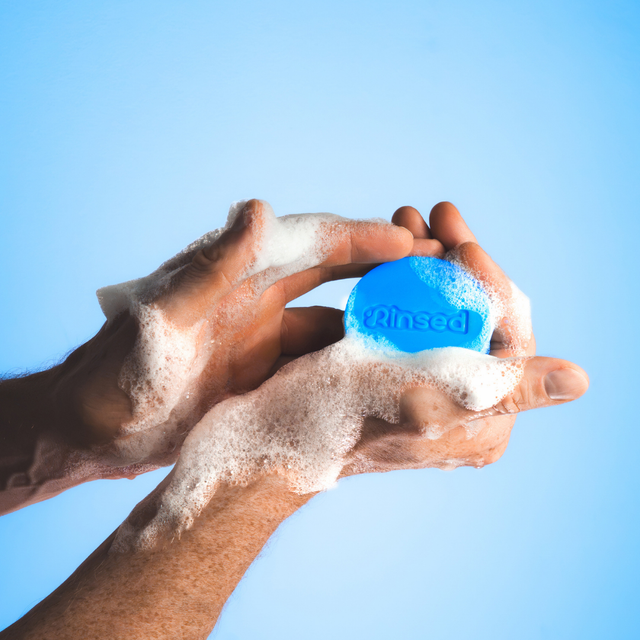
Shampoo, body and face wash, all in one bar. Cooling, refreshing and designed for those always on the go.
With the washing sorted, the last thing is how you behave in the water and on land.
Surfing in Wales: locals and the environment
Respect the locals
Welsh surf communities are tight, and the better reef and point breaks have their regulars. Visit Wales asks visiting surfers to be polite to the locals and take turns at the busier reef and point breaks, the Harbour Trap included. The Pembrokeshire Outdoor Charter's surfing code says the surfer first to their feet has right of way and nobody drops in on another surfer. It also asks you to think of other water users, especially if you are out with beginners. Read our surf etiquette guide before you paddle out.
On land, the lanes to Llangennith, Freshwater West and Hell's Mouth are narrow and the car parks small. Park where you are allowed to, never across gateways or passing places.
Respect the environment
Many of these beaches are protected. The dunes at Freshwater West are a Site of Special Scientific Interest, and the Pembrokeshire Outdoor Charter asks you to keep to existing paths and not create new ones down to the beach. Give seals a wide berth, especially in autumn when there may be pups on some beaches. Take all your rubbish home and leave the beach as you found it, or better.
Summary
Wales has five surf areas worth the drive: Gower, Porthcawl, Pembrokeshire, Ceredigion and the Llŷn. Experienced surfers should aim for autumn to spring and chase whichever coast is offshore; beginners should go in summer, pick a lifeguarded beach like Rhossili, Caswell, Rest Bay or Newgale, and take a lesson. Drive via Harwich or Dover, or take the Eurostar and the train from Paddington. Compare with Cornwall, Ireland and the rest of the UK.
Frequently asked questions
Where is the best surfing in Wales?
The main areas are Gower near Swansea, with Llangennith as its best-known wave; Porthcawl with Rest Bay; Pembrokeshire, with Freshwater West as its best-known surf beach; Ceredigion around Aberystwyth; and the Llŷn peninsula with Hell's Mouth.
Where should beginners surf in Wales?
Visit Wales and the National Trust point beginners to Rhossili and Caswell Bay on Gower, Rest Bay at Porthcawl, Manorbier and Newgale in Pembrokeshire, and Borth in Ceredigion. Go in summer, when lifeguards are on duty, and book a lesson with an approved surf school.
Is Freshwater West good for beginners?
No. Visit Wales says its large waves are dangerous for beginners and that it suits experienced, strong-swimming surfers, and it warns about strong rip currents.
Is Hell's Mouth as scary as it sounds?
Not always. The National Trust calls Porth Neigwl a mellow beach for beginners on small days, while Visit Wales says it is exposed to the full force of the Atlantic. Forecasters warn about rocks and rips, so pick your day and stay within your level.
When is the best time to surf in Wales?
For experienced surfers, autumn to spring, when Visit Wales says the point breaks and big-swell spots work. For beginners, summer, when the waves are smaller, the water is warmest and lifeguards patrol many beaches.
How cold is the sea in Wales?
Long-term averages for Swansea run from about 8.3°C in March to 16.8°C in August, and for Tenby from about 8.4°C to 16.3°C. The RNLI treats anything under 15°C as cold water.
What wetsuit do I need to surf in Wales?
In late winter, surf forecasters suggest a 6/5/4 or a well-fitting 5/4 with gloves, 5 mm boots and a hood. In August, a 4/3, or a 3/2 with 3 mm boots.
When are Welsh beaches lifeguarded?
RNLI lifeguards patrol many Welsh beaches daily in summer, typically from 10am to 6pm, with some also covered over Easter or at weekends in early summer. Dates change each year, so check the RNLI's beach pages before you go.
How do I get to Wales from the Netherlands or Belgium?
Take the Stena Line ferry from Hook of Holland to Harwich, or DFDS from Dunkirk to Dover, then drive west on the M4. Without a car, take the Eurostar to London St Pancras and the train from Paddington to Cardiff, Swansea or Pembrokeshire.
Can I wild camp or sleep in my van near Welsh surf beaches?
Not without the landowner's permission. The Pembrokeshire Coast National Park Authority says wild camping, in a tent or a campervan, is prohibited in Wales without it, and overnight parking isn't allowed at the Freshwater West car park. Use campsites.
Can I still surf the wave pool at Adventure Parc Snowdonia?
No. The park's own website says Surf Snowdonia closed in 2023, and surfing isn't among its current activities.
Do I need an ETA to visit Wales?
Most European visitors now need a UK electronic travel authorisation before they travel, the UK government says. Rules depend on your nationality, so check the official page before you book.
Sources
The facts in this article are based on the sources below, checked in October 2026.
- Surfing in Wales: the best surf spots for experienced wave riders. Visit Wales, 2026.
- Best places to learn surfing in Wales. Visit Wales, 2026.
- Freshwater West beach. Visit Wales, 2026.
- Whitesands beach. Visit Wales, 2026.
- Porthcawl Rest Bay beach. Visit Wales, 2026.
- Porth Neigwl (Hell's Mouth) beach. Visit Wales, 2026.
- Travelling to Wales from elsewhere in the UK. Visit Wales, 2026.
- Getting to Wales from outside the UK. Visit Wales, 2026.
- Porth Ceiriad. Visit Mid Wales, 2026.
- Surfing holidays in Wales. National Trust, 2026.
- Freshwater West and Gupton Farm. National Trust, 2026.
- Gupton Farm campsite. National Trust, 2026.
- Rhossili Bay. Wikipedia, 2026.
- Surfing. Pembrokeshire Outdoor Charter, 2026.
- Fines for illegally-parked campervans. Pembrokeshire Coast National Park Authority, 2020.
- About us. Adventure Parc Snowdonia, 2026.
- Cold water shock. RNLI, 2026.
- Rip currents. RNLI, 2026.
- RNLI warm weather safety advice as lifeguards return to more Welsh beaches. RNLI, 2025.
- Langland Beach. RNLI, 2026.
- Ferry to Hook of Holland and Harwich. Stena Line, 2026.
- Dover to Dunkirk ferries. DFDS, 2026.
- Amsterdam to London train. Eurostar, 2026.
- Get an electronic travel authorisation (ETA) to visit the UK. GOV.UK, 2026.
- Llangennith surf guide. Surf-Forecast, 2026.
- Rhossili surf guide. Surf-Forecast, 2026.
- Caswell Bay surf guide. Surf-Forecast, 2026.
- Langland Bay surf guide. Surf-Forecast, 2026.
- Rest Bay surf guide. Surf-Forecast, 2026.
- Manorbier surf guide. Surf-Forecast, 2026.
- Freshwater West surf guide. Surf-Forecast, 2026.
- Whitesand Bay (Pembrokeshire) surf guide. Surf-Forecast, 2026.
- Newgale surf guide. Surf-Forecast, 2026.
- Borth surf guide. Surf-Forecast, 2026.
- Aberystwyth harbour trap surf guide. Surf-Forecast, 2026.
- Hells Mouth (Porth Neigwl) surf guide. Surf-Forecast, 2026.
- Porth Ceriad surf guide. Surf-Forecast, 2026.
- Hells Mouth (Porth Neigwl) water temperature and wetsuit guide. Surf-Forecast, 2026.
- Swansea sea temperature. Seatemperature.org, 2026.
- Tenby sea temperature. Seatemperature.org, 2026.